Researchers have identified over 150 DNA control signals in brain cells called astrocytes that may influence Alzheimer's disease, using CRISPRi to study enhancer regions in non-coding DNA, which could lead to new insights and potential treatments for the disease.
Scientists at Northwestern University have created the most detailed 4D maps of the human genome's 3D organization over time, revealing how DNA folding influences gene activity and cell function, with implications for understanding diseases and developing targeted therapies.
Scientists have created a detailed 4D map of the human genome, revealing how its components interact over time in three dimensions, which could lead to advances in understanding gene regulation and developing new cancer therapies.
Researchers at the University of Navarra have developed RNACOREX, an open-source software that maps gene regulation networks in cancer, helping to understand tumor behavior and predict patient survival with clear, interpretable results, advancing personalized cancer treatment.
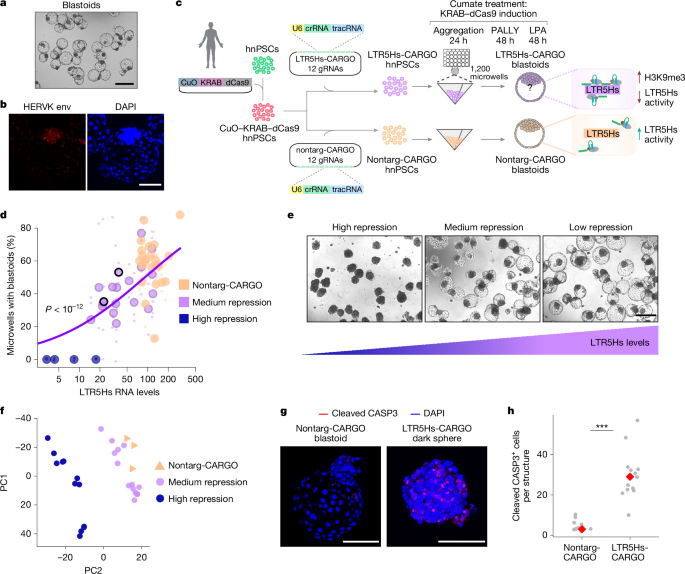
The study uncovers a human-specific regulatory mechanism involving endogenous retroviruses (ERVs), particularly HERVK LTR5Hs, which influence gene expression and lineage specification during early human development, using a stem cell-based blastoid model. Repression of LTR5Hs impairs blastoid formation, alters lineage allocation, and affects the expression of key genes like ZNF729, a human-specific gene regulated by a nearby LTR5Hs insertion that is essential for blastoid formation and proliferation. The work highlights the evolutionary role of ERVs as enhancers shaping human-specific developmental features.
A large-scale study reveals that Alzheimer's disease involves fundamental breakdowns in epigenomic control within brain cells, leading to gene expression dysregulation and cognitive decline, suggesting new treatment avenues targeting genome stability.
A new study suggests that remnants of ancient viruses embedded in our DNA, particularly transposable elements, play a crucial role in early human development and evolution by influencing gene regulation, with potential implications for understanding human diseases and genome innovation.
Researchers at CeMM and MedUni Vienna used a new combination of gene editing and machine learning to map the molecular processes that enable macrophages to quickly and precisely respond to pathogens, revealing a complex network of regulators involved in immune activation.
A new study reveals that ancient viruses embedded in our DNA, specifically transposable elements like MER11, play a crucial role in regulating gene activity, especially during early development, challenging the previous notion that these 'junk' DNA segments are nonfunctional.
Scientists have discovered that disordered gene-regulating proteins rely on a structured partner, beta-catenin, to function properly, challenging previous ideas about their chaotic nature and revealing a hidden organization that could impact understanding of gene control and disease.
Scientists have discovered that previously overlooked 'junk' DNA, specifically transposable elements like MER11, play a significant role in gene regulation and evolution, acting as genetic switches that influence gene expression and potentially contribute to species differences.
A new study reveals that 'junk' DNA, derived from ancient viruses embedded in our genome, actually plays a crucial role in controlling gene activity, especially during early human development, and has contributed to primate evolution.
A recent study reveals that ancient viral DNA embedded in our genome, particularly the MER11 family of transposable elements, plays a significant role in regulating gene expression during early human development. Researchers developed a new classification method to better understand these elements and found that the youngest subfamily, MER11_G4, has a strong ability to activate gene expression and has evolved distinct regulatory functions, contributing to primate evolution.
A study published in Science Advances reveals that ancient viral DNA, previously considered 'junk', plays a significant role in regulating gene expression, especially in early human development, with new classification methods uncovering their regulatory potential and evolution across primates.
A study in Nature reveals that olfactory sensory neurons achieve precise gene expression through stable, solid-like molecular condensates formed by specific DNA motifs and protein interactions, challenging previous liquid-phase models and potentially informing other stable gene expression systems.