Astronomers using ALMA have discovered a galaxy cluster from just 1.4 billion years after the Big Bang that is unexpectedly hot, challenging current models of galaxy formation and suggesting that such structures may form more rapidly than previously thought.
Scientists discovered an extremely hot and old galaxy cluster from just 1.4 billion years after the Big Bang, which challenges current cosmological theories. The cluster's unexpected heat is likely due to energy from supermassive black holes at its core, suggesting galaxy clusters evolve more explosively than previously thought, potentially reshaping our understanding of the early universe.
Scientists discovered a galaxy cluster called SPT2349-56, just 1.4 billion years after the Big Bang, with gas temperatures far exceeding predictions, likely due to energy from supermassive black holes, challenging current models of galaxy cluster evolution.
Astronomers have discovered a rare cosmic event involving three galaxies in the process of merging, each hosting an actively feeding supermassive black hole emitting radio jets, providing new insights into galaxy and black hole growth.
Astronomers have confirmed the first known system where three galaxies, each hosting active supermassive black holes, are merging, providing new insights into galaxy and black hole evolution through high-resolution radio imaging. The system, located 1.2 billion light-years away, shows all three black holes actively feeding and launching jets, a rare and significant discovery that advances our understanding of cosmic growth processes.
An international team of astronomers has found evidence suggesting that the relationship between ultraviolet and X-ray emissions in quasars has evolved over billions of years, challenging the long-standing assumption of its universality and potentially impacting cosmological models. Using data from eROSITA and XMM-Newton, they observed differences in this relationship in quasars from the early universe compared to the present day, which could influence our understanding of black hole growth and the universe's expansion.
2025 was a landmark year in astronomy with discoveries including the interstellar comet 3I/ATLAS, evidence of supermassive black hole formation, weakening dark energy, potential signs of past life on Mars and exoplanets, and the first light of the Vera C. Rubin Observatory, promising a new era of cosmic exploration.
Some physicists propose that our universe might exist inside a black hole of a larger cosmos, based on theories linking black hole information paradoxes, holography, and cosmic geometry, suggesting a universe within a universe concept that challenges traditional views of space and time.
Recent research suggests that the relationship between ultraviolet and X-ray emissions in quasars has changed over billions of years, challenging long-held assumptions about the uniformity of matter surrounding supermassive black holes and impacting methods used to study the universe's structure and evolution.
Astronomers have identified that luminous fast blue optical transients (LFBOTs), including the recent bright event AT 2024wpp, are caused by a black hole tearing apart a massive star, rather than traditional supernovae, providing new insights into extreme stellar interactions and black hole formation.
Some physicists speculate that our universe might be a hologram encoded on a 2D boundary or even exist inside a black hole of a larger universe, based on theories related to black hole thermodynamics and the holographic principle, though these ideas remain highly speculative and not widely accepted as definitive explanations.
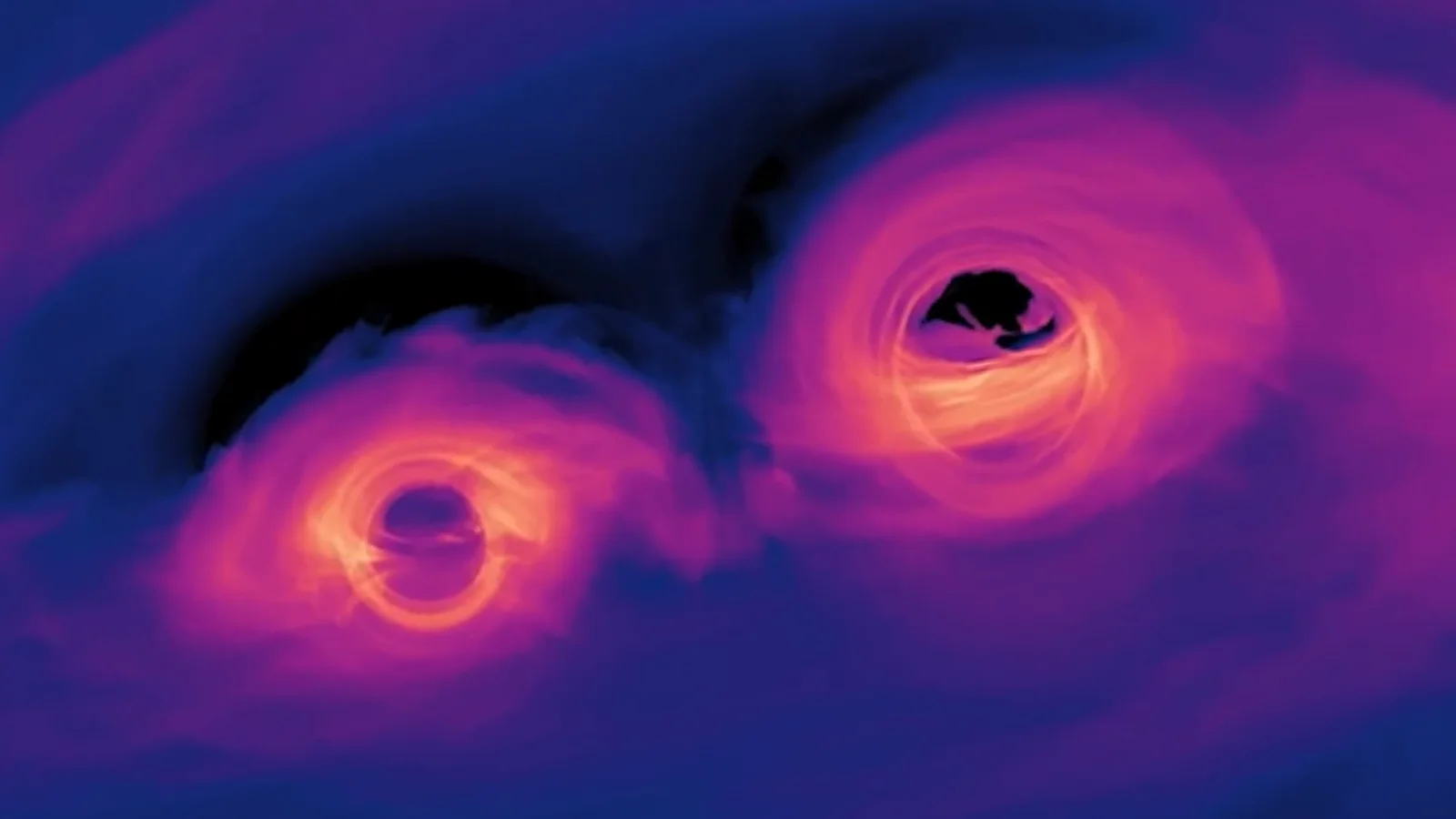
A new study using supercomputers has produced the most detailed simulations to date of how stellar-mass black holes consume and eject matter, incorporating complex physics and general relativity, revealing insights into the behavior of accretion disks, jets, and magnetic fields around black holes.
A new study using supercomputers has produced the most detailed simulations to date of how stellar-mass black holes consume and eject matter, incorporating complex physics and general relativity, which could also apply to supermassive black holes and help explain recent astronomical observations.
2025 was a groundbreaking year for black hole research, featuring discoveries such as a rapidly feeding black hole in the early universe, a runaway supermassive black hole moving at incredible speeds, space tornadoes around the Milky Way's core, energetic flares from our galaxy's black hole, and the detection of the universe's most distant and possibly most massive black holes, all facilitated by advanced telescopes like JWST and ALMA.
Scientists have used the world's most powerful supercomputers to simulate the most powerful black hole ever modeled, revealing new insights into black hole behavior, including super-Eddington accretion, magnetic field effects, and radiation dynamics, challenging previous assumptions and aligning closely with observational data.