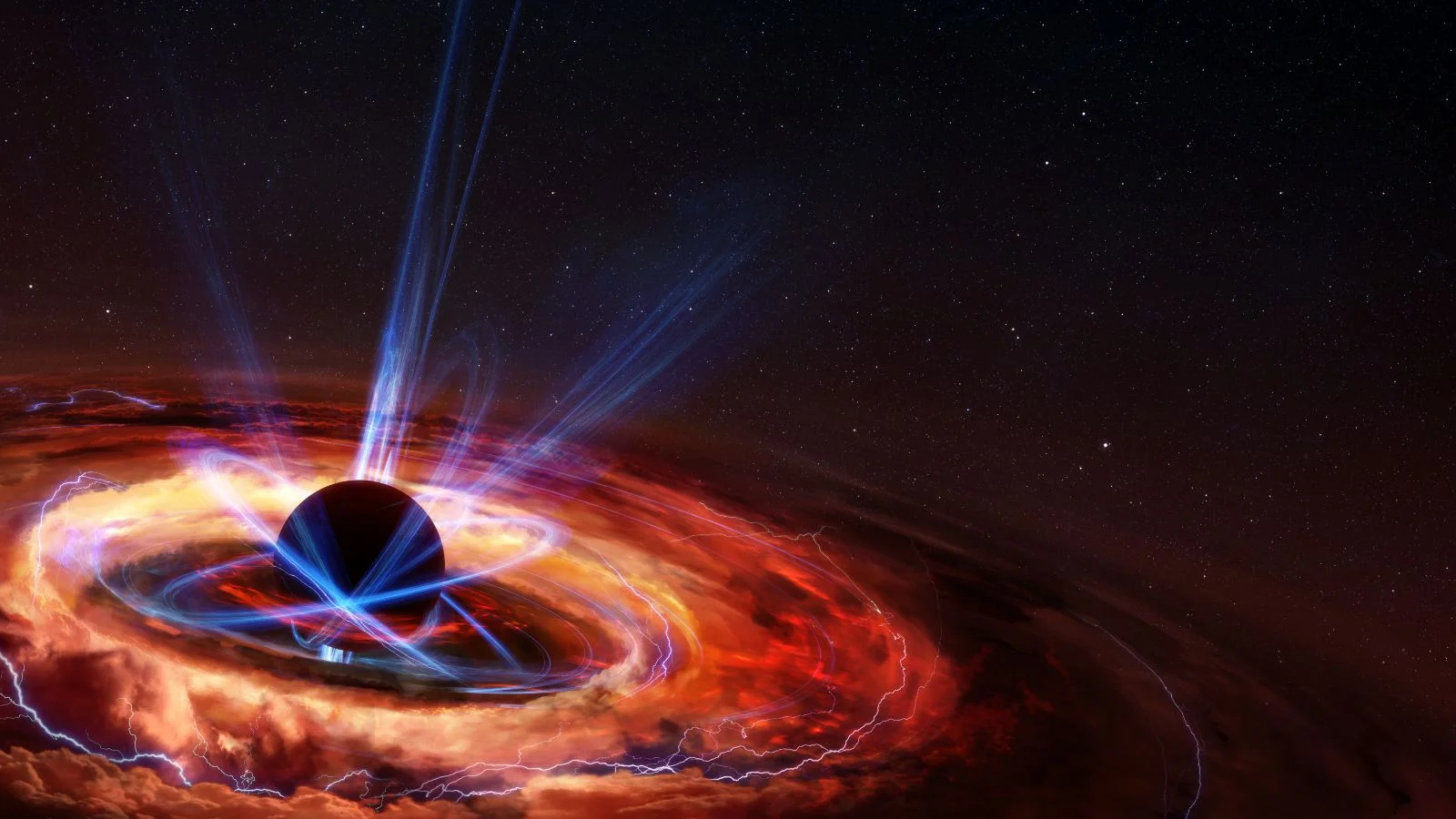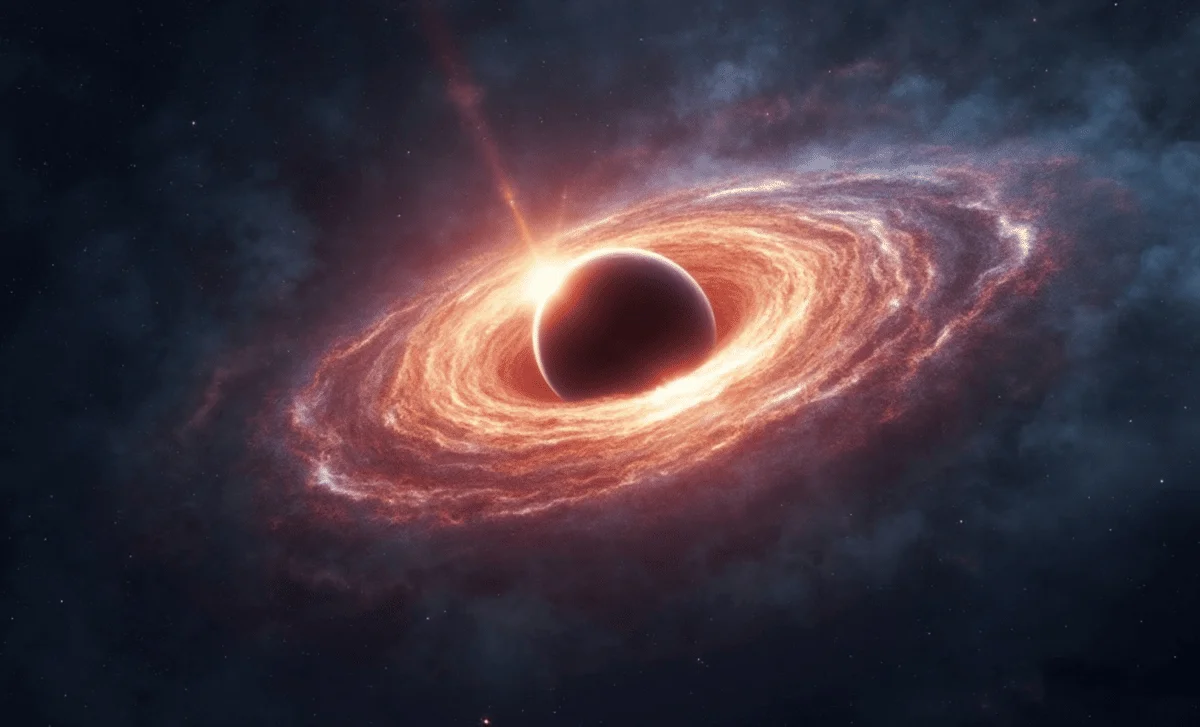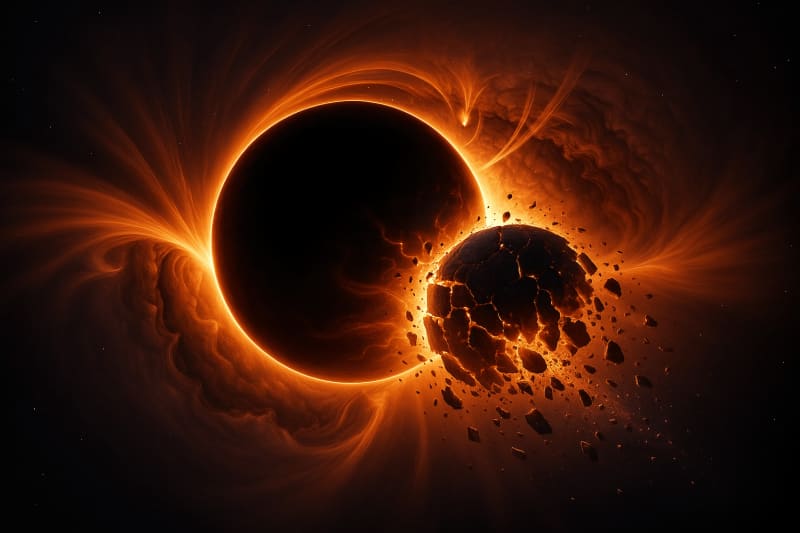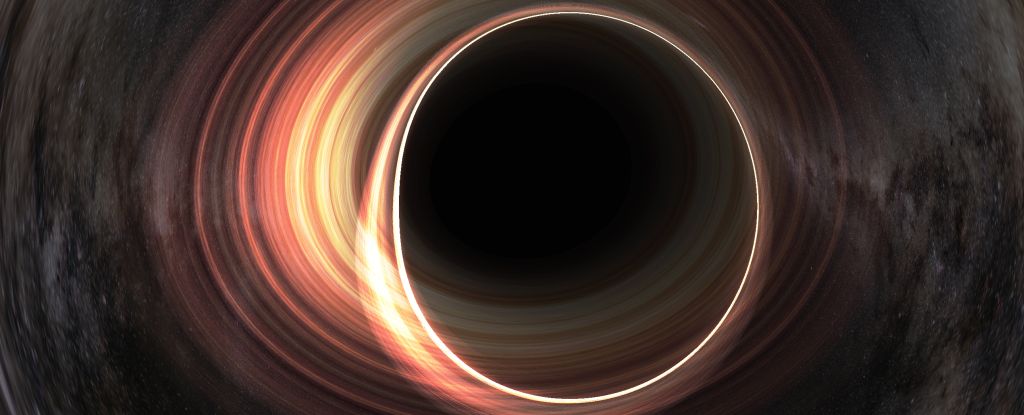
Black holes are formed from collapsing massive stars, creating a region with an event horizon beyond which nothing can escape, and possibly a singularity where matter is compressed infinitely. They influence their surroundings through accretion disks and jets, distort time and space, and may eventually evaporate via Hawking radiation, playing a crucial role in understanding the universe's fundamental laws.
Physicists simulated a black hole in the lab using a chain of atoms, observing Hawking radiation-like effects, which could provide insights into the unification of quantum mechanics and general relativity and help understand black hole phenomena.
A record-high energy neutrino event (KM3-230213A) may be the first observational evidence of Hawking radiation from primordial black holes, which could also constitute most of the dark matter in the universe, suggesting we might have already detected exploding black holes within our cosmic neighborhood.
Scientists warn of a 90% chance that a primordial black hole formed after the Big Bang could explode by 2035, potentially releasing observable Hawking radiation and providing groundbreaking insights into the universe's fundamental particles.
New research suggests a 90% chance that within the next decade, humanity could detect an exploding primordial black hole using current telescopes, which would provide groundbreaking insights into the early universe, particle physics, and dark matter, by observing Hawking radiation from these tiny black holes.
Scientists suggest there's a 90% chance of detecting an exploding primordial black hole within the next decade using current telescopes, which could confirm their existence and provide insights into particles beyond the standard model, potentially revolutionizing our understanding of the universe.
Physicists at UMass Amherst estimate a greater than 90% chance of observing a primordial black hole explosion within the next decade, which could provide groundbreaking insights into the universe's origins and fundamental particles, challenging previous assumptions about black hole lifecycles.
Scientists suggest that primordial black holes with a hypothetical dark electric charge could explode within a decade, emitting detectable Hawking radiation, potentially revealing new insights into the universe's mysteries. The scenario hinges on the existence of such black holes and their interactions with dark matter, which could make their explosions more frequent and observable with current technology.
New research suggests there's over a 90% chance we could observe an exploding primordial black hole within the next decade, which would provide groundbreaking insights into the universe's fundamental particles and origins, potentially revolutionizing physics.
Scientists propose that tiny black holes, formed during cosmic collisions, could emit detectable radiation revealing new physics, including insights into quantum gravity, with current instruments potentially capable of observing these signals.
Scientists propose that tiny black holes, or 'black hole morsels,' formed during black hole mergers could emit detectable radiation, offering a new way to explore quantum gravity and the structure of spacetime using current gamma-ray observatories.
New research suggests the universe may end much sooner than previously thought, potentially within 10^78 years, by extending Hawking radiation principles to all matter based on density, implying a universal and accelerated cosmic evaporation process.
Researchers at Sorbonne University have developed a novel experimental platform using polariton fluids to simulate quantum field theory predictions, including Hawking radiation, in laboratory settings, enabling detailed study of black hole physics and quantum effects.
A recent study suggests that the universe may disintegrate much sooner than previously thought, potentially within 10⁷⁸ years, by extending Hawking radiation theory to other celestial objects like neutron stars, challenging long-held beliefs about cosmic longevity.
New research suggests the universe could end in about 10^78 years due to Hawking-like radiation, which is much sooner than previous estimates, with objects like white dwarfs, neutron stars, and even humans potentially evaporating over this timescale.