A neuroimaging study suggests that long-term musical training helps older adults maintain youthful brain connectivity patterns, which may protect against age-related decline in speech understanding in noisy environments, supporting the idea that engaging in music can build cognitive reserve and promote brain health with age.
Research shows that long-term musical training helps older adults maintain youthful brain connectivity patterns and improves speech perception in noisy environments, supporting the idea that musical activity builds cognitive reserve and mitigates age-related cognitive decline.
A study published in PLOS Biology suggests that long-term musical training can help mitigate age-related decline in speech perception by enhancing cognitive reserve and maintaining youthful neural connectivity patterns, supporting the idea that engaging in music can promote brain health as we age.
A new study suggests that tapping your finger at a moderate pace of about two times per second can improve speech understanding in noisy environments by aligning brain timing with speech rhythms, especially when combined with vocalization, though further research is needed to confirm these effects in diverse populations.
The article explains how the left and right sides of the brain process language differently, with the left hemisphere specializing in speech and the right in melodies, and how these processes develop during critical periods in early life. Research on mice shows that these developmental windows vary by sex and hemisphere, influencing how sound is processed and potentially contributing to neurodevelopmental disorders like autism and schizophrenia. Understanding these mechanisms offers insights into language development and potential early interventions.
A study by the Max Planck Institute reveals that brain wave timing influences how we perceive speech, with more probable sounds and words being recognized during less excitable brain wave phases. This finding supports the role of neural timing in language comprehension and has significant implications for predictive coding theories in speech perception.
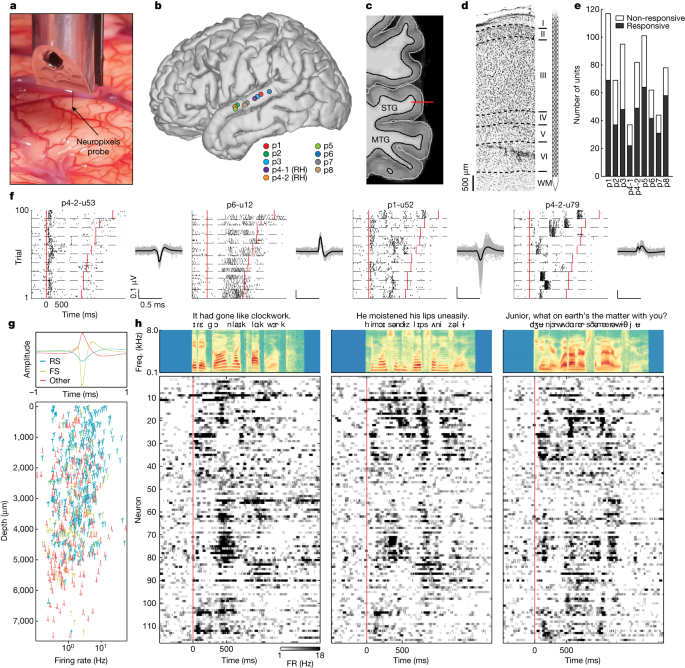
Researchers used high-density multielectrode Neuropixels probes to record cellular activity from hundreds of individual neurons across the cortical layers in the superior temporal gyrus (STG) of the human brain while participants listened to naturally spoken sentences. They found that single neurons in the STG encode a wide range of speech features, including acoustic-phonetic features, onsets from silence, intensity, relative pitch, lexical stress, and phoneme and word sequence probability. The encoding patterns varied across cortical depth, with different neurons tuned to different speech properties. The findings provide insights into the cortical representation of speech and the organization of neuronal responses in the STG.
A study conducted by researchers at the University of Padua in Italy suggests that language learning may begin in the womb. The study observed changes in brain patterns in newborns when exposed to speech, indicating that their brains are already attuned to their mother's language and the rhythms of speech. The research involved 33 newborns with French-speaking mothers who were played audio of a story in French, English, and Spanish. The study found that newborns exhibited brainwaves associated with speech perception and processing when exposed to their mother's language. This suggests that infants are ready to start learning language shortly after birth, and that language experience shapes the functional organization of the infant brain even before birth.
Researchers at Columbia University have discovered that the brain encodes phonetic information differently in noisy environments depending on the volume of the speech and our level of attention to it. The study used neural recordings and computer models to demonstrate that "glimpsed" and "masked" phonetic information are encoded separately in our brain. This discovery could lead to significant advancements in hearing aid technology, specifically in improving auditory attention-decoding systems for brain-controlled hearing aids.