Tag

Neuromodulation

All articles tagged with #neuromodulation

Innovative Neuromodulator Offers Hope for Tinnitus Relief

Originally Published 2 months ago — by Hacker News

The article discusses personal experiences with tinnitus, including its causes, coping strategies, and the importance of acceptance, with some sharing hope that it can become less bothersome over time. It highlights various potential treatments, the impact of hearing damage, and the psychological aspects of living with tinnitus.

Revolutionary Ultrasound Helmet Enables Non-Invasive Deep Brain Stimulation

Originally Published 3 months ago — by Neuroscience News

Featured image for Revolutionary Ultrasound Helmet Enables Non-Invasive Deep Brain Stimulation
Source: Neuroscience News

Researchers have developed a novel ultrasound device capable of simultaneously stimulating multiple precise points in the brain non-invasively, using low-intensity ultrasound to reduce risks and enable visualization of brain activity, with potential applications for treating neurological and psychiatric disorders.

Brain's Balance of Excitation and Inhibition

Originally Published 3 months ago — by Quanta Magazine

Featured image for Brain's Balance of Excitation and Inhibition
Source: Quanta Magazine

The brain maintains a delicate balance between excitatory and inhibitory neurons, which is crucial for healthy functioning. Recent research reveals that inhibitory neurons are more active and specific than previously thought, playing key roles in learning and memory. Additionally, a third category of neuromodulatory neurons influences brain activity on slower timescales, adding complexity to neural regulation. Understanding these interactions could lead to better treatments for neurological disorders caused by imbalances.

Serotonin Circuits Use Motion Cues to Control Behavior

Originally Published 7 months ago — by Neuroscience News

Featured image for Serotonin Circuits Use Motion Cues to Control Behavior
Source: Neuroscience News

Scientists discovered how serotonergic neurons in larval zebrafish process visual feedback related to movement, using a gating mechanism that opens after swimming to help the brain learn which actions lead to successful outcomes, providing insights into neuromodulation and potential implications for understanding mood disorders.

Boston Scientific's $3.7 Billion Acquisition of Axonics

Originally Published 2 years ago — by Mass Device

Featured image for Boston Scientific's $3.7 Billion Acquisition of Axonics
Source: Mass Device

Boston Scientific has agreed to acquire Axonics for approximately $3.7 billion, aiming to strengthen its urology business and expand into the high-growth sacral neuromodulation market. Axonics, based in California, develops neuromodulation systems for urinary and bowel dysfunction treatment. The acquisition is expected to be completed in the first half of 2024, with Boston Scientific projecting a highly accretive impact on its urology business in 2024. This move aligns with Boston Scientific's strategy of pursuing M&A to reinforce category leadership and enter faster growth markets.

Unveiling the Uncertainties: Caffeine's Influence on Brain Plasticity Examined

Originally Published 2 years ago — by PsyPost

Featured image for Unveiling the Uncertainties: Caffeine's Influence on Brain Plasticity Examined
Source: PsyPost

A study published in Frontiers in Psychiatry suggests that chronic caffeine consumption may decrease brain plasticity, which is crucial for learning and memory. The researchers found that long-term caffeine users exhibited reduced brain plasticity when subjected to a brain stimulation protocol. Previous studies have shown mixed results on caffeine's impact on brain plasticity. The study analyzed data from 20 participants and found that regular caffeine consumers had diminished brain responses compared to non-caffeine users. However, the findings are based on a small sample size and need to be replicated. Further research is warranted to understand the relationship between caffeine use and brain plasticity.

Boston Scientific Acquires Relievant Medsystems for $850M in Back Pain Ablation Tech Deal

Originally Published 2 years ago — by PR Newswire

Featured image for Boston Scientific Acquires Relievant Medsystems for $850M in Back Pain Ablation Tech Deal
Source: PR Newswire

Boston Scientific has announced its agreement to acquire Relievant Medsystems, a medical technology company specializing in treating chronic low back pain. The acquisition will expand Boston Scientific's neuromodulation portfolio and provide more treatment options for individuals with vertebrogenic pain. The transaction includes an upfront cash payment of $850 million, with additional contingent payments based on sales performance. The Intracept Intraosseous Nerve Ablation System developed by Relievant is the only FDA-cleared system for vertebrogenic pain and offers a minimally invasive outpatient procedure. The deal is expected to close in the first half of 2024.

"Chilling Relief: The Power of Cool Air in Halting Acute Migraines"

Originally Published 2 years ago — by Medscape

Featured image for "Chilling Relief: The Power of Cool Air in Halting Acute Migraines"
Source: Medscape

Transnasal evaporative cooling shows promise as a nonpharmacologic treatment for aborting migraine attacks, providing relief for most patients without the need for rescue medication. The cooling device works by blowing dry, ambient air across the nasal turbinates, potentially modulating the sphenopalatine ganglion implicated in migraines. The study, presented at the American Headache Society Annual Meeting, found that the lowest flow rate of 6 liters per minute was most effective, with an 88% pain relief rate and a 50% pain-free rate at 2 hours. However, the study was terminated due to a low subject accrual rate, and further research is needed to optimize efficacy and tolerability.

Examining Blood Pressure Laterality in Cardiovascular Disease Progression.

Originally Published 2 years ago — by Medical Xpress

Featured image for Examining Blood Pressure Laterality in Cardiovascular Disease Progression.
Source: Medical Xpress

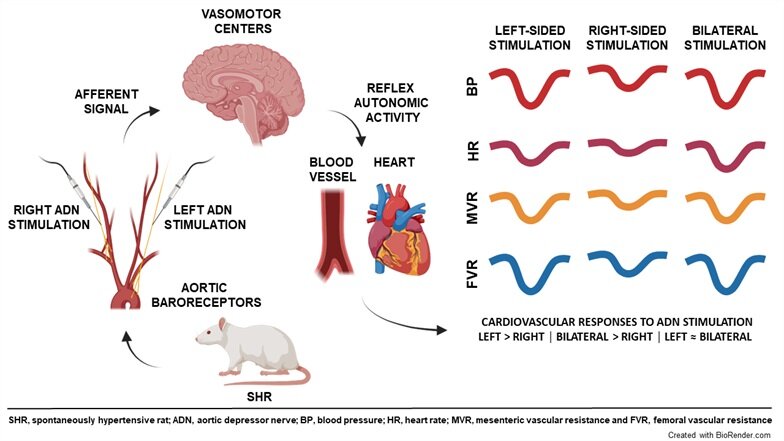
A study by an international team of scientists has shown that the left side of the aortic baroreflex pathway outperformed the right side to contribute greater reflex reductions in blood pressure in an experimental model of hypertension. The study also highlighted the shared similarity of lateralization in the aortic baroreflex function under both normotensive and high blood pressure conditions. The findings could inform current surgical practices of the bilateral implantation of a baroreflex activation therapy device in patients.

Electric Stimulation May Boost Women's Libido, Study Finds.

Originally Published 2 years ago — by New York Post

Featured image for Electric Stimulation May Boost Women's Libido, Study Finds.
Source: New York Post

Electrical impulses on the dorsal genital nerve around the clitoris have been shown to stimulate sexual arousal in women, including those with severe spinal-cord injuries, according to a study conducted at the University of Michigan. The study included nine participants, and each session lasted about 30 minutes. The women reported sensations including “tingling,” “pulsation” and “lubrication,” but no pain or discomfort. The researchers noted that their study was limited by the small number of participants and by the lack of audio-visual materials. Neuromodulation has shown some promise in treating movement disorders such as Parkinson’s disease, epilepsy, pain and depression, and is often used off-label for other neurologic conditions.

The Future of Suicidal Depression Treatment.

Originally Published 2 years ago — by Medscape

Featured image for The Future of Suicidal Depression Treatment.
Source: Medscape

The Stanford neuromodulation therapy (SNT) protocol, a new approach to transcranial magnetic stimulation (TMS) for treatment-resistant depression, has shown promising results in treating high-acuity psychiatric emergencies. The protocol uses a new form of stimulation called theta-burst stimulation, which compresses the entire FDA-approved theta-burst course from 6 weeks into a single day. The treatment has been shown to be effective in people who failed electroconvulsive therapy and can be personalized to an individual's needs. However, more research is needed to determine the ideal protocol and maintenance treatment for long-term success. The treatment is not yet widely available but may become more accessible in the future.