A new study finds autism symptom severity, not diagnostic labels, maps to shared brain-network connectivity and gene-expression patterns linked to autism and ADHD, suggesting a common biology across neurodevelopmental conditions.
A Washington State University study in rats shows that a single in-utero exposure to the fungicide vinclozolin can imprint disease risk that persists for 20 generations, with birth-related mortality rising in later generations. The inherited effects are germline-based epigenetic changes, suggesting long-term implications for human disease and highlighting the potential for epigenetic biomarkers to enable preventative medicine decades before disease onset.
In a small study of 60 Parkinson's patients and matched controls, researchers found distinctive metal profiles in hair—lower iron and copper with higher manganese and arsenic—raising the possibility of a non-invasive diagnostic biomarker. Mouse data linked hair iron deficiency to gut dysfunction, highlighting a gut–brain connection; further, larger studies are needed to confirm causality and mechanism and to validate hair metal patterns as a PD diagnostic tool.
A German study shows that an AI-enhanced blood test analyzing DNA methylation markers can classify people into high- or moderate-risk prediabetes groups with about 90% accuracy, using 1,557 epigenetic markers to form a biological fingerprint. This approach could enable earlier, personalized prevention and reduce progression to type 2 diabetes, potentially serving as a simpler, cost-effective diagnostic tool compared with extensive clinical testing.
A longitudinal study of 108 adults found that roughly 80% of studied biomolecules change in two sharp waves—around age 44 and again in the early 60s—indicating distinct midlife and late-life aging windows that affect lipid and carbohydrate metabolism, immune function, and organ health. Menopause is not the sole driver, and researchers call for larger, more diverse studies to confirm and expand on these findings.
The article highlights that osteoarthritis is increasingly diagnosed in younger, active individuals and discusses how emerging diagnostic techniques—such as spectral fingerprinting using spectroscopy to analyze blood biomarkers—could detect risk before pain or joint damage appears. This early detection could enable preventive actions like targeted exercise, weight management, and injury prevention, potentially reducing long-term disability and healthcare costs. Current treatments focus on symptom management and may involve injections or, in severe cases, joint replacement, but early identification could shift care toward prevention and preservation of joint health.
A new analysis of three Prototaxites fossils from the Rhynie chert suggests the 400-million-year-old largest land organism may be a previously unknown form of multicellular life, distinct from plants, fungi, or animals. Biomarker data challenge straightforward classification, and researchers caution that key questions about anchorage, upright growth, and non-photosynthetic carbon use remain, with follow-up studies planned.
A NIH-backed study reports a four-marker blood test—CA19-9, THBS2, ANPEP, and PIGR—that accurately detects pancreatic ductal adenocarcinoma, including early-stage disease, with 91.9% overall accuracy at a 5% false-positive rate and 87.5% sensitivity for stage I/II cancers; the test also differentiates cancer from pancreatitis and could enable screening for high-risk groups, though larger prediagnostic studies are needed.
A new study published in Science Advances argues that Prototaxites, a 400-million-year-old fossil that could reach about 9 meters tall, is not a plant, fungus, or algae but likely an unknown form of multicellular life. Researchers analyzed fossils from the Rhynie chert in Scotland and found biomarkers that differ from fungi and other structural features, suggesting Prototaxites may occupy an entirely different branch of the tree of life; the team cautions that only a few specimens have been examined and plans follow-up work on related tubular fossils to broaden understanding.
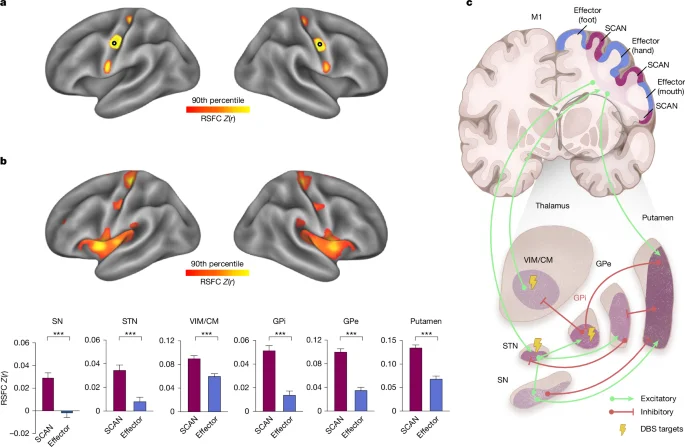
A large, multi-modal study proposes Parkinson’s disease as a somato-cognitive action network (SCAN) disorder, showing PD features SCAN-to-subcortex hyperconnectivity that is reduced by dopaminergic therapy and various neuromodulation methods (DBS, MRgFUS, TMS, adaptive DBS). Targeting SCAN nodes—especially cortical SCAN regions—yields greater symptom relief than conventional effector-area targets, suggesting a circuit-based pathophysiology and treatment strategy, with SCAN connectivity serving as a potential biomarker and guide for personalized therapy.
APA researchers outline a new Diagnostic and Scientific Manual that could replace DSM-5 with a living, broadly accessible guide that emphasizes dimensional diagnoses and etiological factors (cultural, environmental, biological) while guiding research and policy; biomarkers would be added gradually as evidence grows, with the project taking place over years rather than months.
A European study found that blood biomarkers linked to early DNA repair and cellular stress, identified with machine learning, may reveal Parkinson’s long before motor symptoms, paving the way for inexpensive blood tests and earlier treatment—with clinical usage potentially within five years—though brain changes may not fully match blood signals and no cure exists.
The American Psychiatric Association announced a sweeping plan to rework the DSM, renaming it the Diagnostic Science Manual of Mental Disorders and adding patient voices, broader life-context factors, and the potential integration of biomarkers, aiming for a more flexible, inclusive, and educational diagnostic framework—though no timeline is set and changes will involve insurers and clinicians.
Case Western Reserve University researchers propose that asthma is driven by 'pseudo leukotrienes'—leukotriene-like molecules formed when free radicals oxidize lipids—rather than traditional leukotrienes. These molecules were found at higher levels in asthma patients and tracked with disease severity, suggesting they could serve as biomarkers and that therapies aimed at preventing radical formation (instead of just blocking receptors) might more precisely treat inflammation. The findings could also influence treatment of other inflammatory diseases and potentially neurological conditions.
Endometriosis is often diagnosed only after years of medical visits, but startups are racing to develop biomarker-based tests using blood, menstrual fluid, saliva, and stool to speed and improve diagnosis, inspired by patients like María Teresa Pérez Zaballos who spent years seeking a diagnosis and went on to found Endogene.Bio.