Tag

X Ray Telescopes

All articles tagged with #x ray telescopes

science1 year ago

Einstein's Black Hole Predictions Confirmed by 'Plunging Region' Discovery

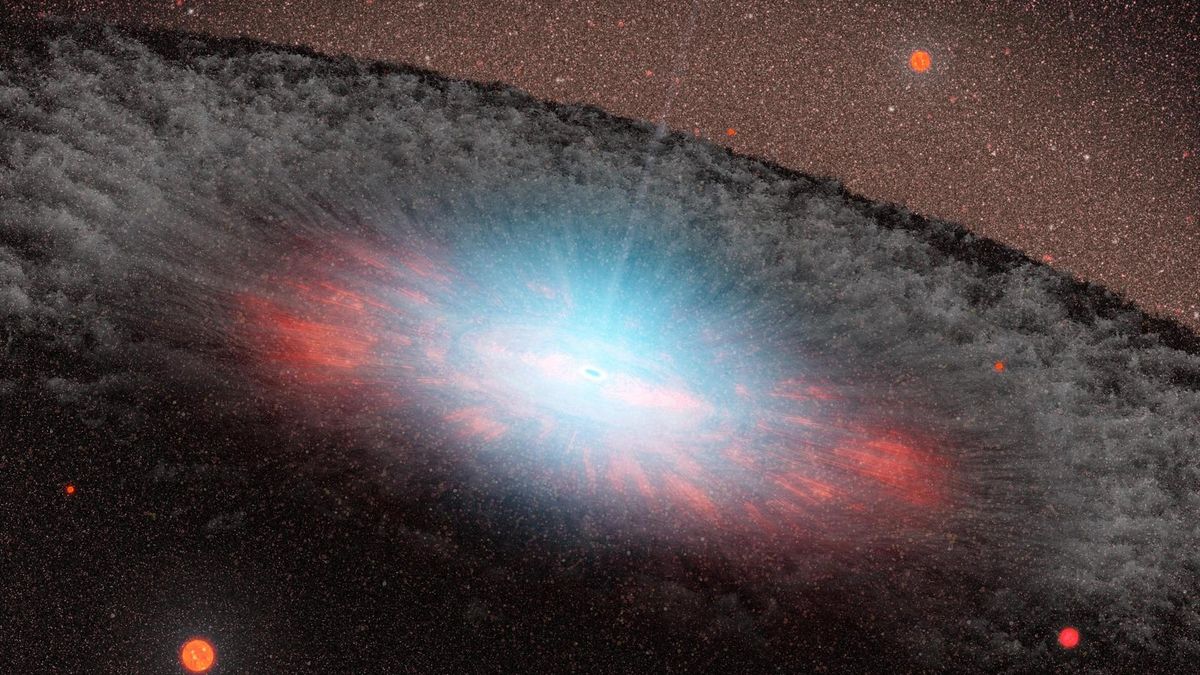
Researchers at Oxford University have provided the first observational proof of "plunging regions" around black holes, where matter stops orbiting and falls directly into the black hole. Using X-ray data from NASA's NuSTAR and NICER telescopes, the study confirms Einstein's prediction about the behavior of matter near black holes and reveals some of the strongest gravitational forces in the galaxy. The findings, published in the Monthly Notices of the Royal Astronomical Society, mark a significant advancement in understanding black hole dynamics.

astronomy1 year ago

"Dancing Black Holes: Unraveling the Mystery of Supermassive Hiccups"

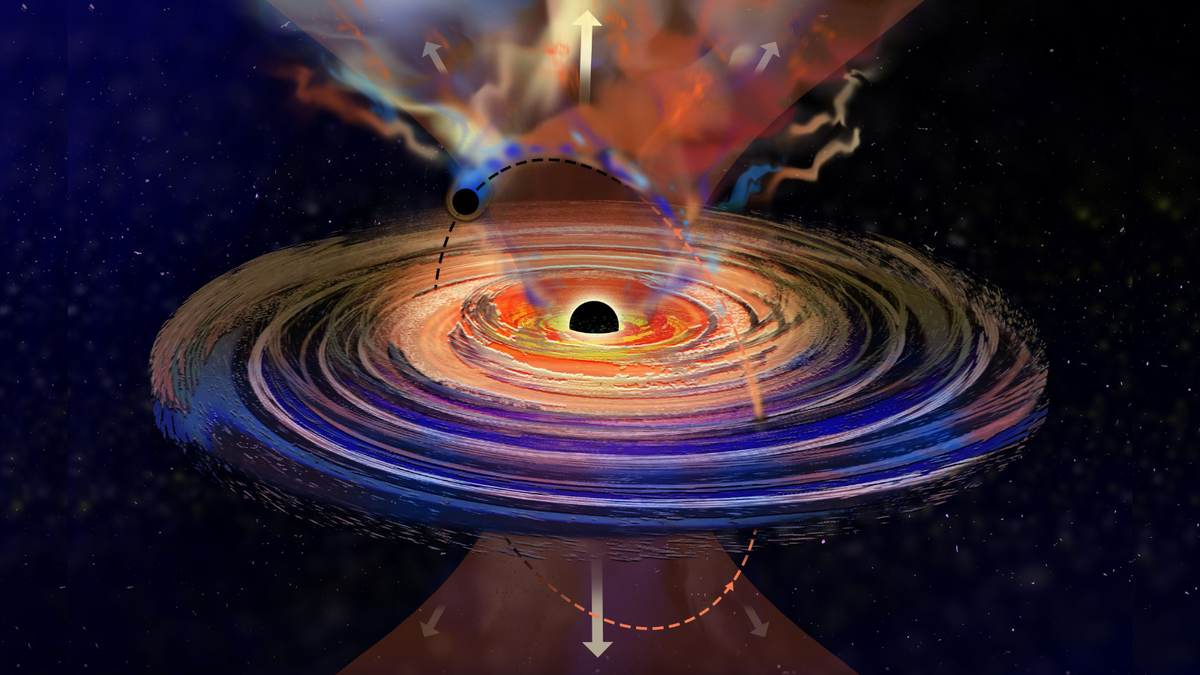
Astronomers have observed a supermassive black hole experiencing periodic eruptions, which are believed to be caused by a smaller black hole diving through its accretion disk. This behavior challenges the conventional understanding of black hole accretion disks and suggests the presence of exotic components such as stars and smaller black holes. The eruptions were triggered by a star being shredded in a tidal disruption event, leading to a sudden influx of matter that brightened the accretion disk. The findings, published in Science Advances, could help astronomers better understand supermassive black holes and their environments.

astronomy1 year ago

"Unraveling Deep Space Mysteries: Neutron Star Glitches and Fast Radio Bursts"

NASA's X-ray telescopes observed a fast radio burst from a magnetar, a type of dead star, within our galaxy, providing unprecedented insights into the mysterious signals from deep space. The observation revealed that rapid changes in the magnetar's spin rate, known as "glitches," are crucial to understanding the process of fast radio burst generation. This groundbreaking discovery sheds light on the enigmatic phenomena of fast radio bursts and marks a major step forward in deciphering their origins, although many questions still remain.

astronomy1 year ago

"Unraveling the Mysteries of Fast Radio Bursts with NASA Telescopes"

NASA's X-ray telescopes have provided new insights into fast radio bursts (FRBs) by studying a burst from a magnetar within our galaxy, revealing rapid changes in magnetar behavior that could explain how FRBs are generated. The telescopes observed the magnetar for hours, catching a glimpse of what happened on its surface and in its surroundings before and after the burst, shedding light on the physics of magnetars and their potential connection to FRBs. This research sets scientists on a path to better understand these extreme cosmic events.

astronomy1 year ago

"Unraveling Deep Space Mysteries: NASA Telescopes and Fast Radio Bursts"

NASA's X-ray telescopes observed a fast radio burst from a magnetar, providing new insights into the mysterious deep space signals. The burst occurred between two "glitches" when the magnetar suddenly started spinning faster, and researchers were surprised to see that it slowed down rapidly in just nine hours. Scientists are considering various factors, such as the magnetar's dense interior and powerful magnetic field, to understand how these bursts are produced. The unprecedented view sets scientists on a path to better understand these extreme radio events and highlights the need for more data to complete the mystery.

astronomy2 years ago

Ghostly Cosmic Hand Unveiled by X-Ray Telescopes

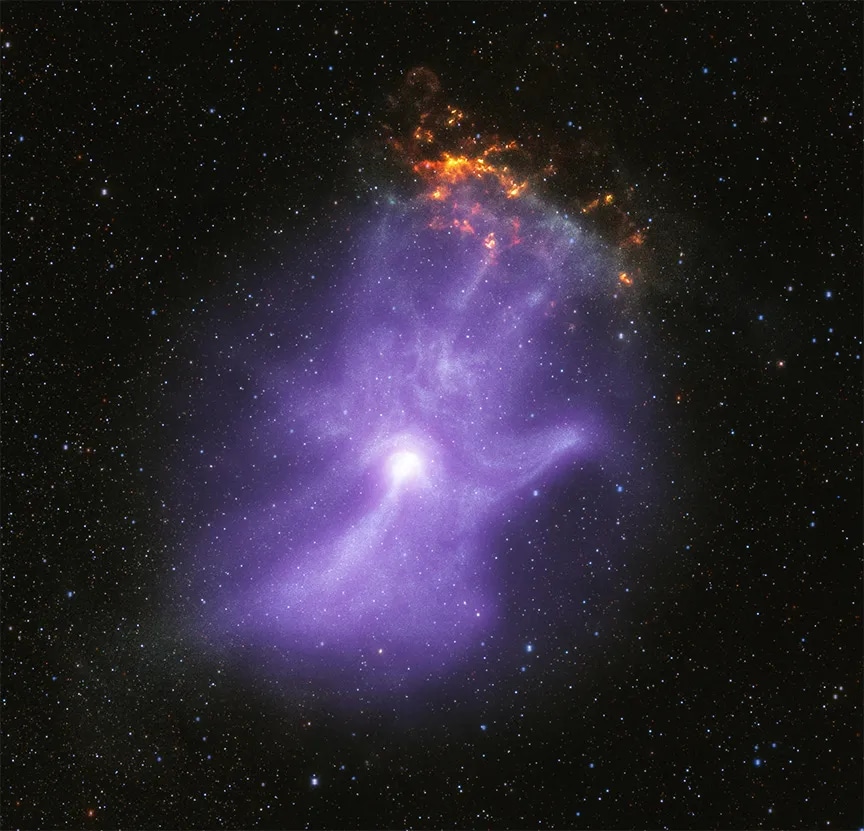
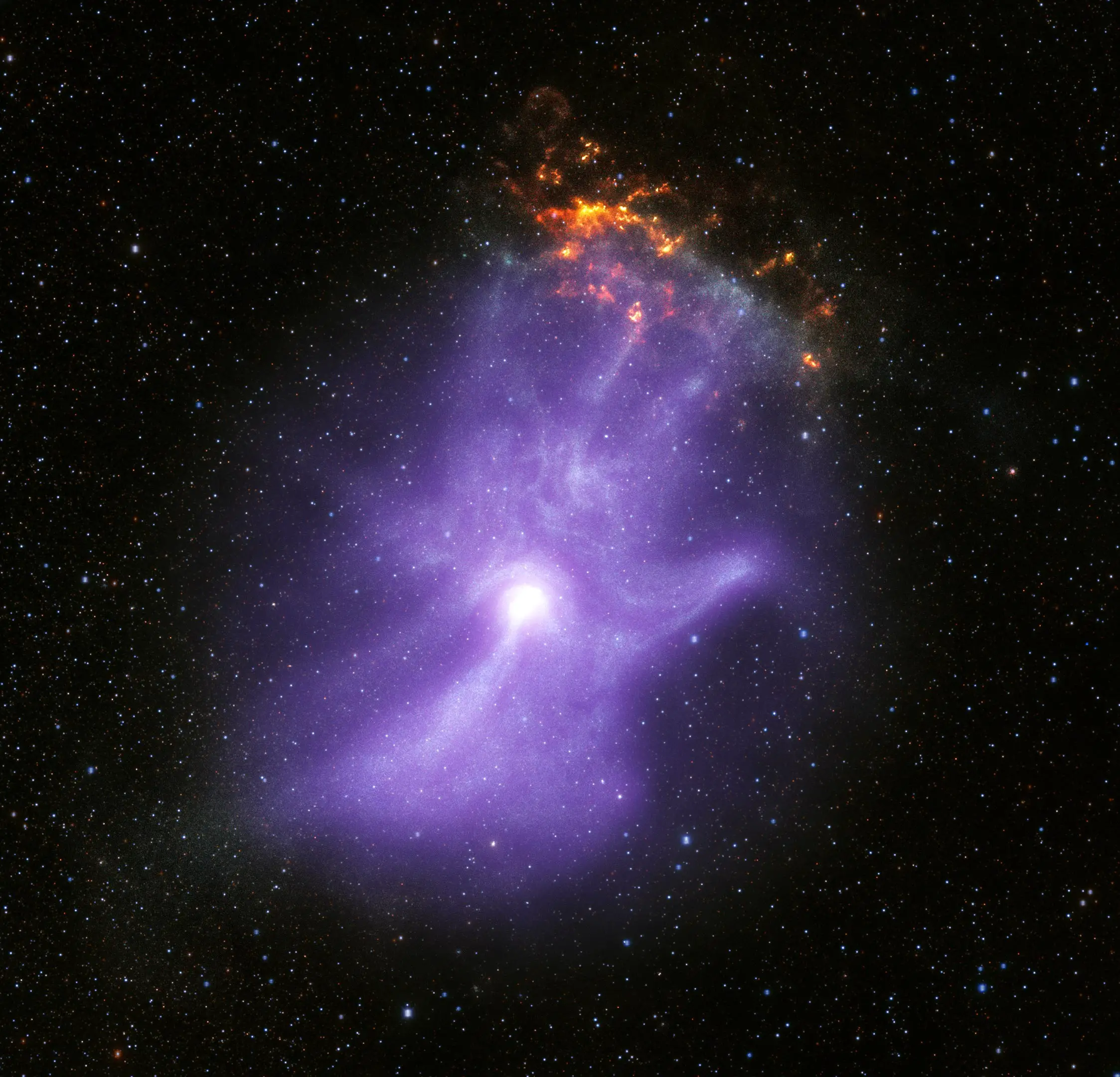
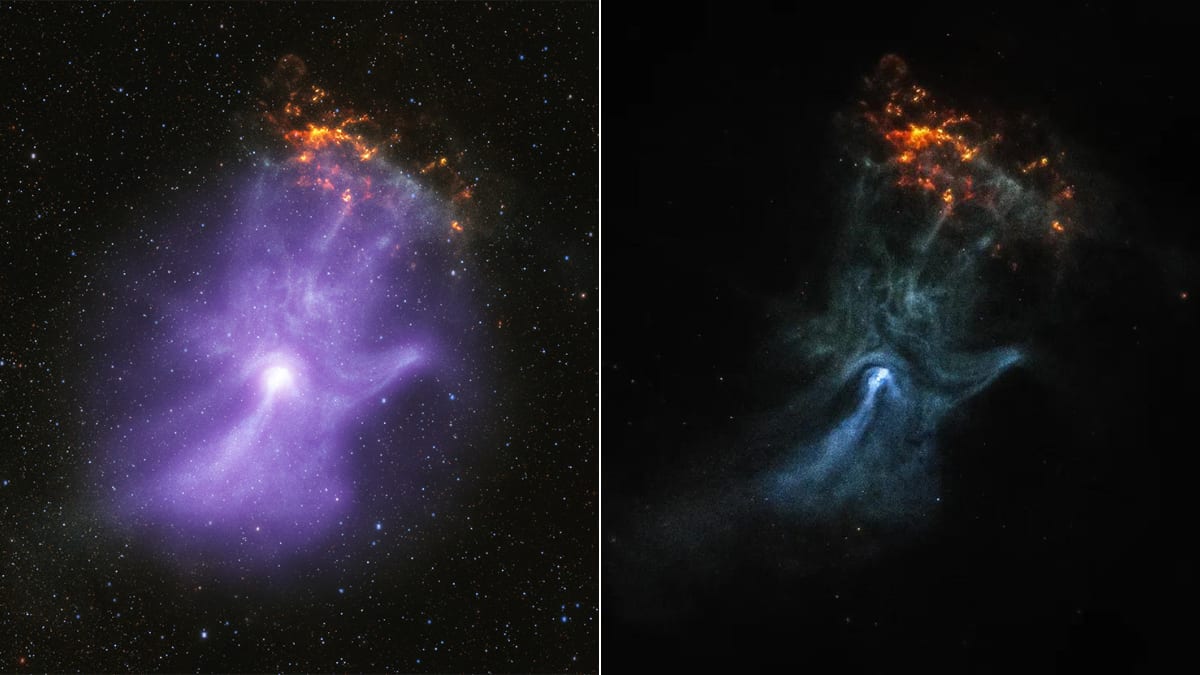
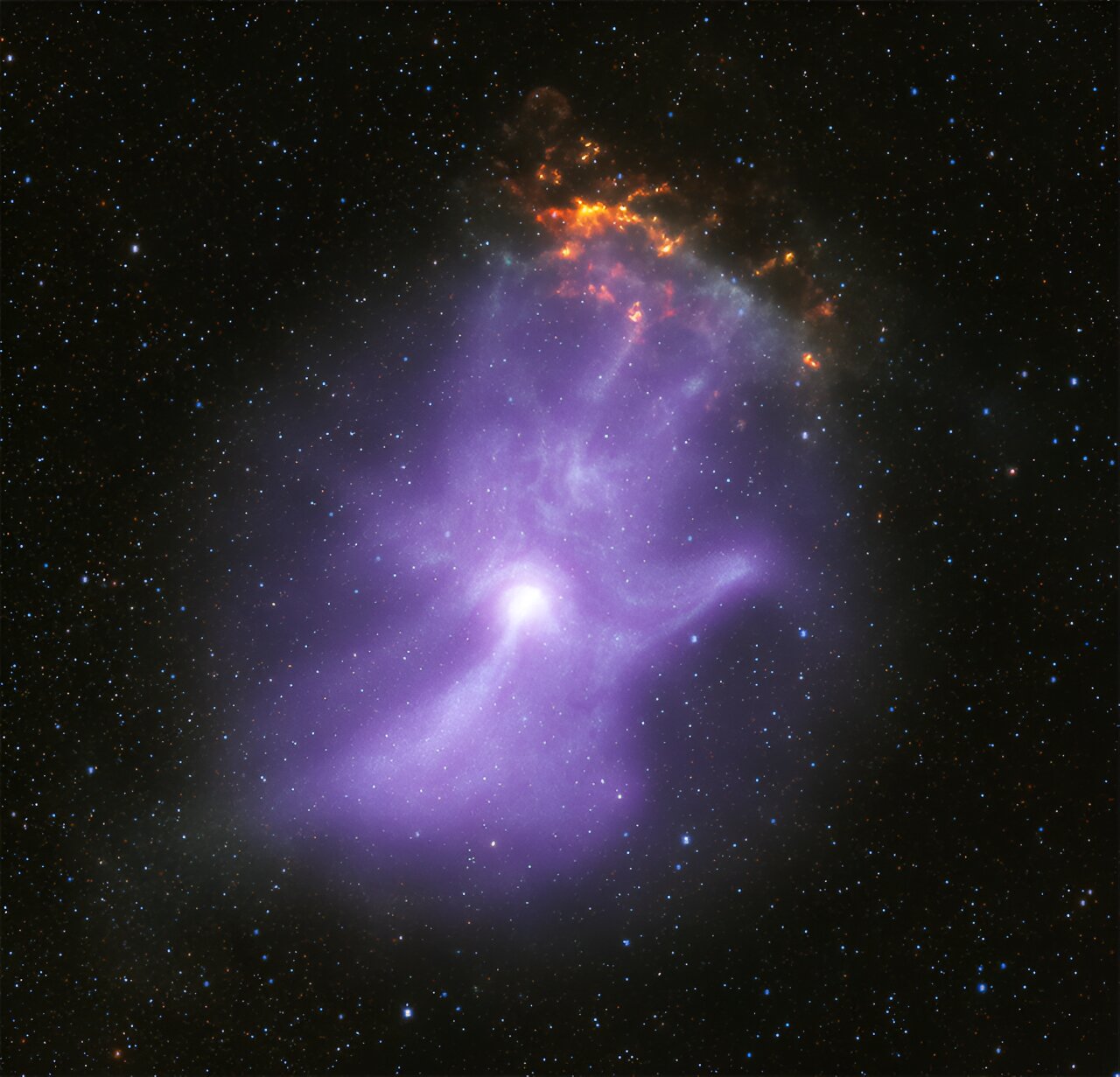
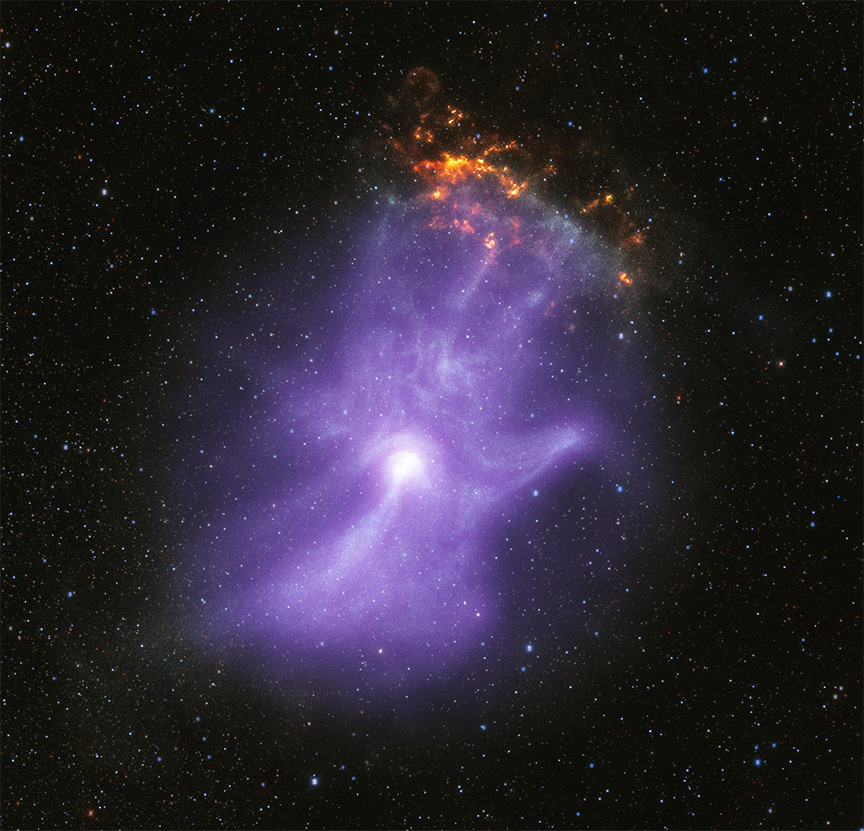
Astronomers using the Chandra X-ray Observatory and the Imaging X-ray Polarimetry Explorer (IXPE) have captured images of a ghostly hand-shaped pulsar wind nebula, known as MSH 15-52, located roughly 16,000 light-years away. The X-ray data reveals the magnetic field lines that shape the nebula, resembling the bones in a human hand. The observations also uncovered previously unknown X-ray jets contributing to the spread of material.

space2 years ago

NASA's X-Ray Telescopes Unveil Ghostly Cosmic 'Hand' of a Dead Star

NASA has released an image captured by the Chandra X-Ray Observatory and Imaging X-ray Polarimetry Explorer (IXPE) showing the remains of a supergiant star that collapsed and formed a neutron star. The image reveals the star's magnetic field, represented by a ghostly purple and white hand-like figure. The IXPE data provides the first map of the magnetic field within the nebula surrounding the neutron star, offering insights into the behavior of energized matter particles and antimatter. This discovery contributes to our understanding of how dying stars impact their environments and provides valuable information on the birth of new stars.

space2 years ago

Eerie 'Face' Haunts Jupiter: NASA's Spooky Discoveries

NASA missions have captured eerie celestial features, including a haunting "face" on Jupiter and a ghostly, skeletal hand-shaped nebula. The Juno mission's close flyby of Jupiter revealed a Picasso-like face emerging from the planet's turbulent atmosphere. Additionally, X-ray telescopes observed a glowing hand-shaped cloud, known as MSH 15-52, which formed from the collapse of a massive star. The cloud is located 16,000 light-years from Earth and is associated with a pulsar. The observations provide insights into the magnetic field and particle acceleration within the nebula.

space-science2 years ago

"NASA's X-Ray Telescopes Unveil the Eerie 'Ghostly Cosmic Hand' in Space"

NASA's Chandra and IXPE telescopes have provided groundbreaking insights into the magnetic "bones" of the hand-shaped pulsar wind nebula, MSH 15-52. By combining data from both telescopes, astronomers have obtained the first map of the magnetic field in the nebula, revealing high levels of X-ray polarization and a remarkably straight and uniform magnetic field. The IXPE data also show a bright X-ray jet directed from the pulsar to the "wrist" of the hand, with the polarization increasing as the magnetic field lines straighten. This research sheds light on the formation and dynamics of pulsar wind nebulae and offers a unique glimpse into extreme physics conditions.

space2 years ago

"X-ray Telescopes Unveil Ghostly Cosmic Hand's Skeletal Structure"

Astronomers have used NASA's X-ray space telescopes to reveal the magnetic field "bones" of a hand-shaped structure in space. The Imaging X-ray Polarimetry Explorer (IXPE) observed the structure, known as MSH 15-52, for about 17 days, providing the first map of its magnetic field. The high degree of polarization in many sections of the structure suggests a consistent and straight magnetic field with little turbulence. The findings also indicate that particles move to regions with uniform magnetic fields after receiving an energy boost in turbulent areas close to the pulsar at the base of the structure.

space2 years ago

"NASA's X-ray Telescopes Unveil Supernova Secrets and Solve Ancient Cosmic Explosion Mystery"

NASA's X-ray telescopes, including the newly launched Imaging X-ray Polarimetry Explorer (IXPE), have observed a pulsar wind nebula called MSH 15-52, which resembles a human hand. The telescopes have revealed the magnetic field "bones" of this cosmic hand-shaped structure, providing insights into the behavior of a collapsed star and the injection of particles into space. The X-ray data show high levels of polarization in certain regions, indicating straight and uniform magnetic fields. These findings shed light on the formation of pulsars and their role as particle accelerators.

space2 years ago

"NASA's X-ray Telescopes Unveil Secrets of Ghostly Cosmic Hand and Historic Supernova Remnant"

NASA's Chandra X-ray Observatory and the Imaging X-ray Polarimetry Explorer (IXPE) have combined their imaging powers to reveal the magnetic field "bones" of a hand-shaped structure in space known as MSH 15-52, a pulsar wind nebula located 16,000 light-years from Earth. The IXPE data provides the first map of the magnetic field in the nebula, showing that regions with high polarization have straight and uniform magnetic fields, while turbulent regions exhibit low polarization. These findings shed light on the behavior of particles and antimatter around pulsars, providing insights into how pulsars can act as particle accelerators. Similar magnetic fields have also been detected in the Vela and Crab pulsar wind nebulae, suggesting their prevalence in these objects.

astronomy2 years ago

"Unveiling the Devastating Impact of a Monster Black Hole on a Star"

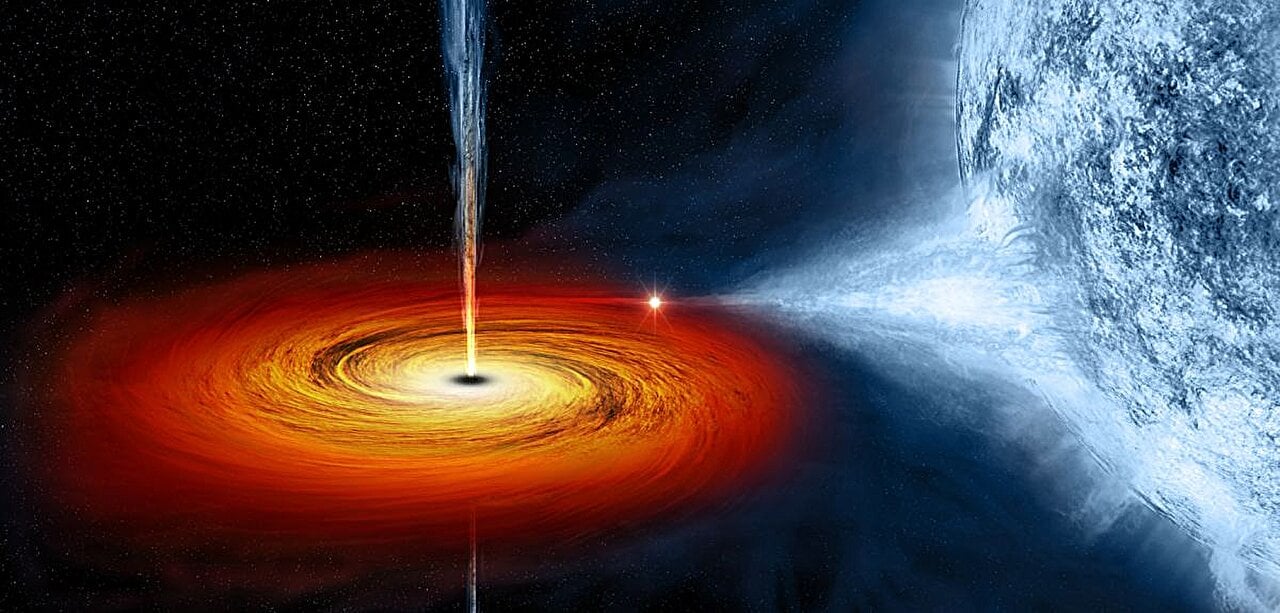
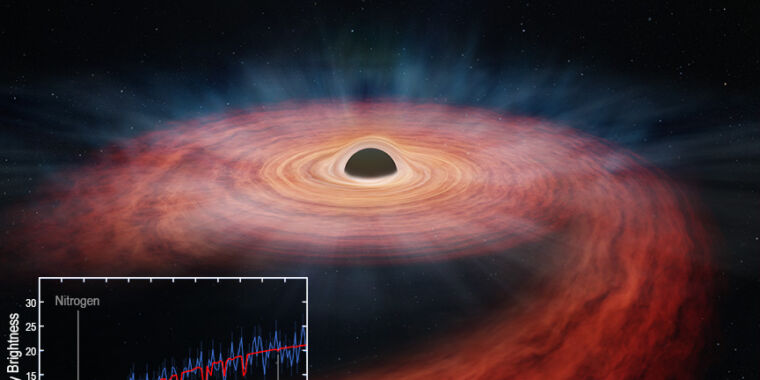
A new forensic analysis of the tidal disruption event ASASSN-14li, where a star was ripped apart by a black hole, reveals that the star was likely three times the mass of the Sun. Observations from NASA's Chandra and ESA's XMM-Newton X-ray telescopes detected carbon and nitrogen in the black hole's accretion disk, indicating the evisceration of a high-mass star. This finding provides valuable insight into the destruction of massive stars by black holes and could aid in the search for similar events in other galaxies.

astronomy2 years ago

Black Hole Assassin: A Stellar Massacre Unleashed in the Galaxy

Astronomers have used a tidal disruption event (TDE), where a black hole shreds a passing star, to measure the amounts of nitrogen and carbon around the black hole, inferring the destruction of a massive star three times bigger than the sun. The TDE, known as ASASSN-14li, was observed using X-ray telescopes and provides detailed information on the rare event of a massive star being destroyed by a supermassive black hole. This forensic analysis sheds light on the composition of the doomed star and offers insights into the destruction caused by black holes.