Chronic circadian disruption, such as night-shift work, accelerates breast cancer development and spread by weakening immune defenses and altering breast tissue, with the immune receptor LILRB4 playing a key role; targeting LILRB4 shows promise for new cancer therapies.
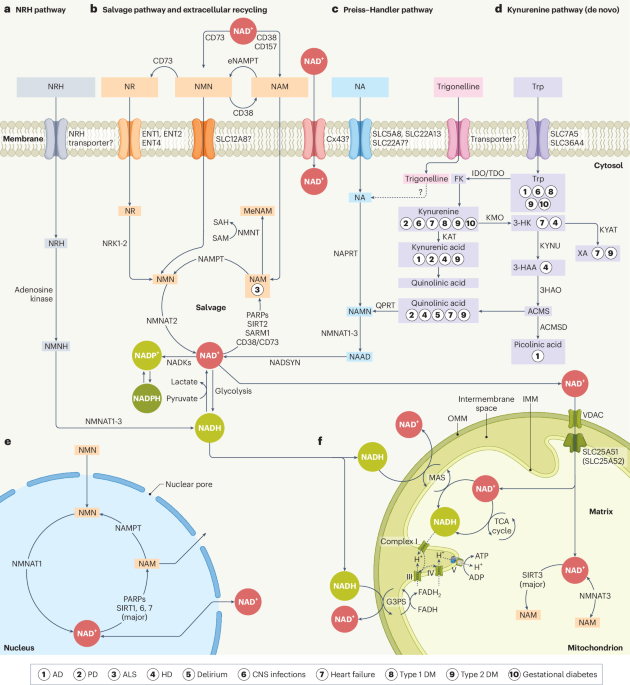
The article reviews emerging strategies, applications, and challenges of targeting NAD+ metabolism in clinical settings, highlighting its potential in treating age-related diseases, neurodegenerative disorders, and cancer, while discussing current research and therapeutic prospects.
Scientists at the Buck Institute discovered that regulating glycogen breakdown in neurons can protect against Alzheimer's by reducing toxic protein buildup and oxidative stress, with potential for new treatments inspired by dietary restriction and existing drugs.
Researchers at UNC have discovered that the protein CGRP affects the brain's lymphatic system by preventing cerebrospinal fluid drainage, contributing to migraine pain. This finding could lead to new therapeutic strategies for migraines, though more research is needed to understand sex differences in migraine prevalence.
A study utilizing anonymized prescription data from over 225,000 individuals found that HIV-positive patients taking reverse transcriptase (RT) inhibitors showed a significantly lower rate of Alzheimer’s disease (AD) compared to the general population. This discovery builds on previous findings that Alzheimer’s-linked genes might be recombined by enzymes similar to those targeted by HIV treatments. The results could pave the way for new therapeutic strategies using existing drugs to combat the growing AD crisis.
Scientists from the University of Copenhagen have discovered that mitochondrial DNA damage plays a crucial role in the progression of Parkinson's disease, leading to widespread brain damage. This breakthrough opens up new possibilities for early diagnosis through blood tests and the development of blood-based biomarkers. The researchers hope that detecting damaged mitochondrial DNA in the bloodstream could serve as an early diagnostic tool and a way to measure treatment efficacy. Further research will focus on therapeutic strategies to counteract mitochondrial dysfunctions and restore normal mitochondrial function in Parkinson's patients.
Researchers at RIKEN have discovered a link between overactive quality control in protein synthesis and neurodevelopmental disorders, which can inhibit neural growth and communication, leading to cognitive dysfunction. By studying mice lacking a key gene in ribosome-associated quality control, the team found that the overexpression of a signaling molecule called TTC3 curbs the extension of neurites, reducing communication between neurons and causing cognitive dysfunction. This finding could pave the way for new therapeutic strategies to target TTC3 or other signaling factors to treat cognitive disorders.
Researchers led by Martin Thanbichler have discovered a central regulator, DipM, that controls different classes of autolysins involved in bacterial cell wall remodeling. DipM interacts with multiple autolysins and a cell division factor, making it the first identified regulator that can control two classes of autolysins. Disruption of DipM leads to cell death, highlighting its critical role in cell shape maintenance and division. These findings may contribute to the development of new therapeutic strategies against bacterial infections by targeting multiple autolytic pathways simultaneously.
A study conducted by the National Institutes of Health (NIH) has identified differences in immune cell profiles and autonomic dysfunction in 12 people with persistent neurological symptoms after SARS-CoV-2 infection. The findings may lead to better diagnoses and new treatments for Long COVID, which includes a wide range of symptoms such as fatigue, shortness of breath, fever, headaches, sleep disturbances, and cognitive impairment. The study adds to growing evidence that widespread immunological and autonomic nervous system changes may contribute to Long COVID, and may help researchers explore possible therapeutic strategies, such as immunotherapy.
Northwestern Medicine investigators have discovered novel sex-specific mechanisms that control how stress hormones impact dopamine transmission and motivation, findings that can inform new therapeutic strategies for treating major depressive disorder. Men are more likely to have a dysregulated HPA axis that is associated with depressive symptoms, while women have higher levels of binding proteins for stress hormones that may prevent dysregulation of the HPA axis. The findings shed new light on how stress hormones impact dopamine transmission and how this impacts depression on a sex-specific basis.