Tag

Albert Einstein

All articles tagged with #albert einstein

"Einstein's Theory Confirmed: Solar Eclipse Validates General Relativity"

Originally Published 1 year ago — by Biography.com

Featured image for "Einstein's Theory Confirmed: Solar Eclipse Validates General Relativity"
Source: Biography.com

A total solar eclipse in May 1919 helped prove Albert Einstein's theory of general relativity, solidifying his status as a scientific superstar. English astronomers Arthur Eddington and Frank Dyson conducted an experiment during the eclipse, confirming Einstein's predictions about the deflection of starlight by the sun's gravity. This groundbreaking discovery revolutionized our understanding of physics and propelled Einstein to global fame, leading to his Nobel Prize in Physics in 1921. Today, the theory of general relativity continues to shape our understanding of the universe and is essential for both astrophysics and everyday technologies like satellite navigation systems.

"Testing Einstein's Theory: The Quest for a Unified Theory of Everything"

Originally Published 1 year ago — by SciTechDaily

Featured image for "Testing Einstein's Theory: The Quest for a Unified Theory of Everything"
Source: SciTechDaily

Kent Yagi, a physicist at the University of Virginia, is leading innovative research using artificial intelligence to bridge the gap between Einstein's theory of general relativity and quantum mechanics, aiming to offer new insights into gravity and the universe's fundamental forces. His work, supported by a prestigious CAREER grant from the National Science Foundation, focuses on studying massive gravitational waves to test Einstein's theories and probe the fundamental laws of nuclear physics. The grant will also fund educational outreach projects to inspire the next generation of scientists.

"Pi Day: Math, Pies, and Pizza Deals"

Originally Published 1 year ago — by The Associated Press

Featured image for "Pi Day: Math, Pies, and Pizza Deals"
Source: The Associated Press

Pi Day, celebrated on March 14 (3/14), honors the mathematical constant Pi, which represents the ratio of a circle's circumference to its diameter and has practical uses in various fields. Originating in 1988, the holiday gained national recognition in 2009 and is marked with pie-themed events and activities, including NASA's "Pi Day Challenge." Pi's significance extends to science, engineering, and even NASA's daily operations, while also serving as a tribute to Albert Einstein, whose birthday coincides with the celebration.

"NASA's LISA Mission: Hunting Ripples in Spacetime from Space"

Originally Published 1 year ago — by Newser

Featured image for "NASA's LISA Mission: Hunting Ripples in Spacetime from Space"
Source: Newser

The European Space Agency plans to launch the first space-based gravitational wave detector, the Laser Interferometer Space Antenna (LISA) mission, in 2035. This mission will allow for the detection of gravitational waves at much greater distances than previously possible, potentially uncovering events from the dawn of time. The spacecraft will detect gravitational waves with wavelengths between 186,400 miles and 1.86 billion miles, using a floating cube of gold and platinum to register the slight movements caused by the waves. This groundbreaking mission is expected to be a game-changer in the field of space exploration and our understanding of the universe.

"Einstein's Breakthroughs: Building on the Past"

Originally Published 2 years ago — by Nature.com

Featured image for "Einstein's Breakthroughs: Building on the Past"
Source: Nature.com

In "The Einsteinian Revolution," authors Hanoch Gutfreund and Jürgen Renn provide a comprehensive analysis of Albert Einstein's groundbreaking contributions to physics, dispelling the myth of him as a solitary scientific genius. They argue that Einstein's work was built on the foundation of earlier scientific knowledge and emphasize the interconnectedness of various fields in his revolutionary breakthroughs. The book also delves into Einstein's philosophical views on science and its relationship to moral values, challenging the notion that science is separate from moral judgments. Overall, the authors present a thought-provoking exploration of Einstein's scientific creativity and its broader historical context.

"Unraveling the Mystery of Dark Energy: New Insights and Discoveries"

Originally Published 2 years ago — by Phys.org

Featured image for "Unraveling the Mystery of Dark Energy: New Insights and Discoveries"
Source: Phys.org

The Dark Energy Survey (DES) has released its final measurement at the 243rd American Astronomical Society meeting, providing one of the best measurements yet of the elusive parameter "w" that describes the nature of dark energy. This measurement, which gives a value of -0.8, challenges the predicted value of -1, indicating that dark energy may not be the cosmological constant proposed by Einstein. However, the uncertainty in the measurement leaves room for the predicted value. The results may signal the end of "Big Rip" models and pave the way for future supernova experiments with next-generation telescopes, shedding more light on the nature of dark energy.

"Demystifying the Theory of Relativity: A Simple Explanation"

Originally Published 2 years ago — by SciTechDaily

Featured image for "Demystifying the Theory of Relativity: A Simple Explanation"
Source: SciTechDaily

The theory of relativity, proposed by Albert Einstein, consists of two related theories: special relativity and general relativity. Special relativity explains the relationship between space, time, mass, and energy, including the constancy of light speed and consistent physics across non-accelerating reference frames. General relativity describes gravity as the warping of space-time by mass. These theories have revolutionized our understanding of the universe and are crucial in various scientific fields, such as particle physics and GPS technology.

The Complex Nature of Gravity: Is it Truly a Force?

Originally Published 2 years ago — by Big Think

Featured image for The Complex Nature of Gravity: Is it Truly a Force?
Source: Big Think

The question of whether gravity is a force is complicated. Gravity can be defined as a force that causes objects to move or deform. Isaac Newton described gravity as a force of attraction between two bodies based on their mass and distance. However, Albert Einstein's theory of gravity proposed that it is the distortion of spacetime caused by massive objects. While Einstein's theory has been validated, it fails to describe gravity at the subatomic level. Scientists are still searching for a theory of quantum gravity that combines gravity with other subatomic forces. On the quantum scale, gravity is thought to be a force transmitted by particles called gravitons. Ultimately, the nature of gravity remains a complex and philosophical question.

"Cracking the Enigma: Unraveling Albert Einstein's Mind-Bending Questions"

Originally Published 2 years ago — by Yahoo News

Featured image for "Cracking the Enigma: Unraveling Albert Einstein's Mind-Bending Questions"
Source: Yahoo News

Albert Einstein, known for his groundbreaking theories of relativity, engaged in thought experiments to explore complex scientific concepts. Some of his mind-melting questions included pondering what would happen if one chased a beam of light, whether two people can experience the same event differently, how time dilation affects space-traveling twins, the equivalence of gravity and acceleration, and the phenomenon of quantum entanglement. These thought experiments contributed to Einstein's special and general theories of relativity and challenged conventional understanding of the physical world.

"Cracking the Enigma: Unraveling Albert Einstein's Mind-Bending Questions"

Originally Published 2 years ago — by Business Insider India

Featured image for "Cracking the Enigma: Unraveling Albert Einstein's Mind-Bending Questions"
Source: Business Insider India

Albert Einstein's thought experiments, known as Gedankenexperiments, helped him conceptualize complex scientific ideas. Some of his mind-melting questions included pondering what would happen if one chased a beam of light, whether two people can experience the same event differently, how space travel affects aging, the equivalence of gravity and acceleration, and the phenomenon of quantum entanglement. These thought experiments laid the foundation for Einstein's special and general theories of relativity and challenged our understanding of the physical world.

"Einstein's Theory Confirmed: Time Slowed 5x After Big Bang"

Originally Published 2 years ago — by Upworthy

Featured image for "Einstein's Theory Confirmed: Time Slowed 5x After Big Bang"
Source: Upworthy

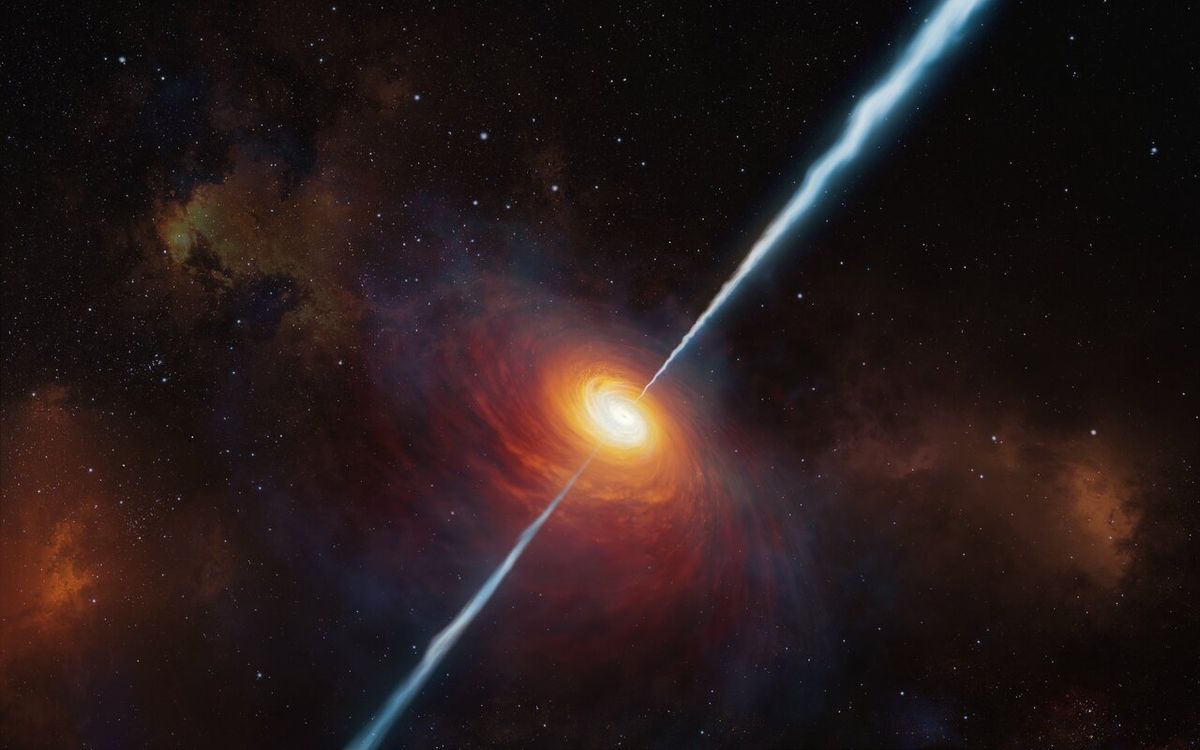
A study conducted by researchers at the University of Auckland has provided further confirmation of Albert Einstein's theory of time relativity. The study focused on quasars, galaxies with active supermassive black holes at their centers, and found that time was five times slower in the quasars of the early universe. The researchers used tools provided by the Sloan Digital Sky Survey, Pan-STARRS, and the Dark Energy Survey to analyze the fluctuations in light emitted by the quasars. This study not only supports Einstein's theory but also suggests that the universe is continuously expanding due to the Big Bang.

Time's Mind-Bending Secrets: From Slower Universes to Wibbly Wobbly Time

Originally Published 2 years ago — by Livescience.com

Featured image for Time's Mind-Bending Secrets: From Slower Universes to Wibbly Wobbly Time
Source: Livescience.com

Astronomers have observed time moving five times slower in the early universe compared to the present day, confirming a prediction made by Albert Einstein in his theory of general relativity. By studying data from quasars dating back to when the universe was just 1 billion years old, researchers found that the expansion of the universe causes light emitted from distant sources to stretch, resulting in a time delay between light pulses. This discovery provides further evidence for the interconnection of time and space and confirms the validity of Einstein's theory.

Universe's Gravitational Wave Background: A Galactic-Scale Discovery

Originally Published 2 years ago — by Simplemost

Featured image for Universe's Gravitational Wave Background: A Galactic-Scale Discovery
Source: Simplemost

Four independent scientific groups have released papers presenting evidence that the universe is being affected by a "gravitational wave background." This discovery supports Albert Einstein's theory of relativity and suggests that massive objects, such as supermassive black holes, are causing waves in the fabric of space-time. Researchers were able to detect this gravitational wave background by studying pulsars and analyzing 15 years of data. Further research is needed to confirm the existence of this background and to gain more insights into supermassive black holes and the formation and evolution of galaxies.

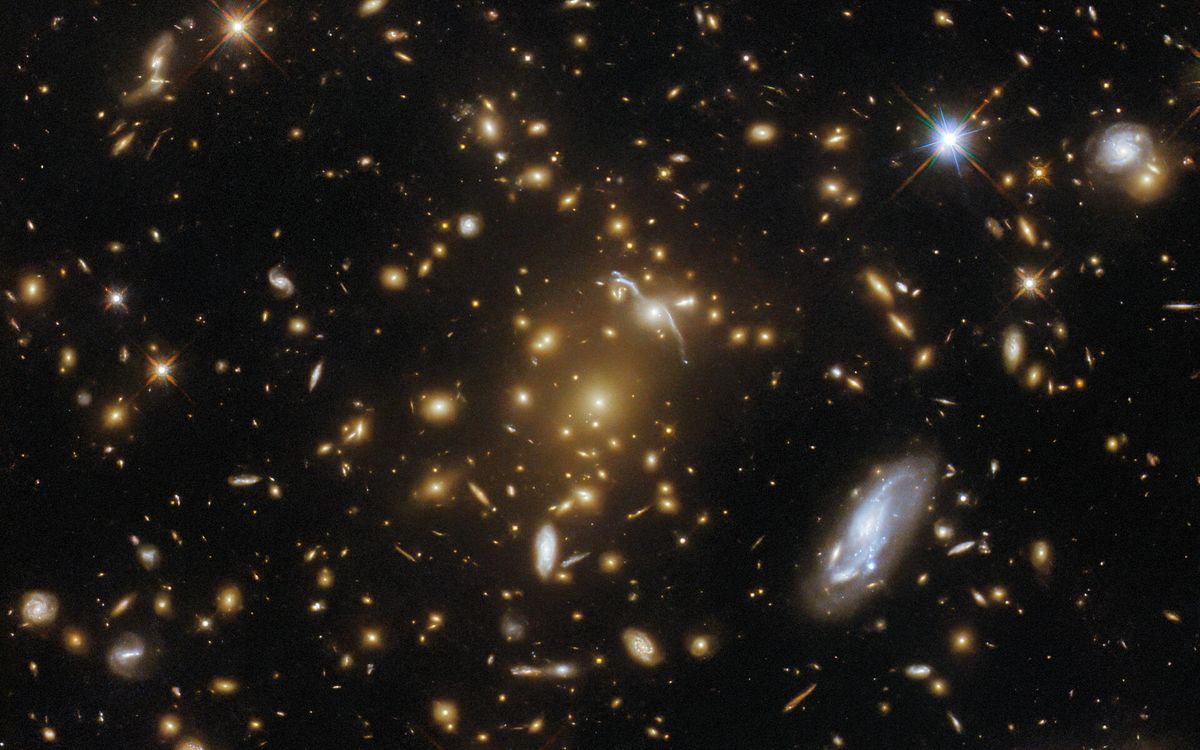
Hubble captures stunning image of massive galaxy cluster.

Originally Published 2 years ago — by Space.com

Featured image for Hubble captures stunning image of massive galaxy cluster.
Source: Space.com

The Hubble Space Telescope has captured an image of a galaxy cluster located nine billion light-years away in the constellation Draco. The cluster, known as eMACS J1823.1+7822, is one of five selected for observation by Hubble astronomers to determine the strength of the "warping" effect predicted by Albert Einstein's theory of general relativity. The distortion caused by massive clusters like eMACS J1823.1+7822 can also help astronomers study mysterious dark matter, which accounts for around 85% of the mass in the universe but is invisible because it does not interact with electromagnetic radiation.