Tag

Special Relativity

All articles tagged with #special relativity

science1 year ago

Tachyons: Faster-Than-Light Particles That Align with Einstein's Relativity

An international team of physicists has proposed that tachyons, hypothetical particles that travel faster than light, could be compatible with Einstein's special theory of relativity. Their research suggests that incorporating both the initial and final states of a system into calculations resolves previous theoretical challenges, potentially allowing tachyons to exist and offering new insights into quantum theory and the formation of matter.

science1 year ago

"The Quantum Theory Unveiling the Origin of Our Universe"

Quantum field theory, a fundamental concept in science, explains that all forces and matter are manifestations of the continuous motion of quantum fields. This theory helps to reconcile paradoxes between quantum mechanics and special relativity, shedding light on the origins of the Universe and the role of the inflation field in its rapid expansion. Quantum fluctuations in the inflation field triggered the formation of galaxies, stars, and the fabric of spacetime, leading to the vast cosmic structures observed today. This demonstrates the enduring success of quantum field theory in our quest to understand the cosmos.

science1 year ago

"Exploring the Limits of Alien Space Travel: The Speed of Light Barrier"

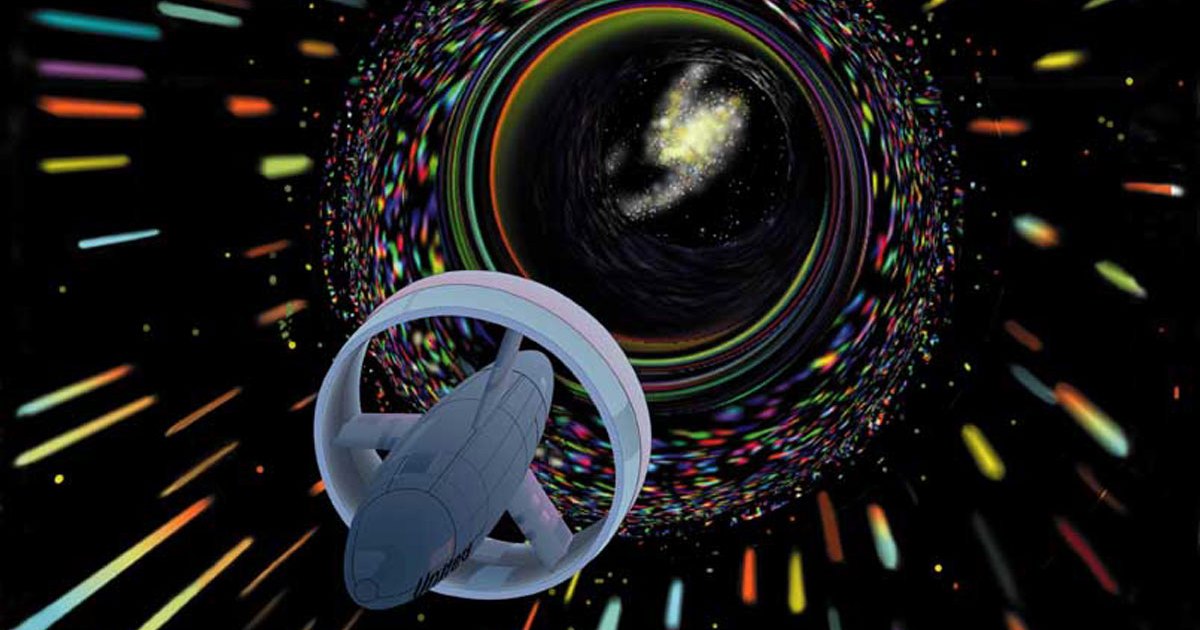
The speed of light is considered an insurmountable limit for space travel, but there are potential ways around it, such as tachyonic motion, wormholes, warp drive, and closed time-like loops in general relativity. While these concepts are currently speculative and unproven, they offer possibilities for faster-than-light travel that may challenge the long-held assumption that alien space travel is limited by the speed of light. As our understanding of the universe evolves, it remains uncertain whether advanced alien species or humanity in the distant future may find ways to overcome this cosmic speed limit.

space2 years ago

"Time Dilation Effects on Mars-Bound Astronauts"

Astronauts heading to Mars will experience time dilation due to their relative speed and proximity to gravitational fields, causing a slight difference in the passage of time compared to Earth observers. While the effect is small for short space missions, it becomes more noticeable for longer stays on Mars. Gravitational time dilation means that a human living exactly 80 years on Mars would die about 12 seconds earlier than on Earth, but from their perspective, time would pass normally.

science2 years ago

"Demystifying the Theory of Relativity: A Simple Explanation"

The theory of relativity, proposed by Albert Einstein, consists of two related theories: special relativity and general relativity. Special relativity explains the relationship between space, time, mass, and energy, including the constancy of light speed and consistent physics across non-accelerating reference frames. General relativity describes gravity as the warping of space-time by mass. These theories have revolutionized our understanding of the universe and are crucial in various scientific fields, such as particle physics and GPS technology.

science2 years ago

The Possibility of Time Travel: An Astrophysicist's Perspective

The concept of time travel has fascinated people for centuries, but whether it is possible remains a mystery. While the laws of thermodynamics suggest that time is irreversible, physicist Albert Einstein's theory of special relativity proposes that time can pass at different rates for different people. Some scientists explore the idea of wormholes, hypothetical tunnels in space that could create shortcuts for time travel, but they have yet to be observed. Paradoxes, such as the famous "grandfather paradox," add to the complexity of time travel. Astrophysicists, however, have a unique form of time travel through powerful telescopes that allow them to observe the past universe. While time travel like in movies may not be possible, scientists continue to research and explore new ideas.

astronomy2 years ago

The Early Universe's Slow Motion Revelation

A new study has provided evidence for time dilation in the early universe by observing quasars. Quasars, powered by supermassive black holes, have fluctuations in intensity that depend on the size of the active galactic nucleus (AGN). By analyzing 190 distant quasars at different wavelengths, researchers found a correlation between distance and the rate of fluctuations, indicating time dilation. The study extended these observations back to when the universe was just a billion years old, with a second from that epoch appearing to last five seconds from our perspective. This supports the standard cosmological model and general relativity.

physics2 years ago

The breakdown of Einstein's equations at light speed.

Einstein's equations of special relativity predict that as objects approach the speed of light, time slows down and space shrinks. However, at the exact speed of light, the equations break down, and it becomes impossible to determine how light experiences time. By using the approach of limits, scientists have been able to examine what happens as objects approach the speed of light. They have found that as objects get closer to the speed of light, time slows down, and space shrinks. From a photon's perspective, it experiences neither time nor space, existing in all places and all times at once.