In 2024, researchers successfully teleported a quantum state of light over 30 kilometers of fiber optic cable amid internet traffic, marking a significant step toward integrating quantum communication with existing internet infrastructure, enabling secure and advanced quantum networks.
Scientists from Kyoto and Hiroshima Universities have developed a new measurement technique to identify the elusive W state of quantum entanglement, a breakthrough that could advance quantum teleportation and computing technologies, bringing us closer to practical quantum networks and possibly even teleportation in the future.
Quantum teleportation, a real phenomenon, involves the transfer of quantum particles and information without physical movement. The process relies on entanglement, a quantum phenomenon where particles become correlated in such a way that the state of one particle is instantly connected to the state of another, regardless of the distance between them. This concept has potential applications in revolutionizing communications, computing, and our understanding of the world. John Preskill, a leading expert in quantum teleportation, discusses the intricacies of entanglement, the process of quantum teleportation, and its potential impact on technologies such as quantum computing and precision measurement.
Researchers have achieved a breakthrough in quantum teleportation by successfully demonstrating a Star Trek-style 'teleportation' of images without physically sending any information between the sender and receiver. Using a nonlinear optical detector, the team was able to remove the need for additional entangled photons, allowing for information to be sent without any physical transfer. This method has advantages in terms of information security, as no information is physically sent and interception is fruitless. However, there is a risk of cloning the original information. With further improvements, this technology could pave the way for teleportation of entire images or even people in the future.
Prof. Guangcan Guo’s team from CAS and USTC published a research review on quantum teleportation, highlighting its importance in quantum communication and computing. The team’s advancements include creating a high-fidelity 32-dimensional quantum entanglement and its successful transmission over long distances, with the paper also discussing quantum technology’s future practical development.
MIT researchers have discovered that photovoltaic nanoparticles can emit streams of identical photons, potentially paving the way for new quantum computing technologies and quantum teleportation devices. The device emits a stream of single photons and could provide a basis for optical quantum computers. The researchers used novel materials that have been widely studied as potential new solar photovoltaics and showed that nanoparticles of these materials can emit a stream of single, identical photons.
A team led by Prof. Guo Guangcan from the Chinese Academy of Sciences provides a comprehensive overview of the progress achieved in the field of quantum teleportation. Quantum teleportation enables the nonlocal transmission of an unknown quantum state, which has deepened the understanding of quantum entanglement. The team has made significant progress in areas such as high-dimensional quantum dense coding, high-dimensional quantum guidance, and high-dimensional quantum teleportation. The paper discussed potential applications and future development in quantum communication and quantum computing in depth, which will promote the practical development of quantum technology.
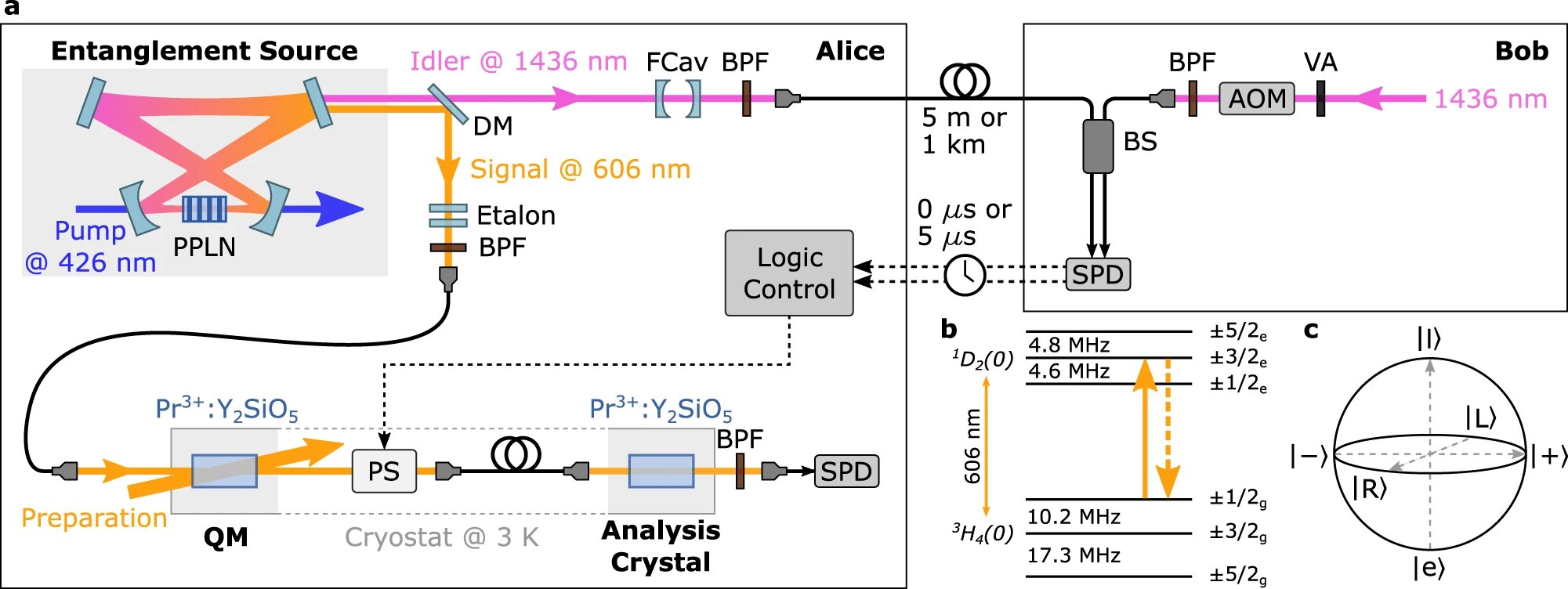
Researchers at ICFO have achieved long-distance quantum teleportation of information from a photon to a solid-state qubit using a multiplexed quantum memory and an active feed-forward scheme. The architecture is compatible with telecommunications channels, enabling future integration and scalability for long-distance quantum communication. The team plans to extend the setup to longer distances while maintaining efficiency and rates and to use the technique in the transfer of information between different types of quantum nodes for a future quantum internet.