
quantum-technology4.245 min read
"Revolutionizing Quantum Technologies with Plasmonics Breakthrough"
2 years ago•Source: SciTechDaily

The latest quantum technology stories, summarized by AI

In January 2024, the French quantum ecosystem experienced significant developments, with Alice & Bob's error-correction research hinting at practical quantum computing, Macron emphasizing quantum in France's economic blueprint at Davos, and calls for more EU funding for quantum technologies. Quantum Processing Units (QPUs) are advancing, posing potential threats to the global financial system, while collaborations and expansions in quantum AI and computing are underway. Additionally, research initiatives and educational events, such as the Lyon Winter School of Quantum Technologies, are contributing to the growth of quantum technology in France.
SciTechDaily•2 years ago
SciTechDaily•2 years ago
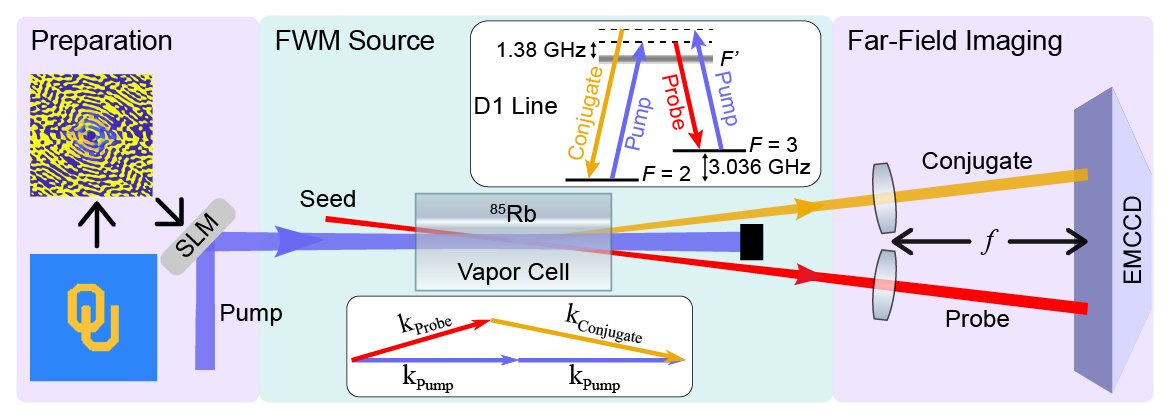
Researchers at the University of Oklahoma have demonstrated the principle of using spatial correlations in quantum entangled beams of light to encode information and enable its secure transmission. The researchers used two entangled beams of light to encode information in the spatial correlations between them, which can only be extracted through joint measurements of the two beams. This approach could enable the secure encoding and transmission of large amounts of information using the spatial properties of light.

Researchers at the University of Chicago have developed a new tool that can help reveal the origin of electronic states in engineered materials, paving the way for their use in future quantum technology applications. The tool uses a technique called layer-encoded frequency-domain photoemission to send two laser pulses into a layered material, allowing researchers to piece together a “movie” that shows how electrons move in each layer. The researchers applied the technique to a two-layered magnetic topological insulator and found that the special electronic state was not in the magnetic layer, which defies theoretical predictions. The technique could also be used to better understand other special materials, like topological superconductors and so-called twistronics.
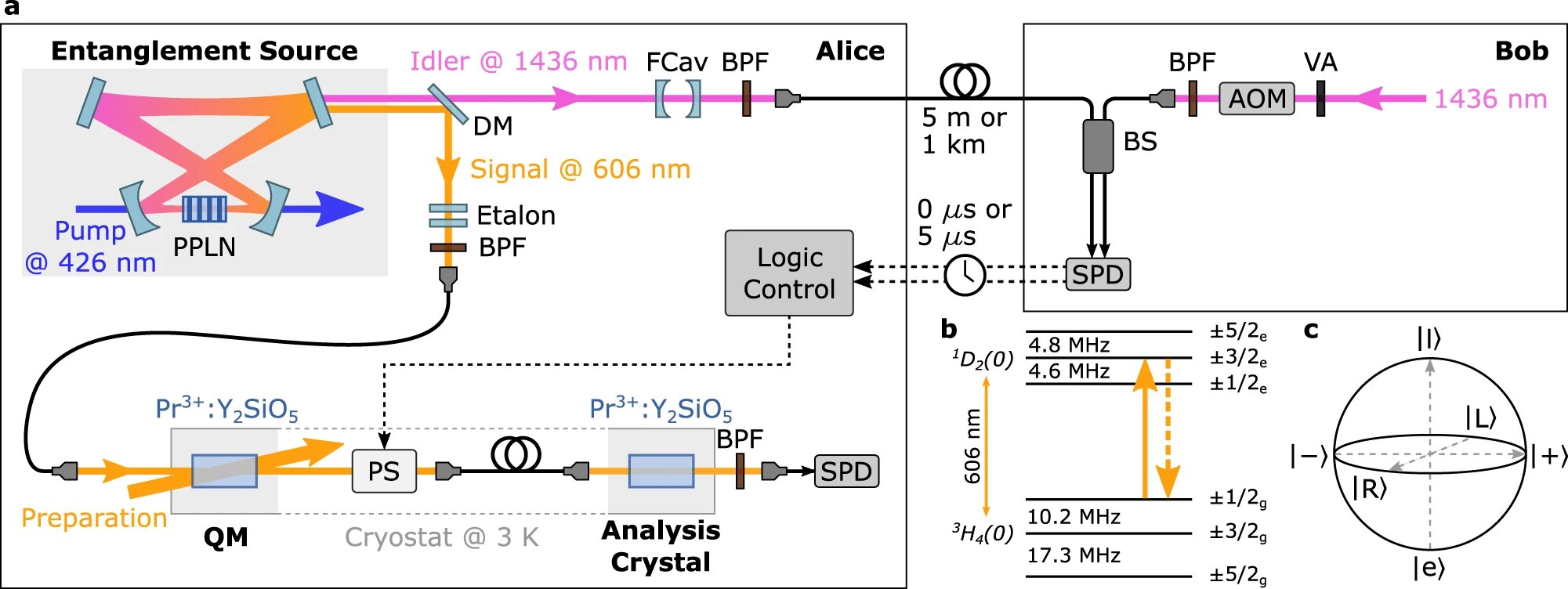
Researchers at ICFO have achieved long-distance quantum teleportation of information from a photon to a solid-state qubit using a multiplexed quantum memory and an active feed-forward scheme. The architecture is compatible with telecommunications channels, enabling future integration and scalability for long-distance quantum communication. The team plans to extend the setup to longer distances while maintaining efficiency and rates and to use the technique in the transfer of information between different types of quantum nodes for a future quantum internet.

Scientists at MIT, University of Texas, RIKEN center for Advanced Photonics, and the University of Oxford have discovered a way to improve the photostability of emitters in hexagonal boron nitride materials, which are crucial building materials for optical quantum technologies. The team found that photobleaching of hexagonal boron nitride vacancy emitters can facilitate photostability suited for quantum applications. They also identified a key to improve the photostability of emitters in hexagonal boron nitride materials that effectively shielded oxygen from the environment to optimize carbon substitution in the hexagonal boron nitride.
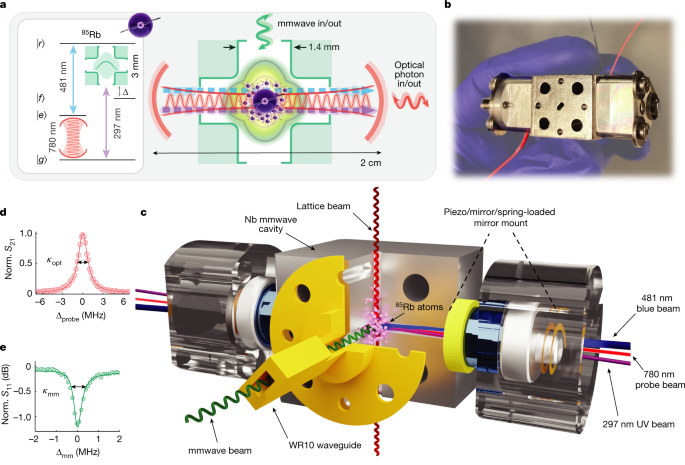
Researchers have demonstrated a quantum-enabled millimeter wave to optical transduction using neutral atoms, which could enable the creation of a quantum internet. The technique involves using a high-Q millimeter wave cavity to couple the millimeter wave and optical fields to a cloud of neutral atoms. The atoms then convert the millimeter wave to an optical signal, which can be transmitted over long distances using optical fibers. This approach could be used in hybrid quantum systems to enable quantum communication between different types of quantum devices.