A study by Robert G. Endres suggests that the spontaneous emergence of life on early Earth was extremely unlikely based on a new mathematical model, raising questions about whether natural processes alone can explain life's origin and considering alternative hypotheses like directed panspermia.

The article discusses the 'Carter catastrophe,' a mathematical equation based on the principles of cosmology and observer probability, which has been used to estimate the potential end of humanity. It highlights how this equation, applied to historical events like the fall of the Berlin Wall and Stonehenge, suggests that our species may have a limited future, potentially ending within the next 19,000 years, depending on various factors like birth rates and technological advances.
Physicists have developed a quantum version of Bayes' rule, derived from fundamental principles, which could impact quantum computing and information theory by updating beliefs in the quantum realm.
A new study using advanced mathematical methods suggests that the spontaneous emergence of life on early Earth was far more improbable than previously thought, highlighting significant barriers to life's natural origin and raising questions about whether alternative mechanisms like panspermia might be involved.
An international team has extended Bayes' rule into the quantum realm, deriving a quantum version from a fundamental principle and linking it to the Petz recovery map, with potential applications in quantum computing and information theory.
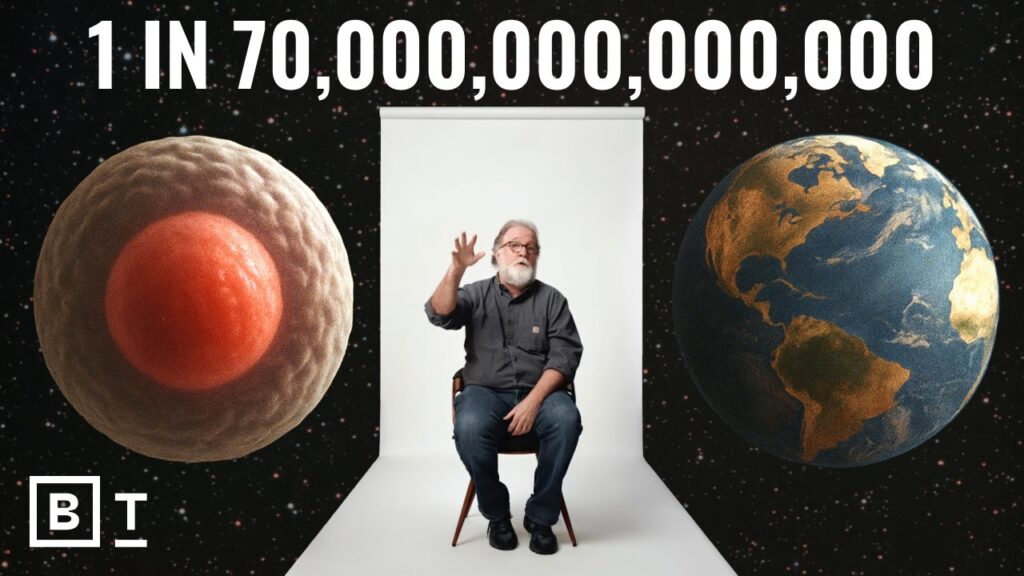
Evolutionary biologist Sean B. Carroll explains that the probability of individual human existence is about one in 70 trillion, emphasizing how contingent and unlikely our presence on Earth is, shaped by a series of improbable events across cosmic, geological, and biological scales.
A study published in Science Advances suggests that a baby's sex is influenced by family-specific factors, maternal age, and genetics, challenging the notion that it is purely random, with some families more likely to have children of the same sex than expected by chance.
The theory of a multiverse, which suggests that our universe is just one among many with different physical properties, has been challenged by experts in probability theory. They argue that the inference from fine-tuning to a multiverse is fallacious reasoning, akin to the inverse gambler's fallacy. While the scientific theory of inflation supports the idea of a multiverse, there is no evidence that different universes have different physical constants. The specific evidence for fine-tuning in our universe makes it highly unlikely that this specific universe, among millions, would be fine-tuned. The author proposes an alternative theory of cosmic purpose to explain the fine-tuning of the universe.
Researchers have conducted a study involving 350,757 coin tosses and found that coin tosses are not truly 50/50. The study reveals that the starting position of the coin introduces a slight bias, causing the coin to land on the same side it was tossed from around 50.8% of the time. The researchers suggest concealing the starting position of the coin when using coin flips for high-stakes decision-making.
QBism, short for Quantum Bayesianism, is a radical interpretation of quantum mechanics that challenges traditional views on probabilities and the nature of the quantum state. Unlike other interpretations, QBism sees the quantum state as a description of our knowledge about the world rather than an objective reality. By emphasizing the role of human observers and their interactions with particles, QBism offers a new perspective on the scientific enterprise and the relationship between humans and the quantum world. This series will explore QBism's research program and its implications for understanding quantum mechanics.
Kern County in California is expected to experience the effects of a storm named Hilary on Sunday, with a 55-60% chance of at least one inch of rain in the desert areas and a 25% chance in Bakersfield. If Bakersfield receives more than 1.18 inches of rain, it will break the record for the entire month. The probability of an inch of rain decreases to around 30% for Monday due to the movement of moisture into other regions.
Researchers have developed a model, called "dynamic prospect theory," that integrates prospect theory and reinforcement learning theory to more accurately describe human and monkey decision-making under uncertainty. The study found that after experiencing an outcome larger than the expected value of the chosen option, participants and monkeys behaved as though the probability of winning in the next lottery increased. This change in behavior appears to be driven by a change in the perception of probabilities, not by a change in the valuation of rewards. The model provides a unified theoretical framework for exploring a neurobiological model of economic choice in human and nonhuman primates.
QBism, an approach developed by Christopher Fuchs and Rüdiger Schack, suggests that quantum mechanics is not a description of reality as it is independently of us, but a tool that helps guide agents in creating reality. QBism's starting point is the personalist Bayesian approach to probability, where probabilities are an agent's personal degrees of belief. QBism's vision is that of an unfinished universe, of a world that allows for genuine freedom, a world in which agents matter and participate in the making of reality.
Lewis Carroll, the author of Alice's Adventures in Wonderland, was also a mathematician who created a book of mathematical puzzles called "Pillow Problems." One of his famous puzzles is the "Pillow Problem" which asks what are the chances that the other marble in an opaque bag containing one marble that has a 50/50 chance of being black or white, but you don’t know which color it is, is also white if you take a white marble from your pocket and add it to the bag, shake up the two marbles in the bag, reach in, and pull a random one out, which happens to be white. The solution will be posted next Monday along with a new puzzle.
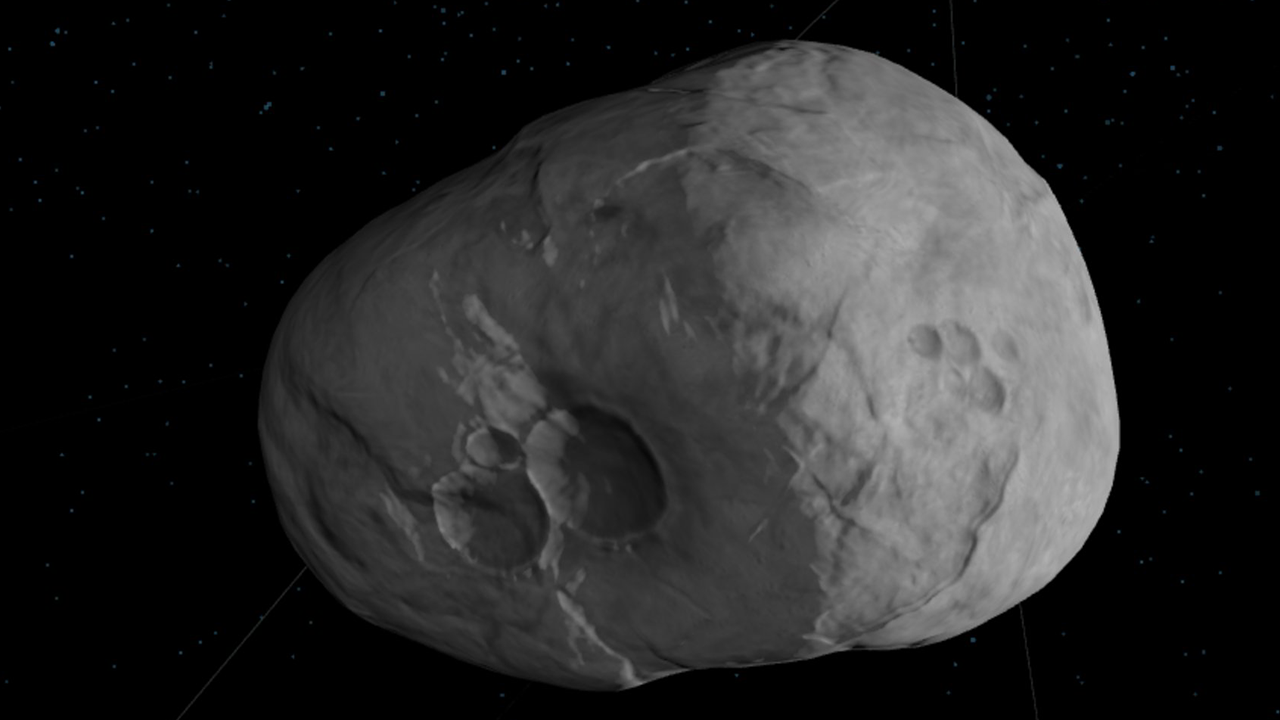
The European Space Agency has said that the probability of the newly-discovered asteroid, 2023 DW, hitting Earth in 2046 has dropped to one in 1,584, down from one in 847. NASA also lowered its odds, reducing the likelihood to one in 770 on Tuesday. The asteroid is estimated to be about the size of a 50-meter Olympic swimming pool. If it does hit Earth, there is a 70% chance it will land in the Pacific Ocean, but it could also hit the U.S., Australia or South-East Asia. However, experts say Earth could defend itself if an asteroid does come charging toward the planet.