12th-grade student scores in math and reading have hit new lows on national tests, with declines predating the pandemic and continuing, highlighting ongoing challenges in American education.
The article summarizes a series on the math behind everyday phenomena and offers a quiz to test knowledge on topics like taxicab geometry, the golden ratio, and sphere packing, encouraging readers to assess what they've learned.
Many animal species, including birds, insects, mammals, and reptiles, can discriminate quantities and perform basic numerical tasks, often using an innate approximate number system (ANS). While some animals like parrots and chimpanzees can approach true counting, most are limited to quick comparisons and simple estimations rather than complex arithmetic. The ability to do actual math, involving symbols and operations like addition and subtraction, appears to be rare and mostly observed in trained animals.
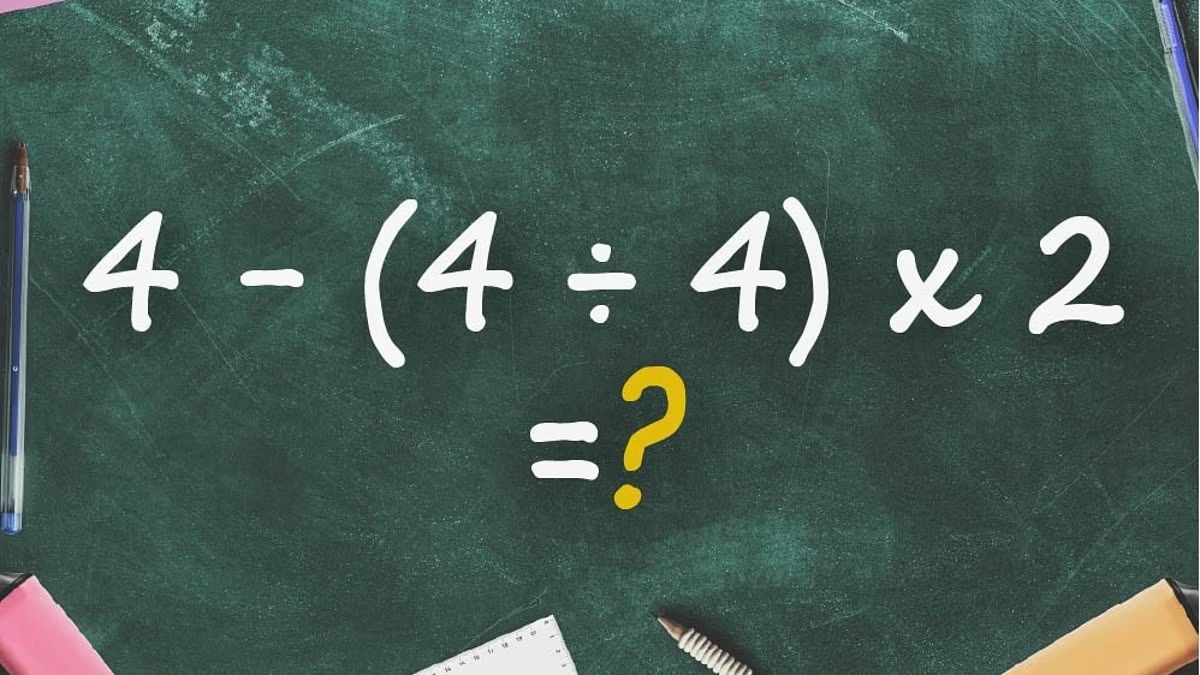
A simple grade school math problem involving the order of operations has caused confusion on social media, with most correctly solving it as 2 by following PEMDAS, while some incorrectly arrived at -2 by ignoring the proper sequence. Another similar math riddle about 500 + 450 ÷ 5 also sparked debate, with most answering 590 by correctly applying division before addition.
The debate over offering algebra to middle school students has become a national flashpoint, with concerns about equity and academic opportunity at the forefront. While top students can benefit from early exposure to the subject, many districts offer few opportunities for Black and Latino eighth graders to study it. The struggle to make algebra more equitable has sparked contentious debates over whether bias and inequality are keeping certain children off the fast track, leading to questions about eliminating algebra in middle schools to level the playing field. However, algebra serves as a crucial crossroads in the education system, with early exposure potentially leading to academic advantages and access to high-status professions, highlighting the need to address racial and economic gaps in math achievement.
A new study from VMware's Natural Language Processing Lab found that chatbots perform better on math questions when prompted with positive thinking, such as framing questions with encouragement or Star Trek references. The study tested various prompts and found that starting responses with "Captain's Log, Stardate [insert date here]:" yielded the most accurate answers for one of the AI models. This surprising result highlights the mysterious nature of AI language models and the limited understanding of how they work, despite being extensively studied and developed.
A new study from VMware's Natural Language Processing Lab found that chatbots perform better on math questions when prompted to pretend they're on Star Trek, with phrases like "Captain's Log, Stardate [insert date here]:" yielding the most accurate answers. The study also revealed that positive thinking or threats can lead to better responses from AI language models, suggesting that the language used to train these models may have included instances where human beings provided more accurate answers when pressured or encouraged. This highlights the mysterious nature of AI language models, as even their creators and researchers struggle to fully understand their inner workings.
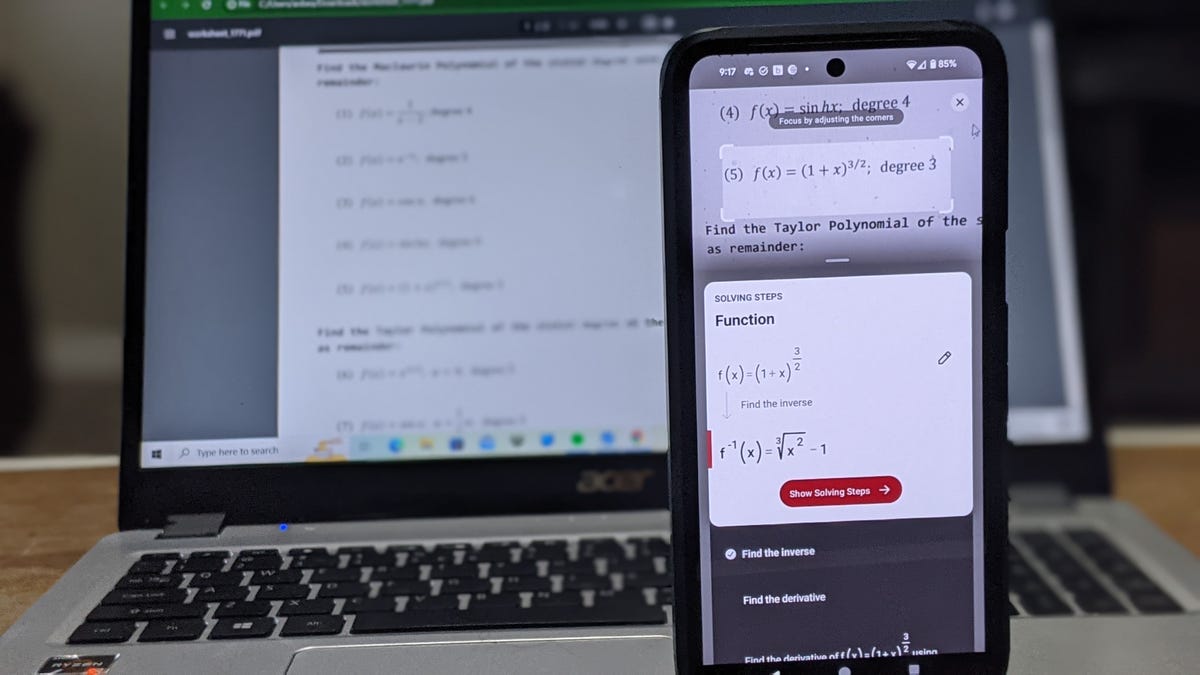
Google has integrated the AI-powered math problem-solving app Photomath into its app ecosystem, allowing users to solve a wide range of math problems with step-by-step explanations. The app, which can recognize both printed and handwritten problems, has gained popularity for its accuracy and speed. While it can be used by students to quickly complete homework, it also serves as a tool for parents to check their children's work, for students to practice before tests, or as a 24/7 tutor. With the increasing presence of AI in education, Google's move to acquire and integrate Photomath demonstrates its commitment to staying ahead in the field.
A study found that prompting an AI chatbot to speak as if it were on Star Trek significantly improved its ability to solve grade-school-level math problems, demonstrating the influence of positive thinking on AI performance. The study, conducted by software firm VMware, revealed that machine learning models are better at writing prompts for themselves than humans are. While the AI's proficiency in mathematical reasoning was enhanced by expressing an affinity for Star Trek, it doesn't mean one should ask AI to talk like a Starfleet commander. The research highlights the complex and somewhat mysterious processes of AI models, emphasizing the need for further understanding and optimization in utilizing chatbot models.
Quanta Magazine has relaunched its Hyperjumps math game, set in the year 2718, where players use arithmetic to navigate a warp-drive-equipped starship to distant solar systems. The game, designed by Pradeep Mutalik, has been simplified based on player feedback, allowing players to create sequences with as few as three exoplanet numbers using addition, subtraction, multiplication, and division. Players can accumulate points, level up, and save their game progress and historical stats by logging into Quanta’s website. The game is part of Quanta’s puzzle offerings, which have been a long-standing feature of the magazine, and comes as the Insights puzzle series is being phased out after seven years.
New York City officials have introduced the Illustrative Math curriculum in an effort to improve and standardize the way algebra is taught in the city's high schools. The curriculum emphasizes conceptual understanding over rote practice and memorization, but it has divided educators. Some argue that it engages students and promotes deep learning, while others believe it lacks structure and fails to support struggling students. The curriculum is being piloted in over 260 schools this year, with plans to expand next year. The success of the curriculum in improving math achievement and performance on Regents exams remains to be seen.
Approximately half of New York City students demonstrated proficiency in math and reading exams this year, indicating a rise compared to last year. However, the results cannot be directly compared due to the overhaul of the exams. Experts suggest that a clearer understanding of student progress and achievement gaps will only be possible when students take a federal exam next year. Despite improvements, significant disparities remain between white and Asian students and their Black and Latino peers. The changes in the exams have made it challenging to assess academic recovery and educational progress in the city.
The New York Times crossword puzzle for September 14, 2023, created by Vasu Seralathan, features a theme centered around the letter X. The X is used as a symbol for various things, including a kiss, multiplication, a strike in bowling, a cross, and the Roman numeral for 10. The puzzle requires solvers to read the Down entries differently when they intersect with an X symbol in the Across entries. The constructor also notes that solvers can draw an X on the grid by connecting the five X's. Tricky clues and additional non-theme material add to the challenge of the puzzle.
This article discusses the mathematical calculations behind the perceived safety of certain assets in the financial markets. It highlights the importance of understanding the underlying risks and uncertainties associated with supposedly safe investments, emphasizing that even the most secure assets can carry hidden dangers.
ChatGPT, an artificial intelligence language model, is reportedly experiencing a decline in its ability to perform basic math calculations accurately, raising concerns about its overall reliability and effectiveness in providing accurate information.