Tag

Planetary Orbits

All articles tagged with #planetary orbits

science1 year ago

Did an Unknown Visitor Reshape Our Solar System?

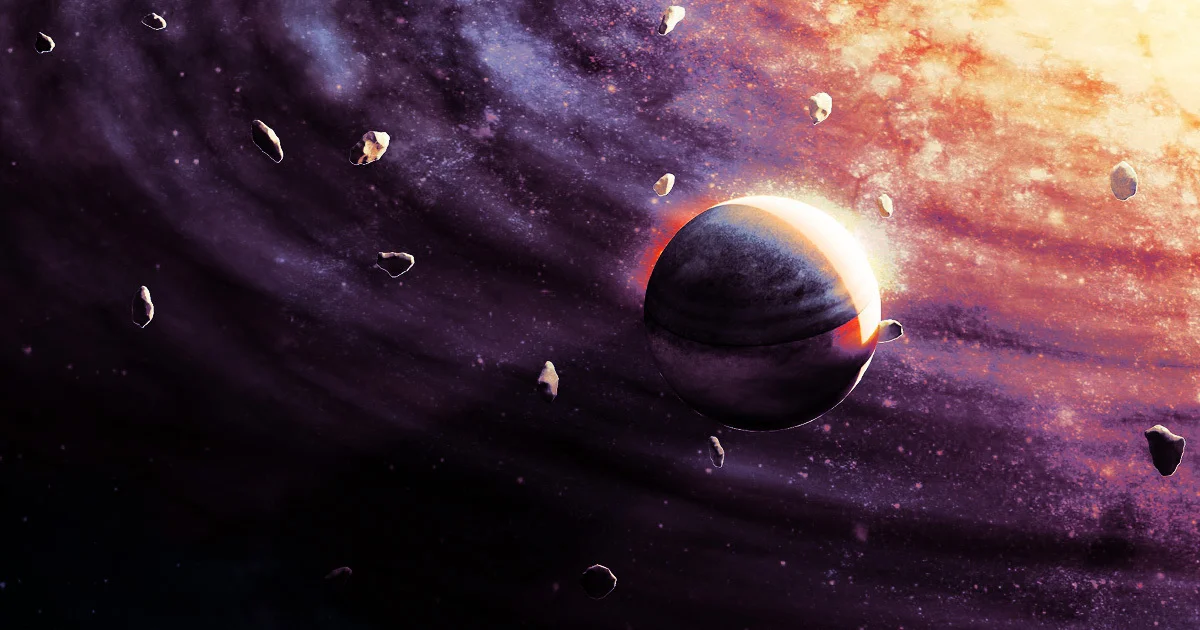
A new study suggests that an enormous interstellar object, possibly up to fifty times the mass of Jupiter, may have passed through the solar system in the distant past, altering the orbits of the planets. This theory challenges the traditional view that gravitational interactions among planets and the protoplanetary disk solely account for the current configuration of the solar system. The researchers' simulations indicate a 1 in 100 chance of such an event occurring, offering a potential explanation for the eccentricities observed in the orbits of gas giants like Jupiter and Saturn.

science1 year ago

Did a Rogue Planet Shape Our Solar System's Orbits?

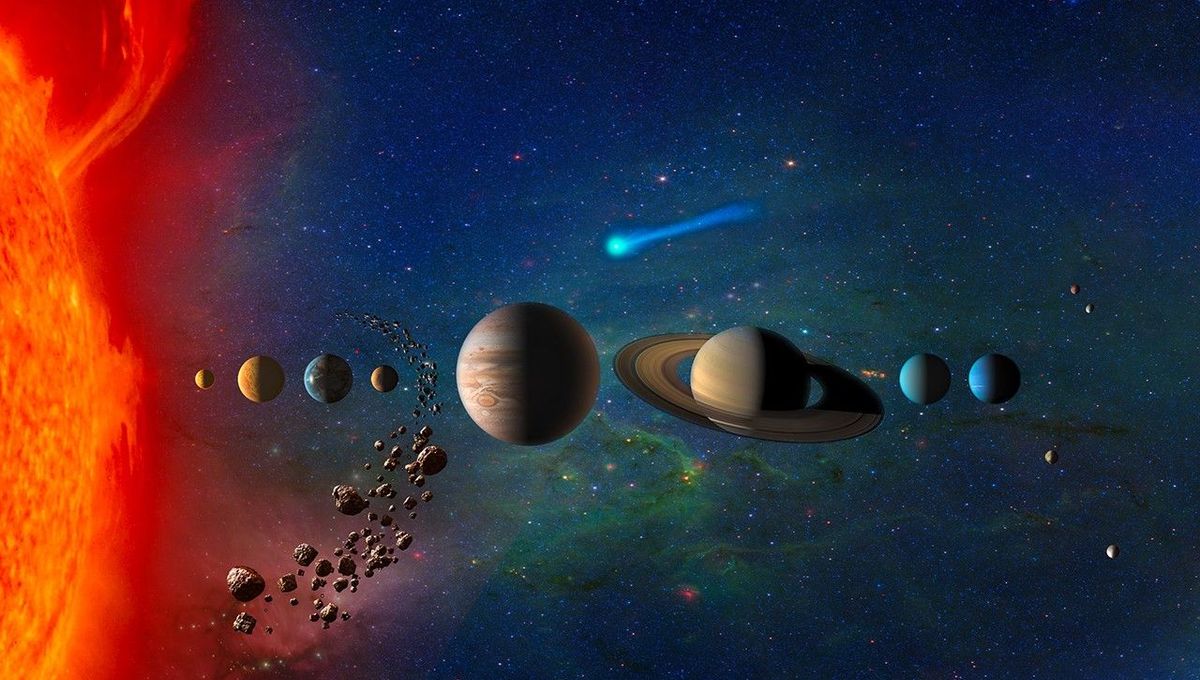
A new theory suggests that a massive interstellar object, potentially 2-50 times the mass of Jupiter, may have passed through our Solar System, influencing the current arrangement of planetary orbits. This hypothesis, proposed by scientists led by Garett Brown from the University of Toronto, offers a plausible explanation for the eccentricities observed in the orbits of gas giants, challenging existing theories of planetary migration and interactions. The study indicates a 1 in 100 chance that such an interstellar visitor could have shaped the orbits we see today.

science1 year ago

Why Are Planets Drifting Away from the Sun's Gravity?

Despite the Sun's strong gravitational pull, planets in the Solar System are gradually moving away from it due to the Sun losing mass through nuclear fusion and solar wind, which reduces its gravitational attraction. This mass loss causes the planets' orbits to expand slightly over time. However, in the distant future, the Sun will become a red giant, potentially engulfing the inner planets, including Earth.

science1 year ago

"Unraveling the Mystery: How Passing Stars Altered Earth's Orbit"

A new study published in The Astrophysical Journal Letters suggests that a chance encounter with a passing star 56 million years ago may have caused the Earth's orbit to change, leading to a significant rise in temperature during the Paleocene-Eocene Thermal Maximum. The study's authors, planetary scientist Nathan Kaib and astrophysicist Sean Raymond, propose that passing stars can make detailed predictions of Earth's past orbital evolution highly uncertain, potentially impacting the planet's climate. While rare, such encounters can have significant effects on planetary orbits and climate.

astronomy1 year ago

"Newly Discovered Planetary Dance Around Young Star Reveals Celestial Harmony"

Orbital resonance, a gravitational phenomenon where planets align and exert a gravitational push and pull on each other during their orbits, has been observed in various planetary systems, including our own solar system and exoplanetary systems. This phenomenon, reminiscent of the harmony of the spheres proposed by Pythagoras and Johannes Kepler, occurs when planets or moons have orbital periods that are ratios of whole numbers. While resonant chains are rare and only seen in 1% of planetary systems, they offer insights into the formation and stability of planetary systems. Astronomers have even used sonification to translate the mathematical relationships of planetary orbits into sound, creating "music of the spheres" for various planetary systems.

astronomy2 years ago

"Dawn of Time: Tiny Black Holes Impacting Earth's Orbit, Study Finds"

A new study suggests that ancient black holes, known as primordial black holes (PBHs), may be altering the orbits of planets in our solar system. These PBHs, which could be made primarily of dark matter, are theorized to have masses between that of asteroids and the size of an average bacterium. While their encounters with Earth wouldn't be catastrophic, they could cause subtle changes in planetary orbits. Detecting these changes, however, presents a significant challenge due to the precision required in measurements and the potential for instrument error.

science2 years ago

Impending Catastrophe: The Threat of a Rogue Star to Our Solar System

Scientists warn that a close encounter with a rogue star could pose a significant threat to Earth and the solar system. Research explores the potential consequences of a hypothetical visit from an interstellar star that has escaped its original galaxy. Computer models suggest that while there is a 92% chance that the known planets in our solar system would remain in their current orbits or similar ones, the encounter could cause irreversible disruption, including changes to planetary orbits and potential collisions. The likelihood of such an event is low, but its impact would fundamentally reshape the orbital arrangement of our planetary neighborhood.

astronomy2 years ago

Impending Catastrophe: The Devastating Consequences of a Rogue Star's Proximity to Earth

A new study explores the potential consequences of a rogue star coming within 100 astronomical units (AU) of our Sun. While the chances of such an event are low, simulations show that there is a high probability that all eight planets in our Solar System would survive, with over 95% chance of no planet being lost. However, the simulations also reveal a range of outcomes, including potential collisions between planets or with the Sun, ejections of certain planets, and disruptions to planetary orbits. The study highlights that Earth's long-term habitability could be affected if its orbit is changed, potentially leading to a warmer or cooler climate. Overall, the study suggests that while the odds of a 100 AU stellar flyby are extremely small, the current stability of our Solar System is likely to remain unchanged.

astronomy2 years ago

Earth's Fate Hangs in the Balance as a Rogue Star Approaches.

A new study explores the potential consequences if a rogue star were to come within 100 astronomical units (AU) of our Sun. While the chances of such an event are low, simulations show that there is a greater than 95% chance that all eight planets in our Solar System would survive. However, their orbits would be significantly disrupted, with potential outcomes ranging from collisions between planets to ejections into the Oort Cloud. The study also considers the possibility of Earth being captured by the passing star or ending up in the Oort Cloud, but emphasizes that the odds of these scenarios are extremely small. Overall, the research suggests that despite the diversity of potential outcomes, the current stability of our Solar System is likely to remain unchanged.

astronomy2 years ago

"Unprecedented Discovery: Two Planets Coexisting in Perfect Orbital Harmony"

While the International Astronomical Union's definition of a planet rules out two planets sharing the same orbit, it is possible for two Earth-like planets to coexist in a stable orbit around their star. The concept of co-orbiting planets challenges the traditional definition of a planet, but simulations and observations suggest that it is feasible. Various mechanisms, such as Lagrange points and orbit swapping, can allow for quasi-stable configurations that can last billions of years. Although no binary planet candidates have been discovered yet, with improved technology and more data, it is expected that examples of co-orbiting planets will be found in the future.

science2 years ago

Predicting Solar System Instability with New Math

Mathematicians have proved for the first time that instability inevitably arises in a model of planets orbiting a sun. The new papers tackle a true n-body problem — showing that instability arises in a planetary system where three small bodies revolve around a much larger sun. Even though the size and shape of the orbits might spend a long time oscillating around fixed values, they will eventually change dramatically.

astronomy2 years ago

Unconventional Exoplanet Defies Orbital Norms

The planetary system WASP-131 has a gas planet, 131b, with an unusual orbit that is tilted about 160 degrees from the rotational plane of the star, making it a high, almost polar retrograde orbit. The mechanism behind the odd orbit isn't clear, but it follows a pattern seen with many hot gas exoplanets. About a quarter of them have significantly tilted orbits. One possibility is the Kozai effect, while another is a magnetic interaction between the planet and the protoplanetary disk early in its formation period.