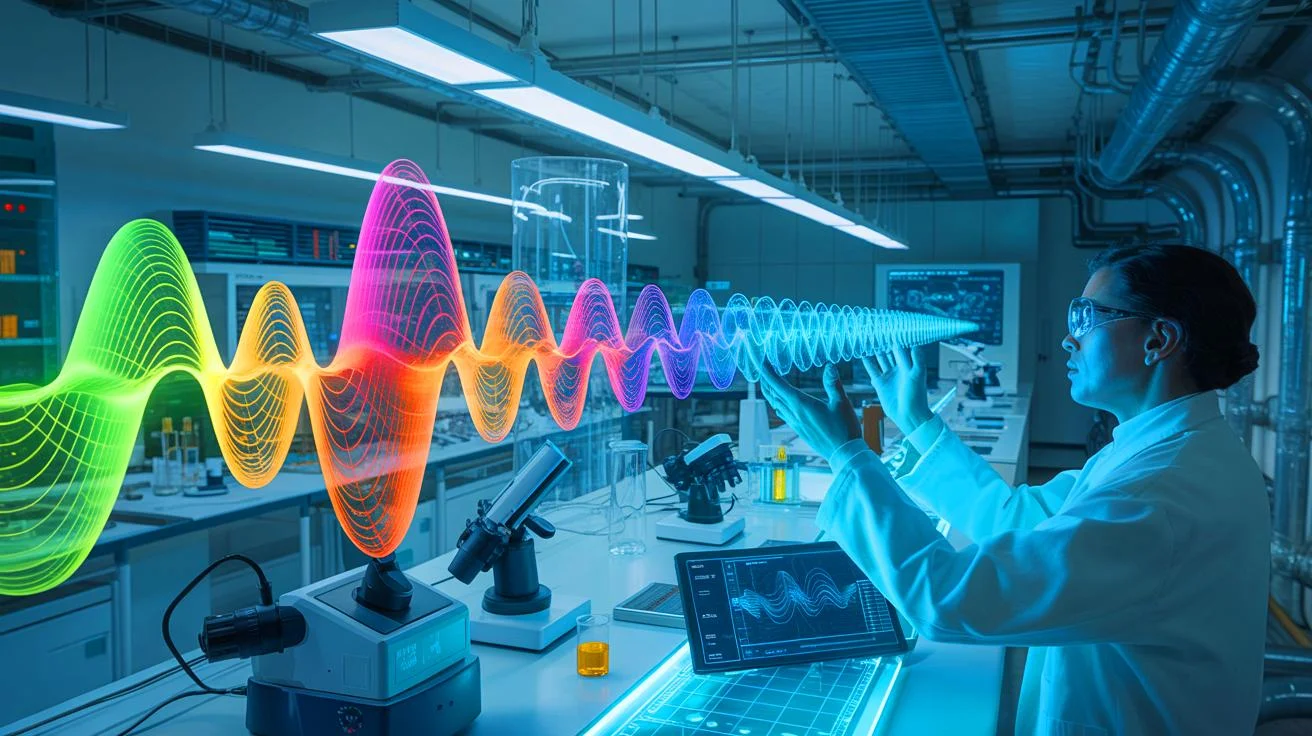
Researchers at CUNY have experimentally confirmed the existence of time reflections, a phenomenon where waves reverse their progression through time, potentially revolutionizing communications, radar, and quantum physics by challenging traditional understandings of wave behavior and symmetry in physics.
Researchers at the City University of New York have achieved a breakthrough in creating light-based time reflections using a metamaterial with adjustable optical properties. By dynamically adding or removing material along a waveguide, they were able to alter the waveguide's effective properties and manipulate light's temporal components. This breakthrough has revealed counterintuitive effects, such as the beginning of the original signal appearing at the end of the reflected signal and changes in light's frequencies. The researchers also observed that colliding beams of light can behave like colliding billiard balls when a time reflection occurs. These findings hold promise for advancements in signal processing, communications, and energy conversion applications.
Physicists have demonstrated time reflections of electromagnetic waves for the first time by switching the dielectric constant of a metamaterial, allowing for greater control over the interaction between waves and matter. This breakthrough could have promising applications in photonics, potentially leading to faster computers, cell phones, and wireless communication. Time reflections involve a reversal in the order and frequency lengthening of the wave, with the end of the signal being reflected first. The challenge lies in changing the properties of the medium quickly and uniformly enough to time reflect electromagnetic signals, but the use of metamaterials has overcome this obstacle.
Scientists are exploring the idea of retrocausality, where actions in the future could influence the past, to better understand quantum physics. This phenomenon challenges classical physics ideals like locality and realism, but could help explain quantum entanglement and time reflections. Kenneth Wharton and other scientists believe that retrocausality could hold the key to understanding the quantum realm in a time-symmetric way.
Scientists from the Advanced Science Research Center at the CUNY Graduate Center in New York City have successfully observed time reflections, a special kind of reflection that occurs when an entire medium in which an electromagnetic wave travels completely changes course. The researchers sent broadband signals through a strip of metal filled with electronic switches, all connected to reservoir capacitors, triggering the switches whenever they wanted, increasing the impedance throughout the metal strip. The discovery could completely change how some scientists approach this intriguing mechanic in the future and is a huge step forward in the field of quantum mechanics.
Scientists have observed "time reflections" in electromagnetic waves, a phenomenon that was previously only hypothesized to exist. By using a special kind of material, researchers saw signals reverse in time by quickly triggering a change in the physical properties. The discovery could lead to practical applications, including wireless communications and new small, low-energy computers.