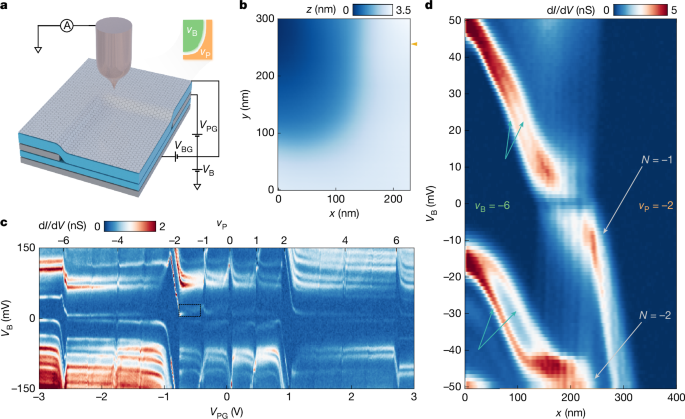
The article discusses the visualization and analysis of interaction-driven restructuring of quantum Hall edge states in graphene using advanced scanning tunneling microscopy techniques, providing insights into the topological and electronic properties of these states.
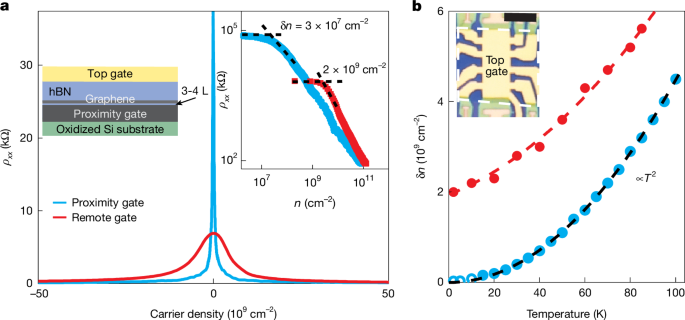
Proximity screening using atomically thin hBN and graphite gates significantly enhances the electronic quality of graphene, achieving record-high quantum mobilities (~10^7 cm^2/Vs), exceptional charge homogeneity, and enabling the observation of Landau quantization and quantum Hall effects at millitesla magnetic fields, although it suppresses some many-body phenomena.
Researchers have observed electrons forming quasiparticles with fractional charges without the influence of a magnetic field, a phenomenon previously unseen. This discovery, made in 2D materials like twisted graphene and molybdenum ditelluride, challenges existing theories and could have significant implications for quantum computing. The exact mechanisms behind this effect remain unclear, prompting further investigation into the role of moiré patterns and potential new quantum phases of matter.
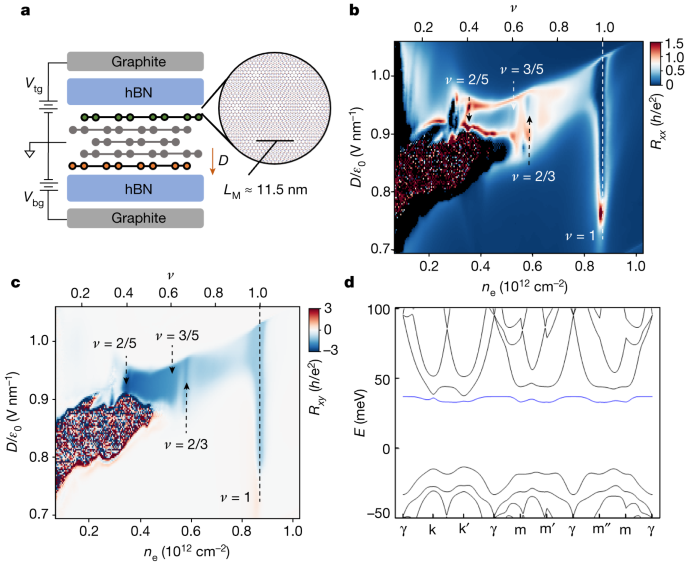
Researchers have observed the fractional quantum anomalous Hall effect in multilayer graphene, a significant finding in the field of physics. This effect, which was previously observed in topological insulators, is now seen in multilayer graphene, opening up new possibilities for studying exotic quantum phenomena in this material. The discovery adds to the growing body of research on quantum Hall states and topological insulators in various materials, providing insights into the fundamental properties of quantum matter.
An international team led by Markus Greiner at Harvard has realized a Laughlin state using ultracold neutral atoms manipulated by lasers. The experiment involves trapping a few atoms in an optical box and implementing the ingredients required for the creation of this exotic state: a strong synthetic magnetic field and strong repulsive interactions among the atoms. The researchers imaged the atoms one by one through a powerful quantum-gas microscope and demonstrated the peculiar "dance" of the particles, which orbit around each other, as well as the fractional nature of the realized atomic Laughlin state. This milestone opens the door to a wide new field of exploration of Laughlin states and their cousins in quantum simulators.