Tag

Electrons

All articles tagged with #electrons

Innovative Qubit Technology Uses Liquid Helium to Trap Electrons

Originally Published 3 months ago — by Ars Technica

Featured image for Innovative Qubit Technology Uses Liquid Helium to Trap Electrons
Source: Ars Technica

A new qubit technology involves trapping lone electrons on the surface of liquid helium, leveraging old physics and the superfluid properties of helium to potentially scale quantum computers more efficiently. The system uses low temperatures and unique trapping methods to control electrons, offering a promising alternative in quantum tech development.

Quantum Forces: Why Matter Feels Solid

Originally Published 1 year ago — by Big Think

Featured image for Quantum Forces: Why Matter Feels Solid
Source: Big Think

The solidity of matter, despite atoms being mostly empty space, is explained by quantum mechanics, particularly the Pauli Exclusion Principle. This principle states that no two fermions, such as electrons, can occupy the same quantum state simultaneously, preventing atoms from passing through each other and giving rise to the impenetrability of solid objects. This quantum mechanical rule, combined with quantum uncertainty and electrostatic repulsion, ensures that matter remains stable and occupies space, making everyday experiences like sitting in a chair possible.

Unveiling the Secrets of X-ray Emission Mechanisms

Originally Published 1 year ago — by Phys.org

Featured image for Unveiling the Secrets of X-ray Emission Mechanisms
Source: Phys.org

Penn State researchers have used mathematical modeling to explain why electrons in lab experiments can exceed the energy expected from the applied voltage, a phenomenon observed since the 1960s. Their study reveals that an energy feedback process involving X-ray emissions and photon interactions is responsible. The research also shows that electrode shape and material affect this process, with flat electrodes maximizing the effect. These findings could lead to advancements in X-ray production, making machines faster and more compact.

"Chiral Electron Paths: A Twist in Physics Revolutionizing Technology"

Originally Published 1 year ago — by physicsworld.com

Featured image for "Chiral Electron Paths: A Twist in Physics Revolutionizing Technology"
Source: physicsworld.com

Researchers in Germany have successfully sent single electrons along structured chiral paths, achieving chirality in electron matter waves without angular momentum. This work, which parallels earlier research with photons, could have significant applications in electron microscopy and the study of magnetic materials. However, some scientists are skeptical about the claim of chirality without angular momentum and the lack of citation of previous related work.

"Physicists Investigate Mysterious Electron Clusters"

Originally Published 1 year ago — by Quanta Magazine

Featured image for "Physicists Investigate Mysterious Electron Clusters"
Source: Quanta Magazine

Researchers have observed electrons forming quasiparticles with fractional charges without the influence of a magnetic field, a phenomenon previously unseen. This discovery, made in 2D materials like twisted graphene and molybdenum ditelluride, challenges existing theories and could have significant implications for quantum computing. The exact mechanisms behind this effect remain unclear, prompting further investigation into the role of moiré patterns and potential new quantum phases of matter.

"The Singular Electron: A Strange Theory of Universal Uniqueness"

Originally Published 1 year ago — by IFLScience

Featured image for "The Singular Electron: A Strange Theory of Universal Uniqueness"
Source: IFLScience

Theoretical physicist John Wheeler proposed a theory that there is only one electron in the universe, moving forward and backward in time, which could explain why electrons and positrons share properties. However, this idea is highly unlikely to be correct, as it does not account for the unequal numbers of electrons and positrons in the universe, and the prevalence of matter over antimatter. Despite its unlikelihood, Wheeler's theory had a lasting impact on physicist Richard Feynman, who explored the concept of positrons as electrons moving backward in time in a subsequent paper.

"Unveiling the Enigmatic Wigner Crystal: A Breakthrough in Quantum Physics"

Originally Published 1 year ago — by ScienceAlert

Featured image for "Unveiling the Enigmatic Wigner Crystal: A Breakthrough in Quantum Physics"
Source: ScienceAlert

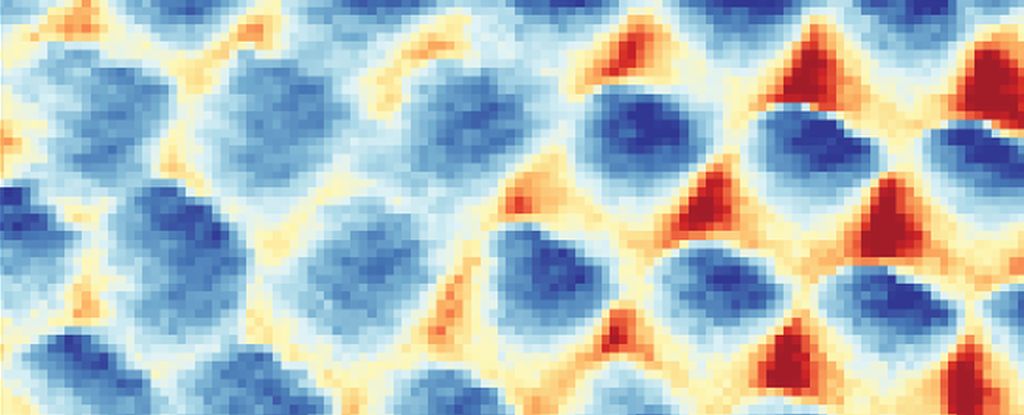
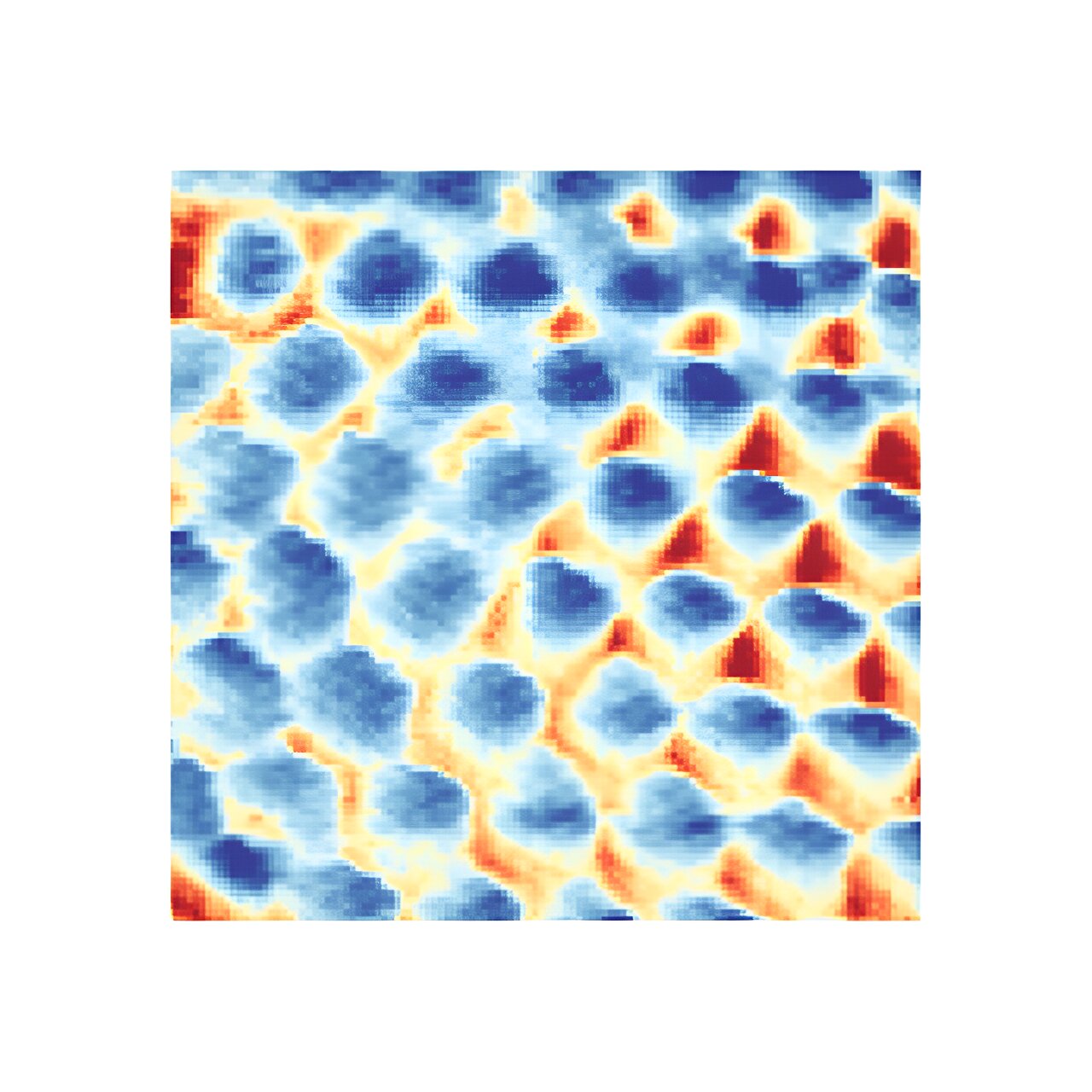
Physicists have finally captured direct observational evidence of the Wigner crystal, a peculiar kind of matter proposed by Eugene Wigner 90 years ago, in which free electrons are forced together in a crystalline lattice due to their mutual repulsion. Using high-resolution scanning tunneling microscopy, a team of physicists from Princeton University observed the Wigner crystal in pristine graphene at extremely low temperatures and low densities, confirming its properties and revealing its novel quantum nature, including strong zero-point motion. This groundbreaking discovery provides the first direct images of the Wigner crystal and contradicts previous theories about its stability and density range.

"Unveiling the Enigmatic Wigner Crystal: Electron Visualization Breakthrough"

Originally Published 1 year ago — by Phys.org

Featured image for "Unveiling the Enigmatic Wigner Crystal: Electron Visualization Breakthrough"
Source: Phys.org

Physicists at Princeton University have successfully visualized the Wigner crystal, a crystal made entirely of electrons, for the first time using a scanning tunneling microscope. This breakthrough confirms a 90-year-old theory proposed by Eugene Wigner and could lead to the discovery of new quantum phases of matter. The researchers used pristine graphene and low temperatures to directly image the crystal, observing its triangular configuration and its ability to transition into an electron liquid phase. They also discovered the quantum nature of the crystal, including the "zero-point" motion of electrons, and are now investigating how the crystal melts and transitions into other exotic liquid phases.

"Discovery: Electrons Found Moving at Light Speed in 4 Dimensions"

Originally Published 1 year ago — by ScienceAlert

Featured image for "Discovery: Electrons Found Moving at Light Speed in 4 Dimensions"
Source: ScienceAlert

Physicists have isolated the behavior of Dirac electrons in a superconducting polymer, allowing them to oscillate at the speed of light and exist under conditions that make them massless. This discovery will aid in understanding topological materials and their potential applications in quantum computers. By leveraging electron spin resonance, the researchers were able to directly observe the behavior of Dirac electrons in the material, distinguishing them from standard electrons. The team found that the motion of Dirac electrons is dependent on temperature and magnetic field angle within the material, providing new insights into their behavior and potential for future technology.

"Unusual Electron Behavior in Metallic Kagome Ferromagnets"

Originally Published 1 year ago — by Nature.com

Featured image for "Unusual Electron Behavior in Metallic Kagome Ferromagnets"
Source: Nature.com

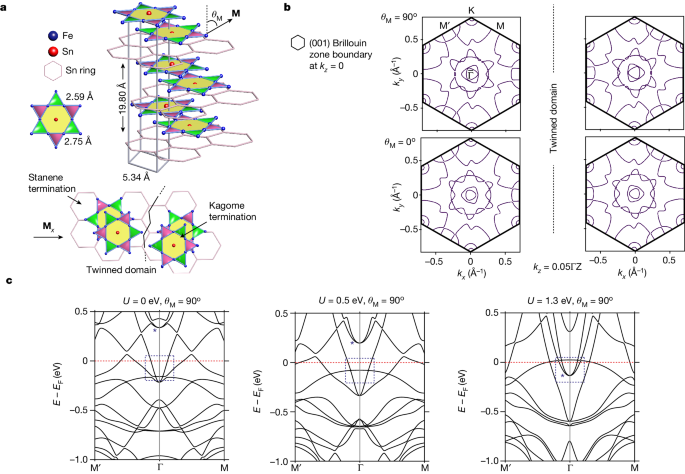
Researchers have conducted a detailed experimental study of the distinct electron pockets in the metallic kagome ferromagnet Fe3Sn2 using state-of-the-art laser-based micro-focused ARPES, overcoming averaging over crystallographic twins and surface sensitivity. The study revealed two distinct yet equivalent areas rotated from each other by 180°, indicating twinned domains, and provided insights into the electronic band structure and quasiparticle behavior at low temperatures. The findings suggest a many-body origin for the observed electron pockets and highlight the potential for exploiting electron-correlation effects for both measurement of the effective Coulomb interaction and the discovery of new electronic phenomena in materials with strongly influenced band structures.

"Capturing Electrons in Action: Groundbreaking Real-Time Study of Liquid Water"

Originally Published 1 year ago — by Phys.org

Featured image for "Capturing Electrons in Action: Groundbreaking Real-Time Study of Liquid Water"
Source: Phys.org

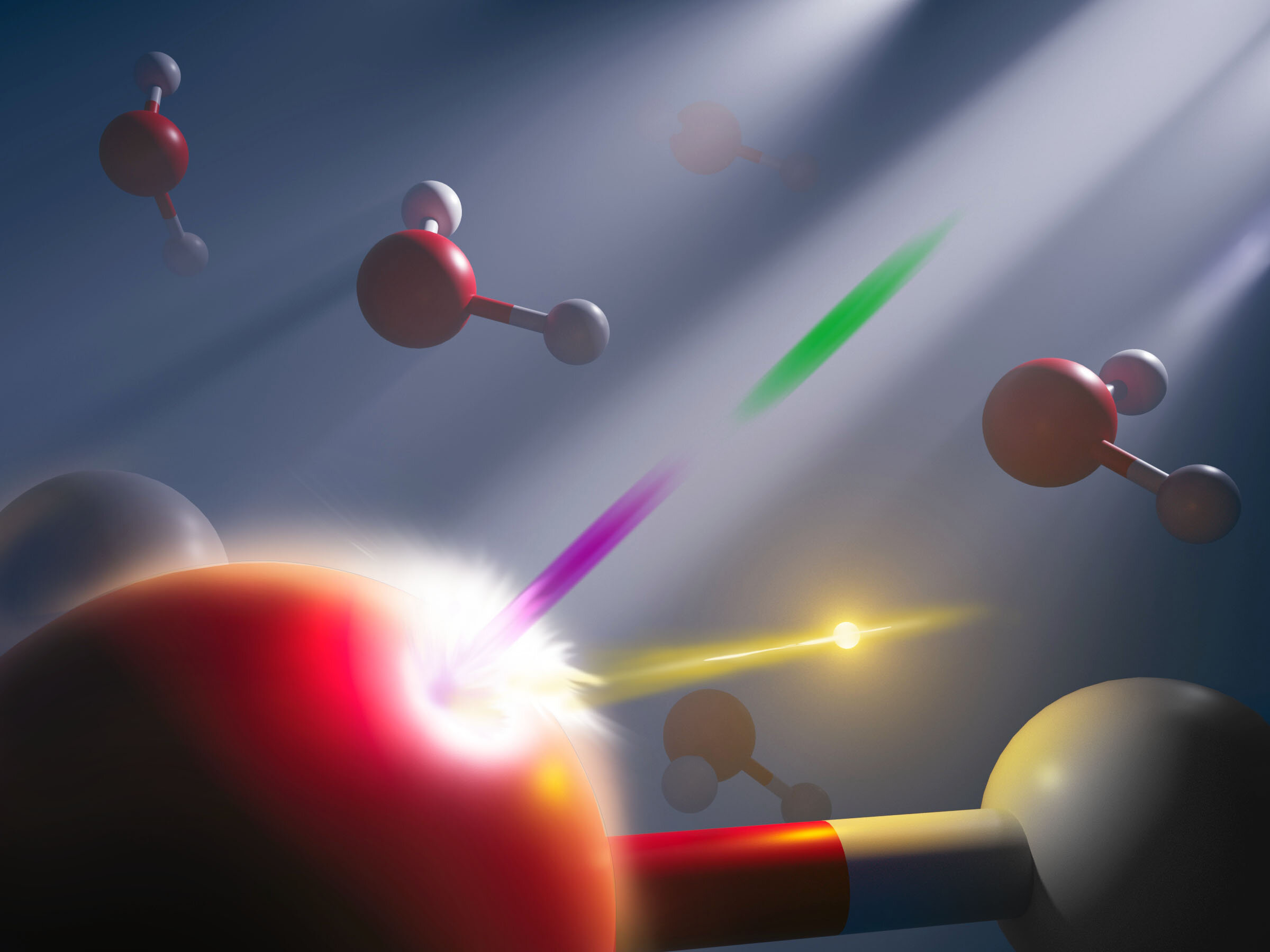
Scientists have successfully captured the movement of electrons in real-time in liquid water using attosecond X-ray pulses, providing new insights into the electronic structure of molecules in the liquid phase and the immediate electronic response to X-ray exposure. This breakthrough allows for a deeper understanding of radiation-induced chemistry and its effects on objects and people, with potential applications in space travel, cancer treatments, nuclear reactors, and legacy waste. The research, published in the journal Science, involved a multi-institutional collaboration and marks a significant advancement in attosecond physics.

"Uncovering a Novel Quantum Magnetic Material with Surprising Properties"

Originally Published 1 year ago — by WIRED

Featured image for "Uncovering a Novel Quantum Magnetic Material with Surprising Properties"
Source: WIRED

Scientists have discovered a new type of magnetism, called Nagaoka magnetism, which is not driven by traditional electron exchange interactions. By experimenting with single-layer sheets of atoms that form intricate moiré patterns, researchers found that a material synthesized from semiconductors molybdenum diselenide and tungsten disulfide displayed unusual magnetic properties. The material exhibited ferromagnetic behavior when it had up to 50% more electrons than lattice sites, and this magnetism was driven by the movement of electrons forming two-electron combinations called doublons, creating small, localized ferromagnetic regions within the lattice.

Unveiling the Mysterious 'Demon' in a Peculiar Superconductor

Originally Published 2 years ago — by WIRED

Featured image for Unveiling the Mysterious 'Demon' in a Peculiar Superconductor
Source: WIRED

Physicists at the University of Illinois, Urbana-Champaign have potentially discovered the elusive "demon" wave predicted by physicist David Pines in 1956. Using a technique to track electrons as they bounce off materials, the team observed periodic waves rippling through swarms of electrons in a superconducting metal called strontium ruthenate. These waves, known as "modes," closely match Pines' calculations and demonstrate the existence of the long-sought-after demon. While the exact implications of this discovery are still unknown, it adds a new particle to the understanding of metallic effects and highlights the presence of undiscovered vibrations in materials.

"Saturday's Science Roundup: Black Hole Discovery, Dire State of Polar Bears, Electron Jail Construction"

Originally Published 2 years ago — by Phys.org

Featured image for "Saturday's Science Roundup: Black Hole Discovery, Dire State of Polar Bears, Electron Jail Construction"
Source: Phys.org

NASA has discovered the most distant black hole ever observed, dating back to 470 million years after the big bang. MIT physicists have trapped electrons in a pure crystal, creating a rare electronic state in a three-dimensional material. Polar bear populations are declining due to melting polar ice and diminishing arctic seals. Researchers have explored training an AI system to seek pharmaceutical breakthroughs using intuition, with promising results.

Electrons successfully trapped in groundbreaking 3D crystal experiment

Originally Published 2 years ago — by MIT News

Featured image for Electrons successfully trapped in groundbreaking 3D crystal experiment
Source: MIT News

Physicists at MIT have successfully trapped electrons in a three-dimensional crystal for the first time, creating an electronic "flat band" state. This state allows electrons to behave collectively and exhibit quantum effects, potentially leading to superconductivity and unique forms of magnetism. The crystal's atomic geometry, resembling the Japanese art of basket-weaving called "kagome," allows the electrons to be trapped and settle into the same energy band. The researchers also demonstrated that by manipulating the crystal's composition, they could transform it into a superconductor. This breakthrough opens up new possibilities for exploring rare electronic states in three-dimensional materials and developing technologies such as ultraefficient power lines and faster electronic devices.