Tag

Quasiparticles

All articles tagged with #quasiparticles

science1 year ago

Discovery of Directional Mass Quasiparticles Opens New Physics Frontier

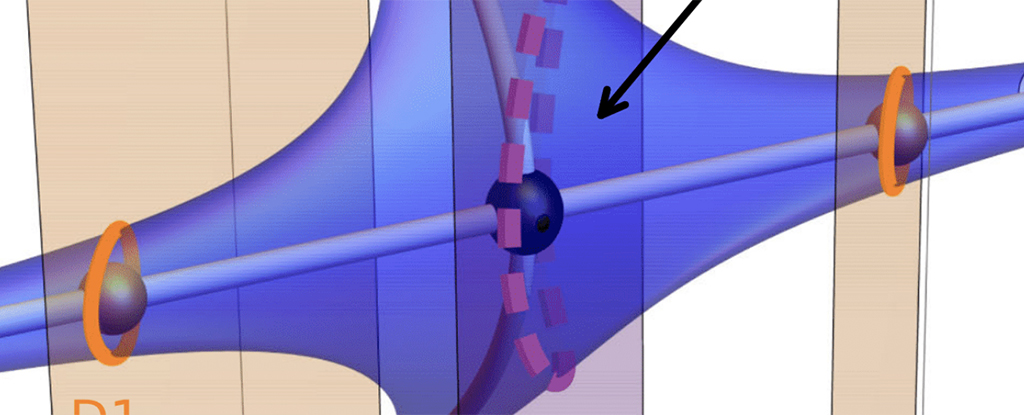
Scientists have discovered a quasiparticle, known as a semi-Dirac fermion, that exhibits mass only when moving in one direction, a phenomenon first theorized 16 years ago. This discovery, made in a ZrSiS semi-metal crystal under extreme conditions, challenges conventional physics and could impact fields like quantum physics and electronic sensors. The research, published in Physical Review X, highlights the need for further exploration to fully understand the implications of this unique quasiparticle.

science1 year ago

Exploring the Quantum Mysteries of Metals

A new study led by Rice University physicist Qimiao Si explores the unusual behavior of quantum critical metals, which defy traditional physics at low temperatures. These metals, known as strange metals, experience significant changes at quantum critical points, where quasiparticles lose their identity, affecting the material's electronic structure. The research offers insights into high-temperature superconductors and suggests a universal pattern in quantum critical materials, potentially advancing the development of new superconductors.

science1 year ago

Discovery of Directional Mass in Quasiparticles Unveiled

Researchers have discovered semi-Dirac fermions, quasiparticles with mass in one direction but massless in another, within the semi-metal crystal ZrSiS. This discovery, made using a magnet 900,000 times stronger than Earth's magnetic field at Florida's National High Magnetic Field Lab, could lead to technological advances in batteries and sensors. The findings, published in Physical Review X, reveal unique electron behaviors and highlight the potential of semi-Dirac fermions in various applications.

science-and-technology1 year ago

"Physicists Investigate Mysterious Electron Clusters"

Researchers have observed electrons forming quasiparticles with fractional charges without the influence of a magnetic field, a phenomenon previously unseen. This discovery, made in 2D materials like twisted graphene and molybdenum ditelluride, challenges existing theories and could have significant implications for quantum computing. The exact mechanisms behind this effect remain unclear, prompting further investigation into the role of moiré patterns and potential new quantum phases of matter.

science-and-technology2 years ago

Unveiling the Magnetic Revolution: Diamonds, Rust, and Measuring Natural Monopoles

Researchers have measured quasiparticles with single, double, and quadruple magnetic poles on the surface of hematite, a rock similar to rust. These peculiar magnetic configurations, known as magnetic monopoles, were observed for the first time in a naturally occurring magnet. The formation of these monopoles is connected to the property of emergence, where the combination of many physical entities produces something new with unique properties. The discovery could have implications for improving computer technology and memory logic.

physics2 years ago

"Unveiling the Bizarre Conductivity: Exotic Liquid-Like Electricity Flow in Strange Metals"

Researchers studying strange metals have discovered evidence that challenges our understanding of electrical currents. By conducting quantum measurement experiments on nanowires made of ytterbium, rhodium, and silicon, they found that the behavior of electrical currents in strange metals differs from that of normal metals. Instead of quasiparticles, the researchers observed a more liquid-like flow of charge, suggesting that the traditional model of quasiparticles may not apply in these materials. The findings support a theory proposed over 20 years ago and raise questions about how charge moves collectively in strange metals.

science2 years ago

"Discovery of Exotic Charge Transport in Quantum Material Shocks Physicists"

Physicists at Rice University have conducted quantum noise experiments on a "strange metal" quantum material, providing evidence that electricity flows through these materials in an unusual liquid-like form that cannot be explained by quasiparticles. The experiments measured quantum charge fluctuations known as "shot noise" and found that the noise was greatly suppressed compared to ordinary wires. The researchers suggest that this may indicate that quasiparticles are not well-defined or that charge moves in more complex ways. The study's findings contribute to a better understanding of charge transport in quantum materials and raise questions about the nature of strange metals in various physical systems.

science-and-technology2 years ago

"Revolutionary Quasiparticles: Unlocking Faster-Than-Light Potential for Compact Light Sources"

Quasiparticles, which behave like single entities, have been found to exhibit properties that seemingly defy the laws of physics, including traveling faster than the speed of light. Harnessing these properties could lead to the development of powerful and compact light sources, revolutionizing industries such as medical imaging, nuclear physics, and semiconductor manufacturing. The collective movement of quasiparticles can create effects similar to faster-than-light travel, although no individual particle exceeds the speed of light. This discovery could democratize access to powerful light sources and enable significant scientific and technological advancements.

science-and-technology2 years ago

Revolutionary Quasiparticles: The Future of Ultra-Bright Light Sources

Scientists have developed a method to produce ultra-bright light, known as coherent light, by creating synchrony among particles. This breakthrough could lead to a technological and scientific revolution, with potential applications in healthcare, technology, and astrophysics. The compact machine that produces this ultra-bright light could make X-rays and radiotherapy treatments more affordable, enable the creation of powerful computer chips, and deepen our understanding of cosmic behavior. The researchers compare the motion of the quasiparticles in their experiment to a Mexican wave, where each individual electron contributes to the collective motion, resulting in highly synchronized photons and extremely bright light.

science2 years ago

Scientists Uncover the Elusive 'Demon Particle' in Groundbreaking Study

Physicists from the University of Illinois Urbana-Champaign have discovered a transparent, massless, and neutral "demon" particle that could aid in understanding superconductors. The particle, theorized by physicist David Pines in 1956, is a quasiparticle formed by two plasmons falling out of phase with each other. Unlike other particles, demons do not interact with light, making them difficult to detect. The discovery was made while studying the electronic properties of strontium ruthenate, and further research is needed to fully comprehend the functions of this quasiparticle.

science2 years ago

Observing the Quantum World: Vanishing Electrons during Cooling

Researchers at the University of Bonn and ETH Zurich have observed a unique effect in the quantum world where electrons slowly vanish during cooling. This phenomenon, known as critical slowing down, occurs during phase transitions and is typically observed in bosons. However, the researchers have now demonstrated that it can also occur in fermions, such as electrons. By studying the collapse of quasiparticles, which are a superposition of immobile and mobile electrons, the researchers gained new insights into the exotic world of quantum physics. The findings contribute to a better understanding of phase transitions and may have implications for quantum information technology.