Scientists at Harvard have achieved a major breakthrough by successfully realizing a Laughlin state, an exotic quantum liquid, using ultracold neutral atoms manipulated by lasers. The Laughlin state, characterized by electrons dancing around each other while avoiding collisions, is associated with the existence of fractional charge-carrying particles called anyons. By imaging the atoms individually through a quantum-gas microscope, the researchers were able to observe the unique properties of the Laughlin state, opening up new avenues for exploring and manipulating anyons in quantum simulators.

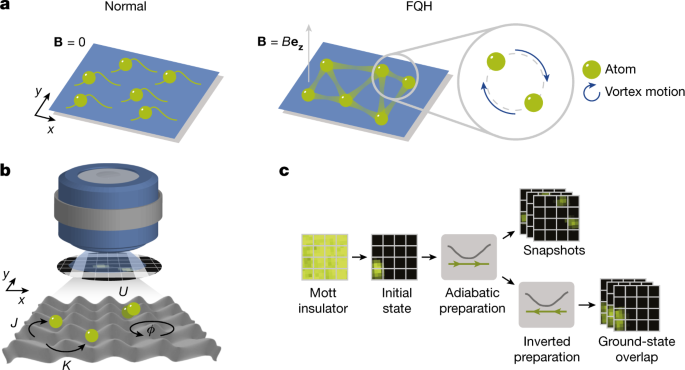
An international team led by Markus Greiner at Harvard has realized a Laughlin state using ultracold neutral atoms manipulated by lasers. The experiment involves trapping a few atoms in an optical box and implementing the ingredients required for the creation of this exotic state: a strong synthetic magnetic field and strong repulsive interactions among the atoms. The researchers imaged the atoms one by one through a powerful quantum-gas microscope and demonstrated the peculiar "dance" of the particles, which orbit around each other, as well as the fractional nature of the realized atomic Laughlin state. This milestone opens the door to a wide new field of exploration of Laughlin states and their cousins in quantum simulators.
Researchers have realized a fractional quantum Hall state with ultracold atoms in an optical lattice, which is a lattice version of a bosonic ν = 1/2 Laughlin state with two particles on 16 sites. The state exhibits many hallmark features of Laughlin-type FQH states, including a suppression of two-body interactions, a distinctive vortex structure in the density correlations, and a fractional Hall conductivity of σH/σ0 = 0.6(2) by means of the bulk response to a magnetic perturbation. This work provides a starting point for exploring highly entangled topological matter with ultracold atoms.