Tag

Superconductors

All articles tagged with #superconductors

science1 year ago

Exploring the Quantum Mysteries of Metals

A new study led by Rice University physicist Qimiao Si explores the unusual behavior of quantum critical metals, which defy traditional physics at low temperatures. These metals, known as strange metals, experience significant changes at quantum critical points, where quasiparticles lose their identity, affecting the material's electronic structure. The research offers insights into high-temperature superconductors and suggests a universal pattern in quantum critical materials, potentially advancing the development of new superconductors.

technology1 year ago

Neuroscience Theory Paves Way for Superfast Superconductor-like Chips

Researchers have developed a method to create computer chips that operate at the 'edge of chaos,' a state that allows for rapid information transmission similar to the human brain. By using a material called lanthanum cobaltite, they achieved signal amplification without separate amplifiers, mimicking the behavior of superconductors. This breakthrough could lead to simpler and more efficient computer chips, potentially operating at normal temperatures and pressures, by reducing the need for repeaters and buffers.

technology1 year ago

Gold-Plated Superconductor Paves Way for Scalable Quantum Computing

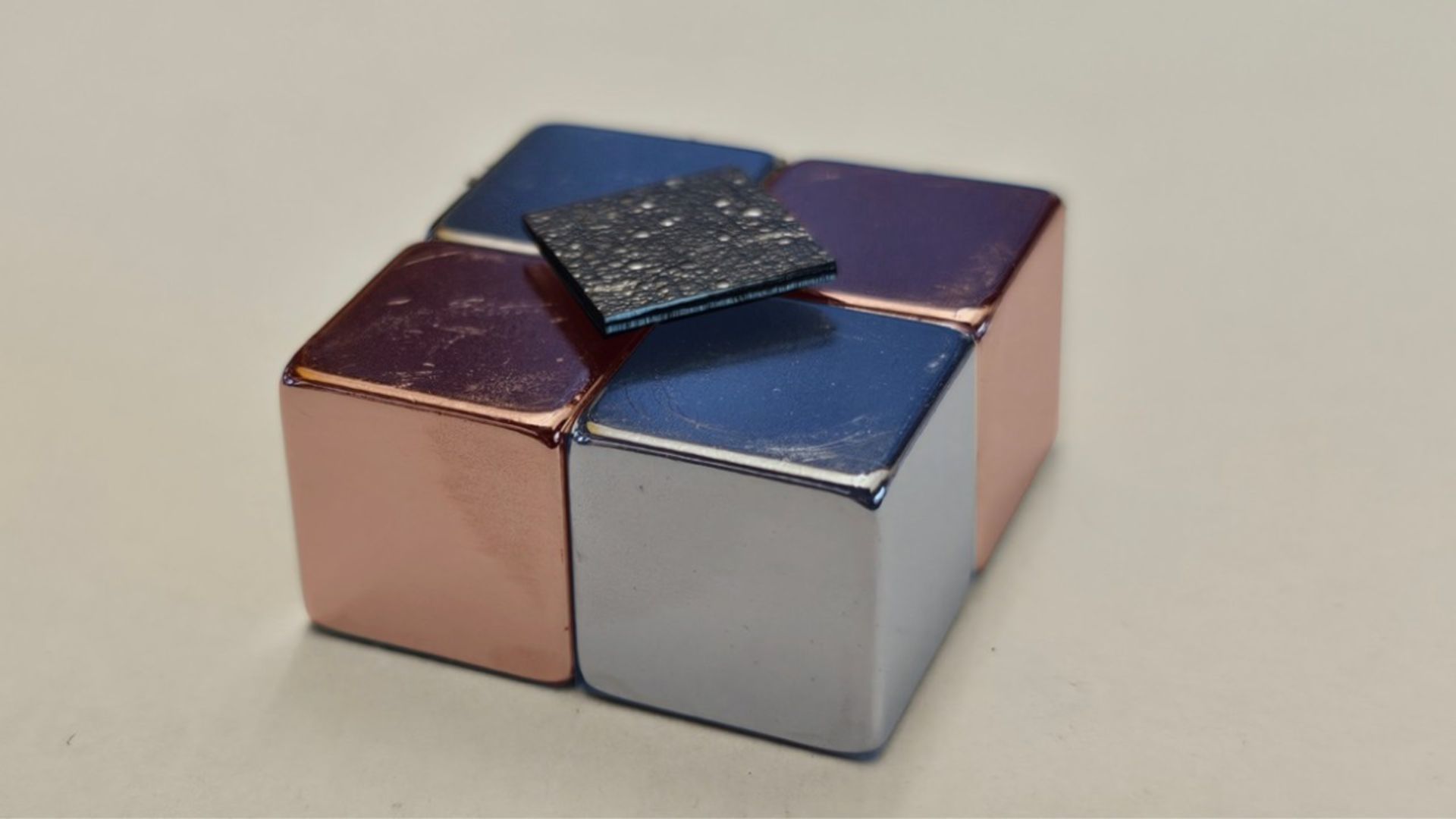
Researchers at the University of California, Riverside, have developed a new superconductor material by combining trigonal tellurium with a thin film of gold, potentially enhancing quantum computing reliability. This interface superconductor, which becomes superconducting through the proximity effect, shows promise due to its robust quantum qualities and ability to suppress decoherence. The material's unique properties, including enhanced spin energy and resistance to magnetic fields, make it a promising candidate for future quantum computers, although further exploration is needed to determine its practical applications.

science-and-technology1 year ago

Supersolid Vortices: Unveiling Quantum Tornadoes in a Dual State of Matter

Physicist Francesca Ferlaino's team at the University of Innsbruck has captured images of quantized vortices in a supersolid, a state of matter that combines properties of solids and superfluids. This discovery could inform the development of room-temperature superconductors, enhancing the scalability and accessibility of quantum technology. Supersolids may also provide insights into the interiors of neutron stars and improve the stability and efficiency of quantum devices by reducing the need for ultra-low temperatures.

science-and-technology1 year ago

Breakthroughs in Room-Temperature Superconductors Spark New Possibilities

Scientists at the University of Illinois Chicago are developing new materials that could enable superconductors to function at room temperature, potentially revolutionizing their applications in power grids and transportation. The research, led by PhD candidate Adam Denchfield, explores rare earth hydrides and proposes new material designs that show promise in computer simulations. These designs aim to achieve superconductivity at higher temperatures without the need for extreme cooling, marking a significant step towards practical room-temperature superconductors.

science1 year ago

"Controversy Surrounding Room-Temperature Superconductor Discovery"

Physicist Ranga Dias defends his discredited research on superconducting materials, claiming he has been unfairly targeted and harassed. Last year, Dias claimed to have created a room-temperature superconductor, but his work has since been widely discredited. Despite the initial excitement over the potential breakthrough, his fellow scientists now accuse him of embarrassing the field.

science-and-technology1 year ago

"Unpowered Levitation: Japan's Innovative Graphite Breakthrough"

A research team in Japan has achieved levitation without using any external energy source by developing a new material, opening possibilities for gravity-free technology in the future. This breakthrough utilizes the principle of magnetic levitation, where superconducting magnets create a strong magnetic field and diamagnetic materials levitate, enabling objects to float and travel at high speeds.

science-and-technology1 year ago

"Unveiling the Hidden Nature of Superconductors through Quantum Breakthrough"

Researchers at Tokyo Tech have identified the quantum critical point in superconductors, solving a three-decade-old mystery and enhancing the understanding of superconductivity fluctuations. By measuring the thermoelectric effect in superconductors over a wide range of magnetic fields and temperatures, they revealed the full picture of fluctuations in superconductivity and demonstrated that the anomalous metallic state in two-dimensional superconductors is due to the existence of a quantum critical point. This breakthrough sheds light on the properties of superconductors at cryogenic temperatures and has implications for the development of materials with large thermoelectric effects at low temperatures.

physics1 year ago

"Discovery: Electrons Found Moving at Light Speed in 4 Dimensions"

Physicists have isolated the behavior of Dirac electrons in a superconducting polymer, allowing them to oscillate at the speed of light and exist under conditions that make them massless. This discovery will aid in understanding topological materials and their potential applications in quantum computers. By leveraging electron spin resonance, the researchers were able to directly observe the behavior of Dirac electrons in the material, distinguishing them from standard electrons. The team found that the motion of Dirac electrons is dependent on temperature and magnetic field angle within the material, providing new insights into their behavior and potential for future technology.

science-and-technology1 year ago

"Discovery of Naturally Occurring Unconventional Superconductor"

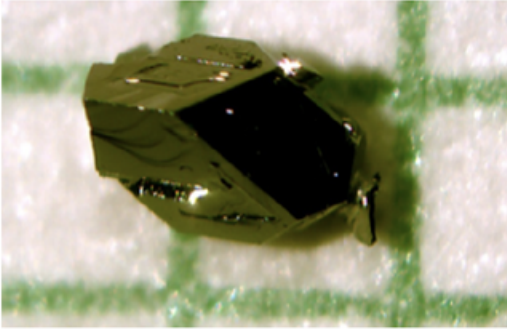
Researchers have identified the naturally occurring mineral miassite as an "unconventional superconductor" when purified, functioning at 5.4 degrees Kelvin. This discovery offers a promising new angle for future superconductor advancements, although impurities in the natural form of the mineral hinder its superconducting properties. Uncovering the mechanisms behind unconventional superconductivity is seen as crucial for economically-sound applications of superconductors, and this finding represents a step forward in the search for economically-viable superconductors.