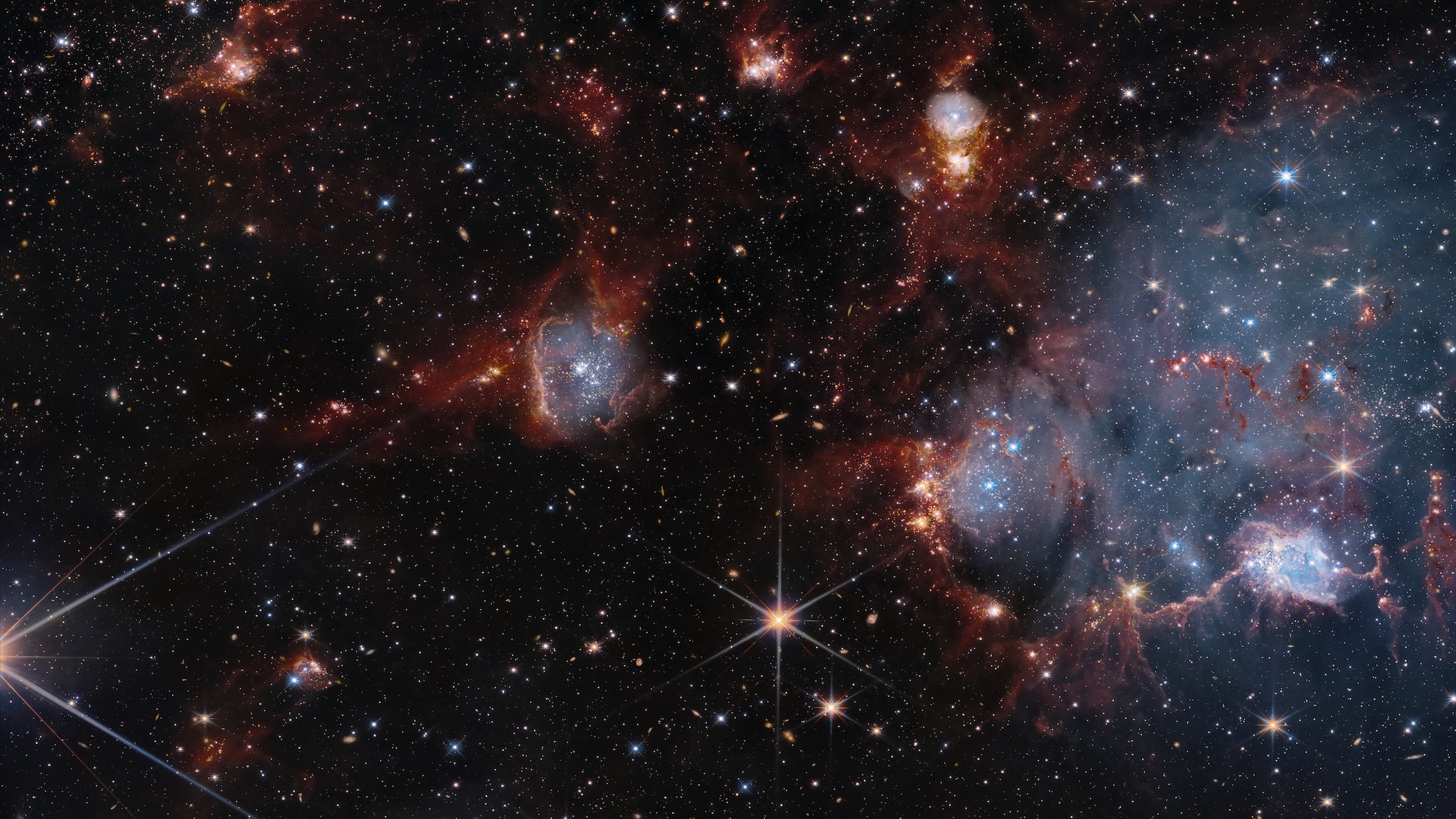
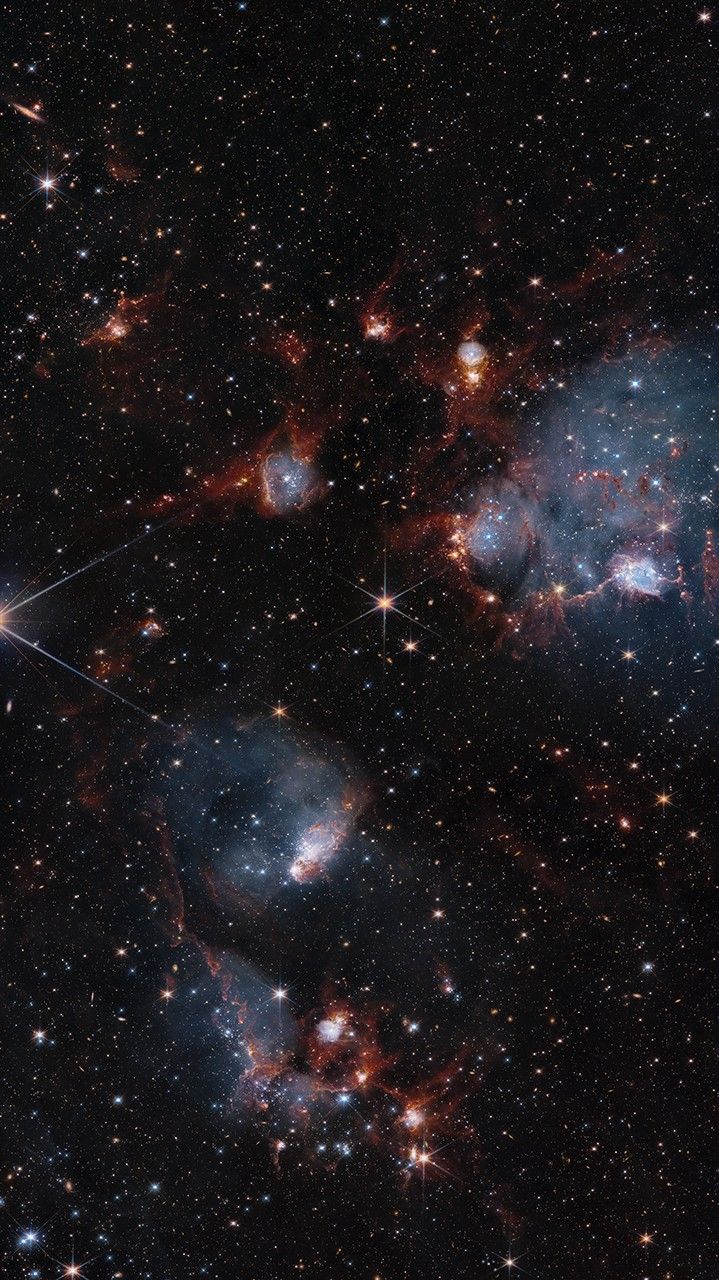
NASA's Hubble and James Webb telescopes collaborated to capture a detailed image of the open star clusters NGC 460 and NGC 456 in the Small Magellanic Cloud, revealing insights into star formation processes in a dwarf galaxy 200,000 light-years away.
NASA's Hubble and Webb telescopes have captured detailed images of the star clusters NGC 460 and NGC 456 in the Small Magellanic Cloud, revealing the complex interplay of gas, dust, and star formation, and providing insights into early universe conditions and galaxy interactions.
For the first time, astronomers have detected magnetic fields in massive stars outside the Milky Way, specifically in the Large and Small Magellanic Clouds. This discovery offers a unique opportunity to study star formation and evolution in environments similar to the early universe, as these stars are metal-poor like the first stars. Using the FORS2 instrument on the Very Large Telescope, researchers successfully measured magnetic fields in several massive stars, suggesting that low metallicity has little impact on magnetic field strength in these stars. Further studies are needed to confirm these findings.
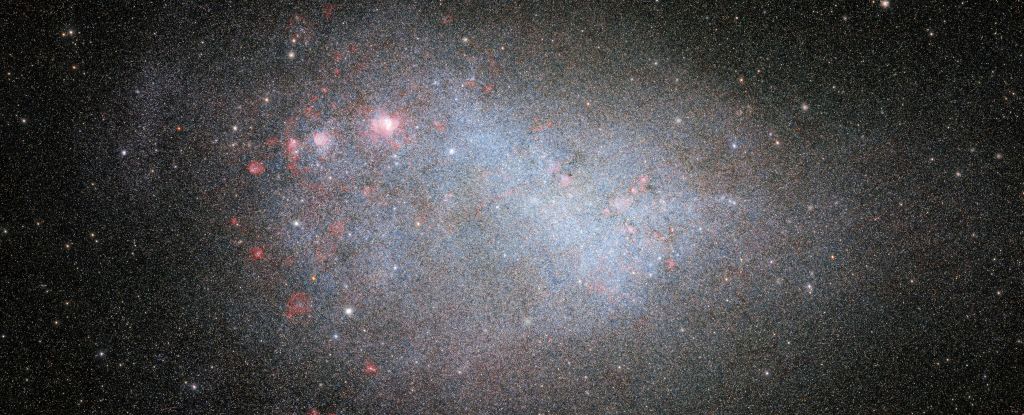
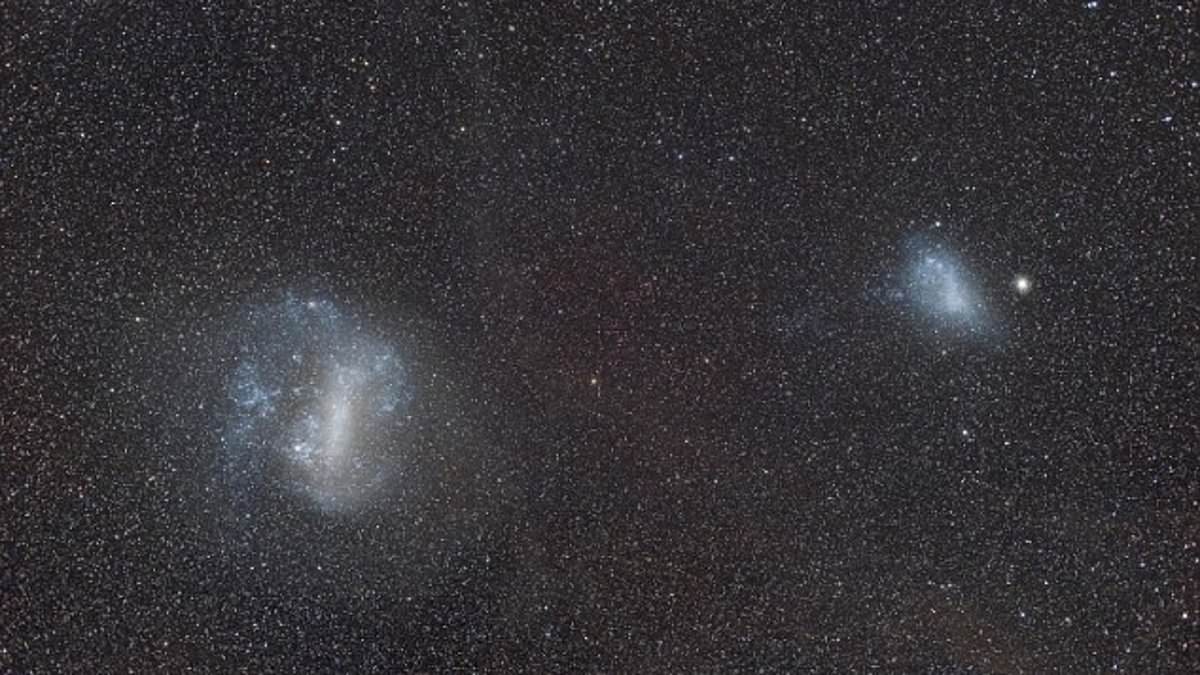
Astronomers have discovered that the Small Magellanic Cloud, previously thought to be a single galaxy orbiting the Milky Way, is actually two separate galaxies superimposed along our line of sight. New analysis suggests that the rearmost blob of stars is located some 16,000 light-years behind the other. This finding challenges previous interpretations and has been supported by data from the Gaia survey and a galactic survey using the Australian Square Kilometer Array Pathfinder radio telescope. The Small Magellanic Cloud, along with its larger sibling, the Large Magellanic Cloud, is slowly being subsumed into the Milky Way, providing a front row seat to the process of galactic growth.
Astronomers are calling for the Large and Small Magellanic Clouds, two dwarf galaxies visible from the Southern Hemisphere, to be renamed due to their association with the violent colonialist legacy of their namesake, Ferdinand Magellan. The astronomers argue that indigenous peoples had already discovered and named these galaxies before Magellan's arrival. They propose changing the 'm' in LMC and SMC to 'meridional' or using 'Milky' to better reflect the clouds' connection to the Milky Way. However, not everyone agrees with the renaming, with some criticizing the plea as '#woke astronomy'.
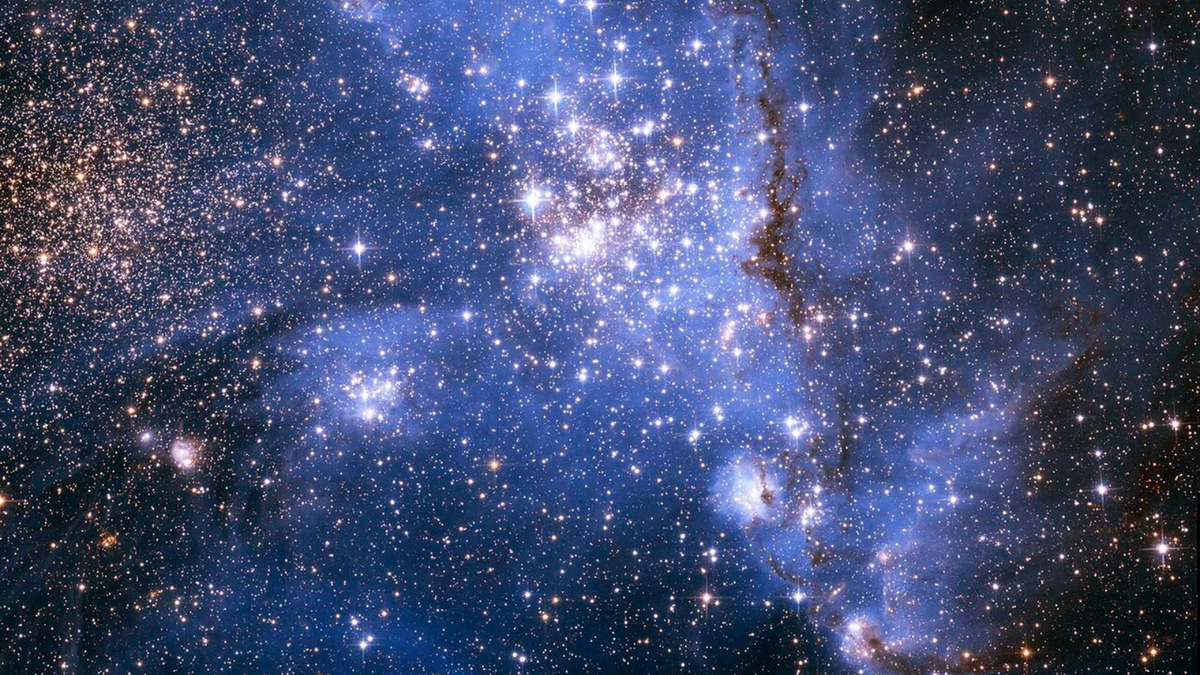
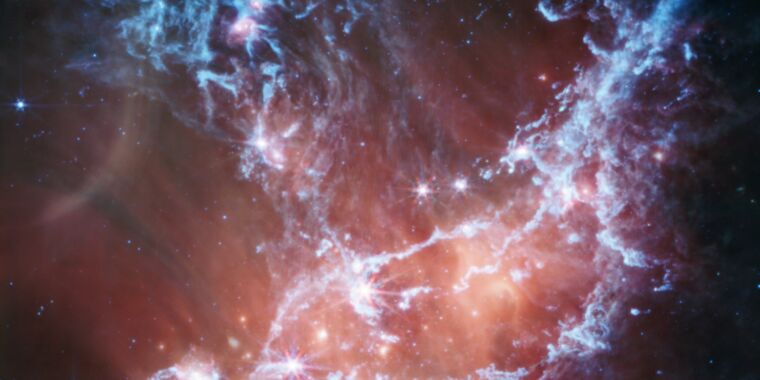
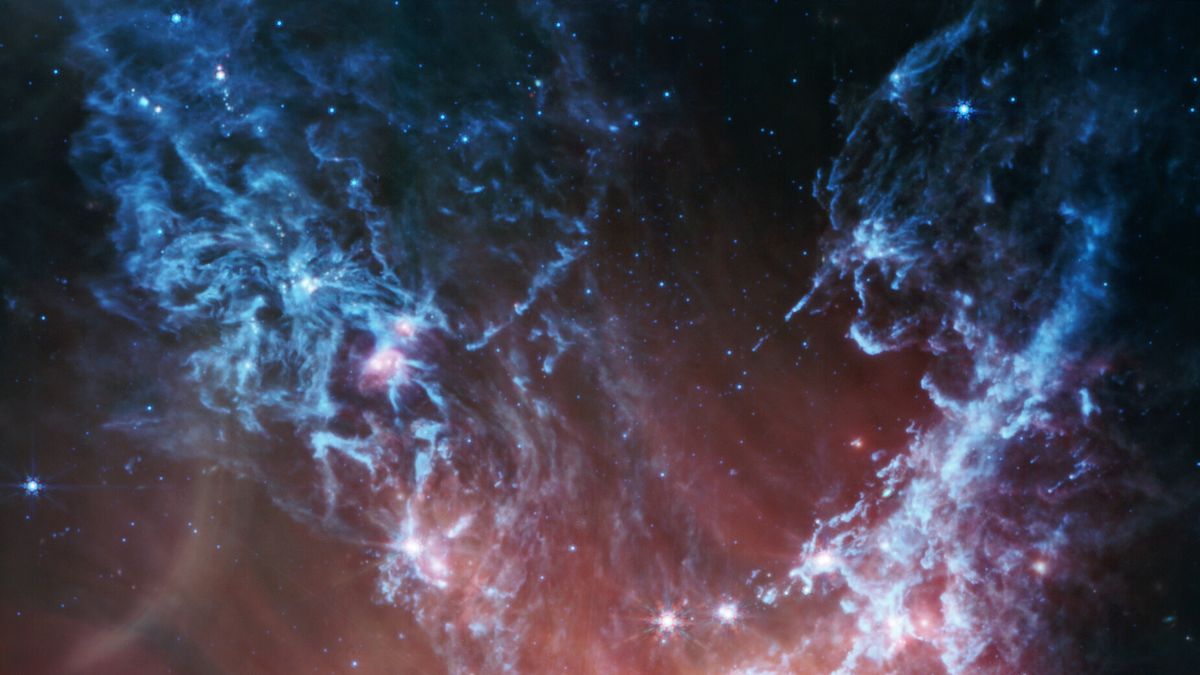
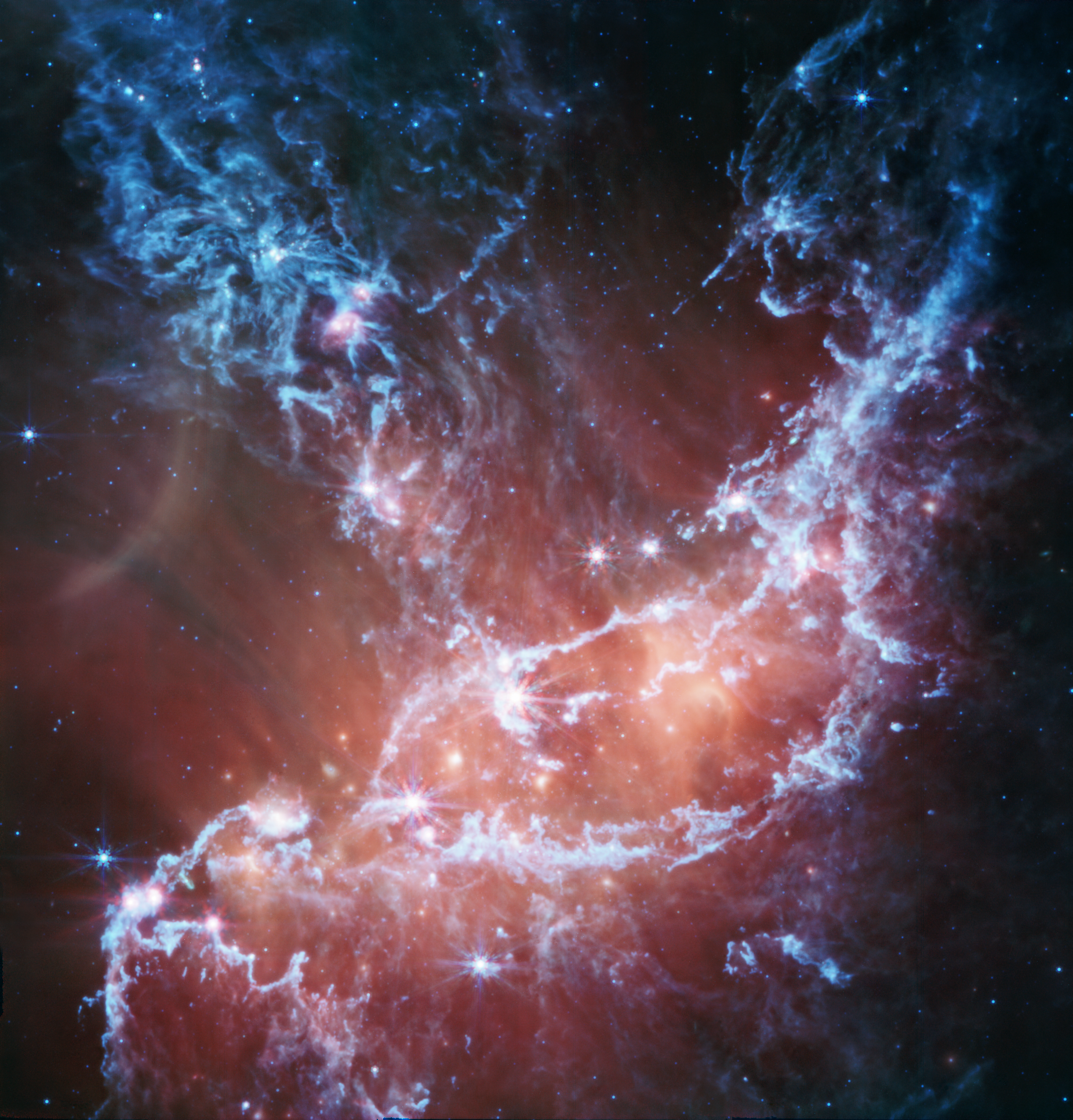
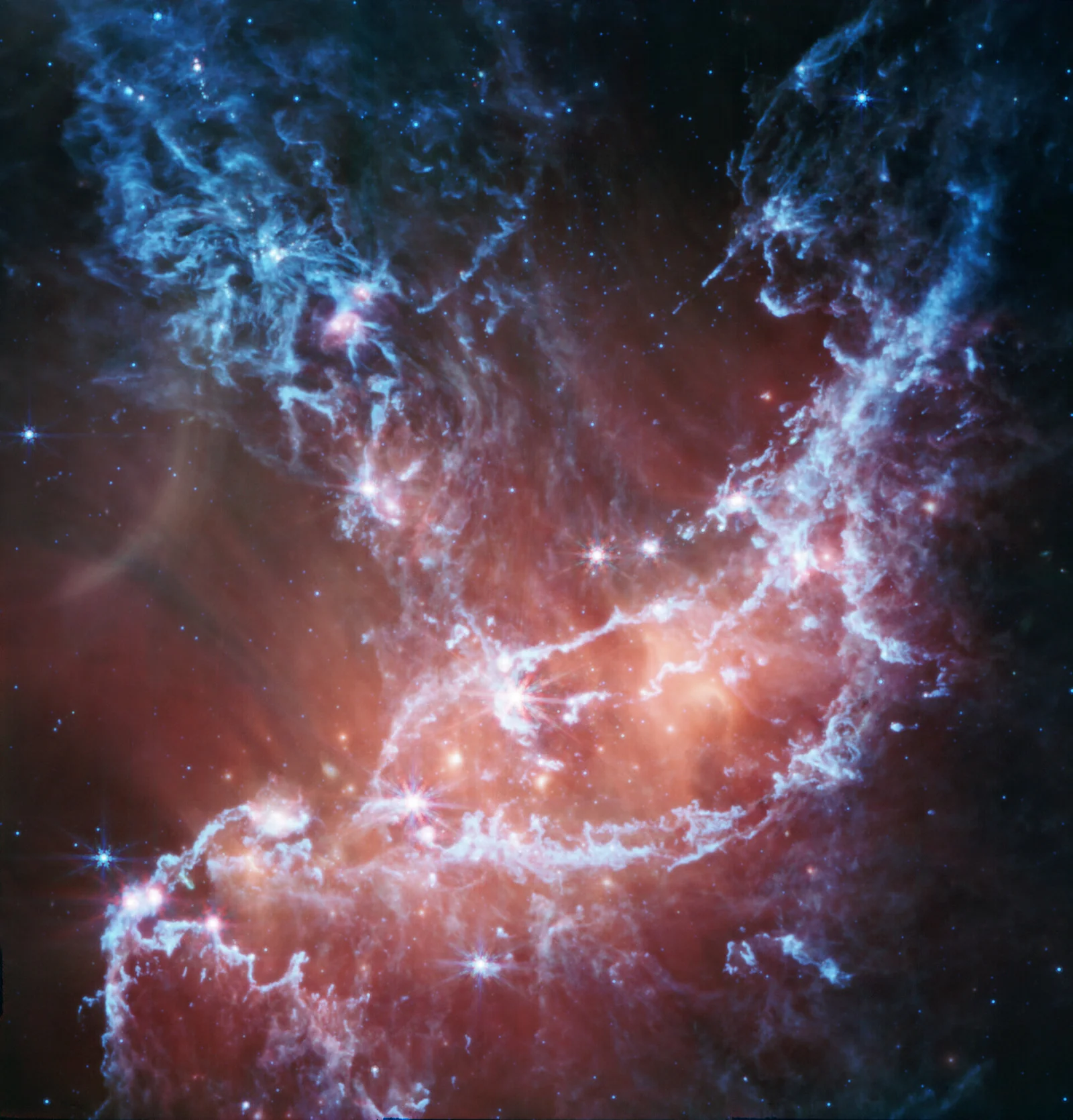
NASA's James Webb Space Telescope has captured a new infrared image of NGC 346, a bright star cluster in the Small Magellanic Cloud. The image reveals blue silicates and polycyclic aromatic hydrocarbons, with bright patches indicating areas with numerous protostars. The cluster contains young stars, some as young as 2 million years old, still embedded in their dusty cocoons.
NASA's James Webb Space Telescope has captured a stunning image of NGC 346, a star-forming region in the Small Magellanic Cloud. The image reveals young stars blanketed in dust, contrary to expectations, and provides insights into the number of stars and protostars in the region. This observation could shed light on the cosmic noon era billions of years ago when star births peaked and heavy element levels were lower.
NASA's James Webb Space Telescope has captured a stunning infrared image of NGC 346, the brightest and largest star-forming region in the Small Magellanic Cloud. The image reveals filaments of dust and gas, contrary to expectations that the SMC would lack significant amounts of dust due to its lower concentration of heavy elements. By combining data from both the near-infrared and mid-infrared, astronomers are gaining a better understanding of the stars and protostars within this dynamic region, shedding light on galaxies that existed billions of years ago.
The James Webb Space Telescope has captured a stunning image of NGC 346, the brightest and largest star-forming region in the Small Magellanic Cloud. The image reveals the presence of ample cosmic dust within the region, contrary to previous expectations. The image showcases blue tendrils of material containing dusty silicates and sooty chemical molecules, as well as red emission from warm dust heated by massive stars. The image also highlights bright patches and filaments indicating the presence of numerous protostars. By combining data from both the near-infrared and mid-infrared, astronomers gain a better understanding of star formation in the early universe.
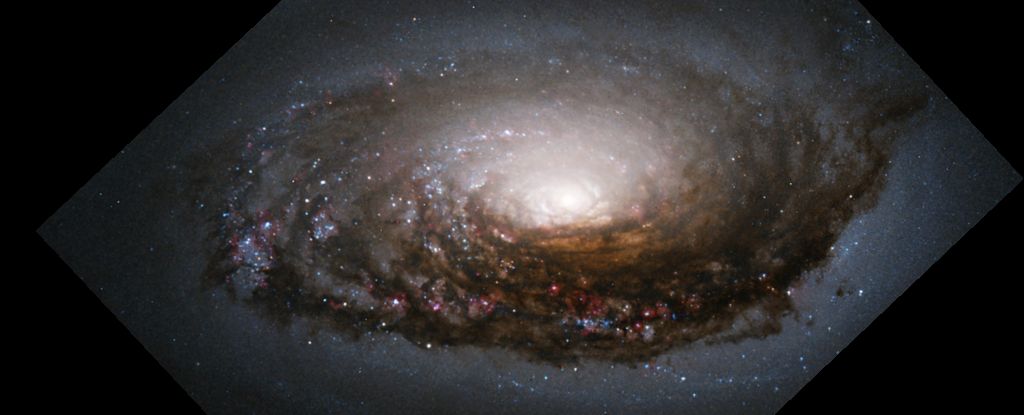
Astronomers have discovered that the outer disk of the Evil Eye galaxy, also known as M64, came from a smaller, gas-rich satellite dwarf galaxy that M64 recently cannibalized and wrapped itself in. The discovery could give us a glimpse into the future of our own Milky Way galaxy, as estimates of the mass and contents of the shredded satellite suggest that it was remarkably similar to the Small Magellanic Cloud, a Milky Way satellite dwarf galaxy that will one day be subsumed into the larger mass. The findings suggest that M64's unique counter-rotating disk was a recent merger with a gas-rich satellite very similar to the Small Magellanic Cloud.
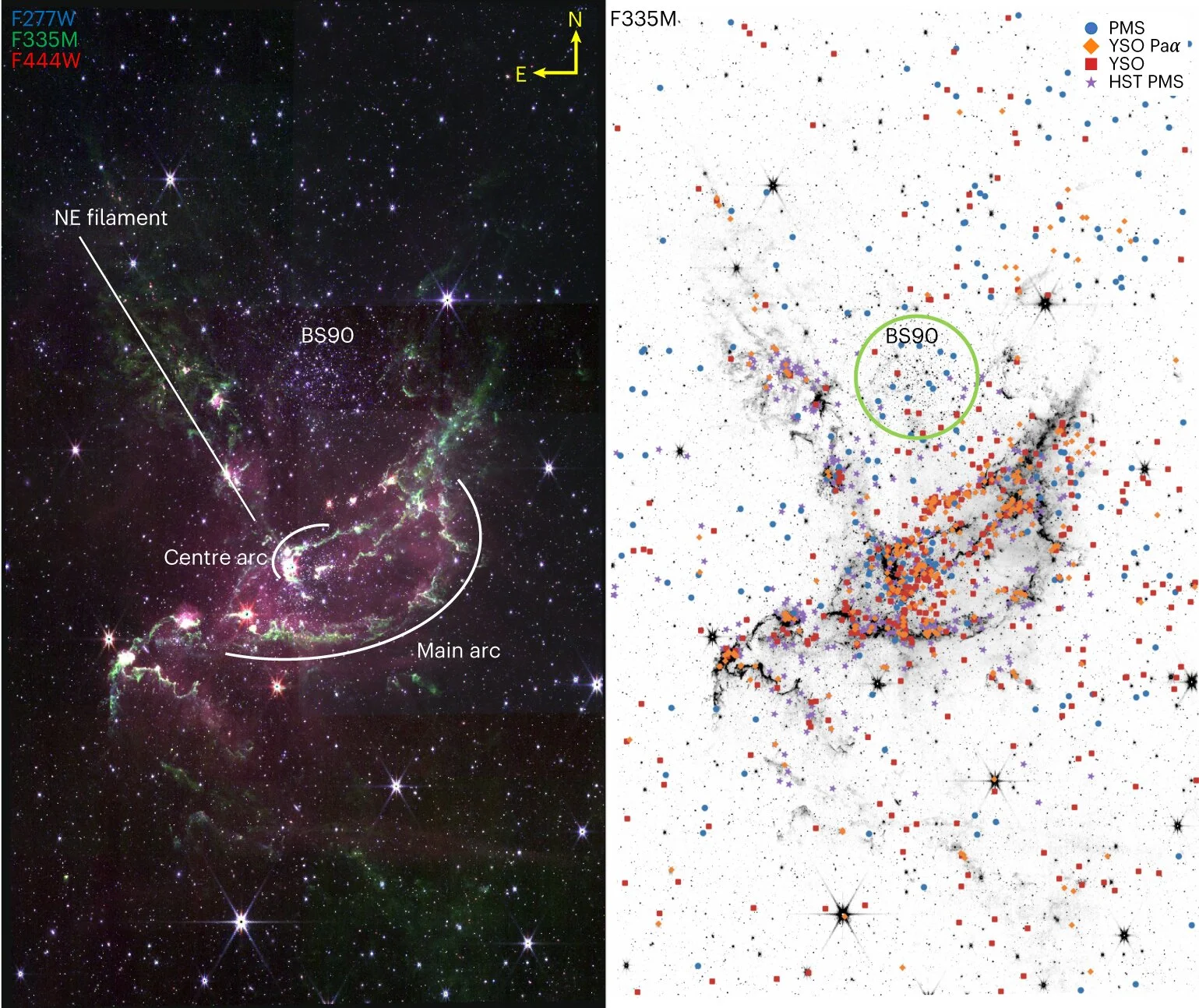
An international team of space scientists has used data from the James Webb Space Telescope to study a part of the Small Magellanic Cloud and found evidence suggesting that planets could have formed during the "cosmic noon." The team focused on a part of the SMC called NGC 346, which is made up of hundreds of young, low-mass stars, and found evidence of rock-forming elements in the SMC, despite the lack of metals, suggesting that many planets may have been forming around them at that time.