Tag

Kilonova

All articles tagged with #kilonova

science1 year ago

Neutron Star Collisions: Cosmic Explosions and Element Creation

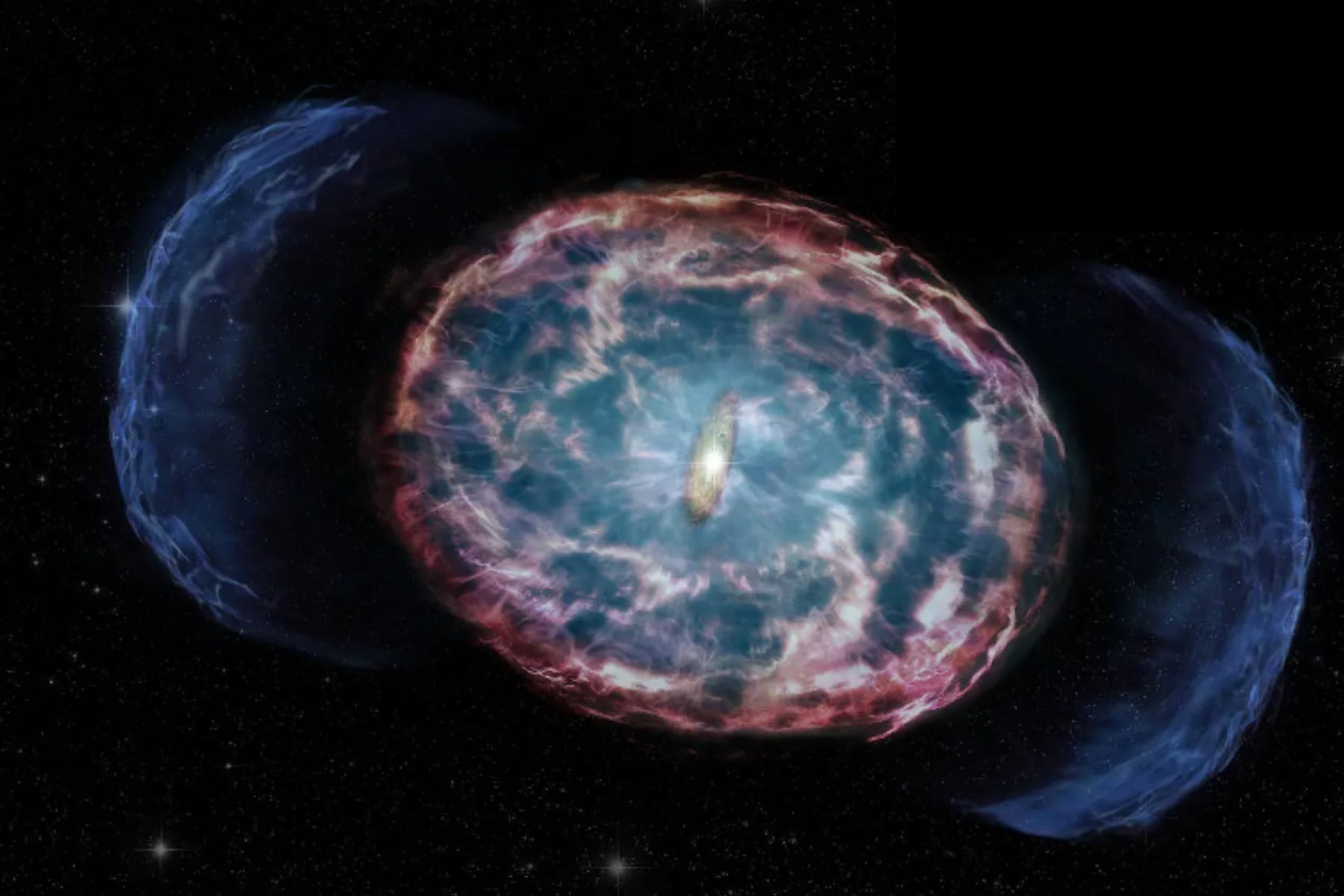
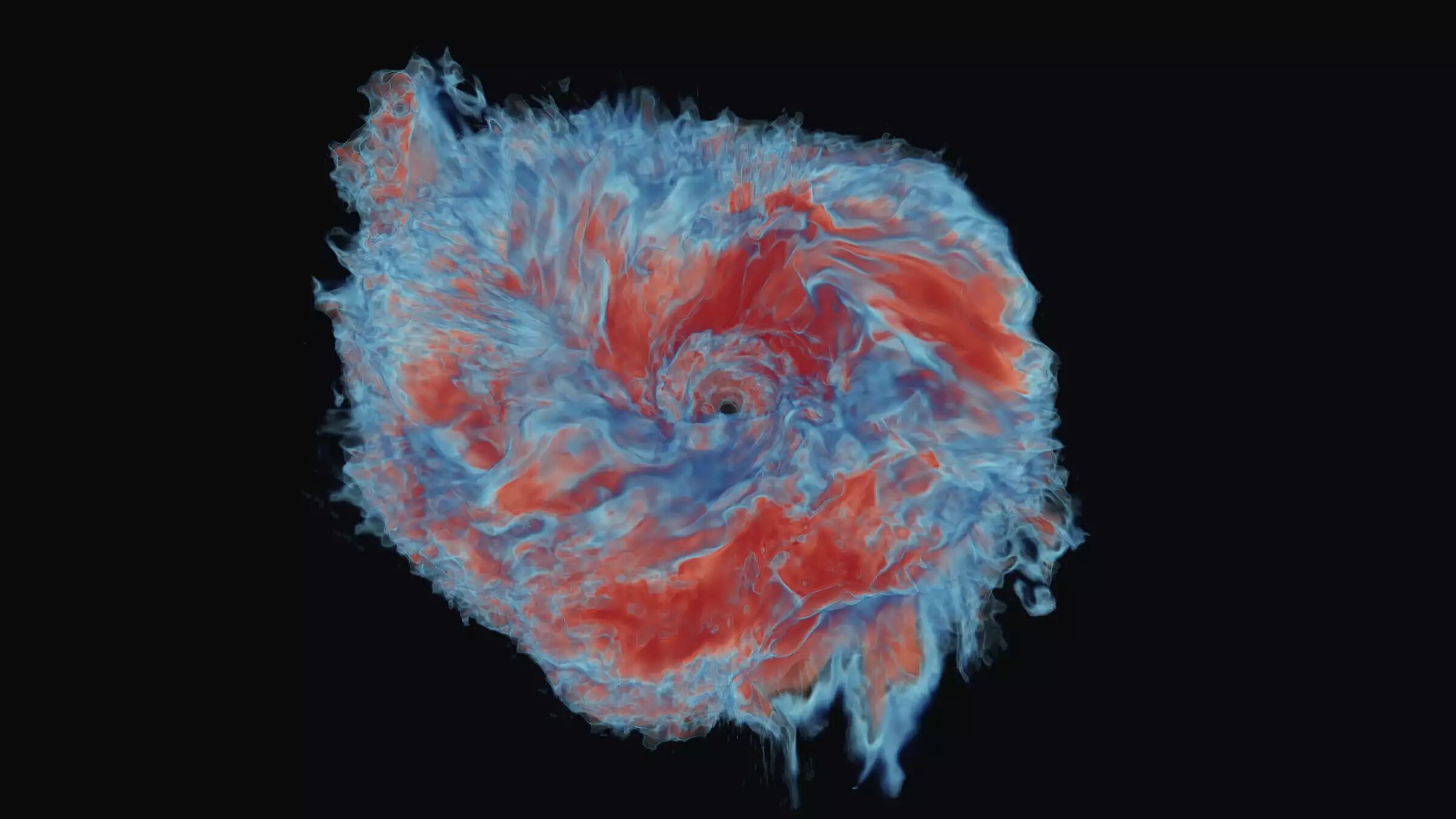
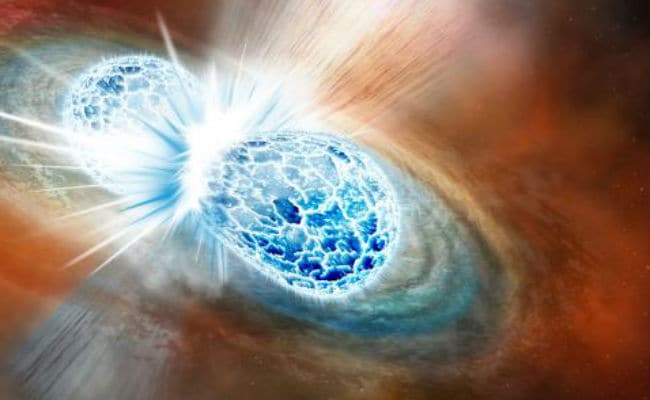
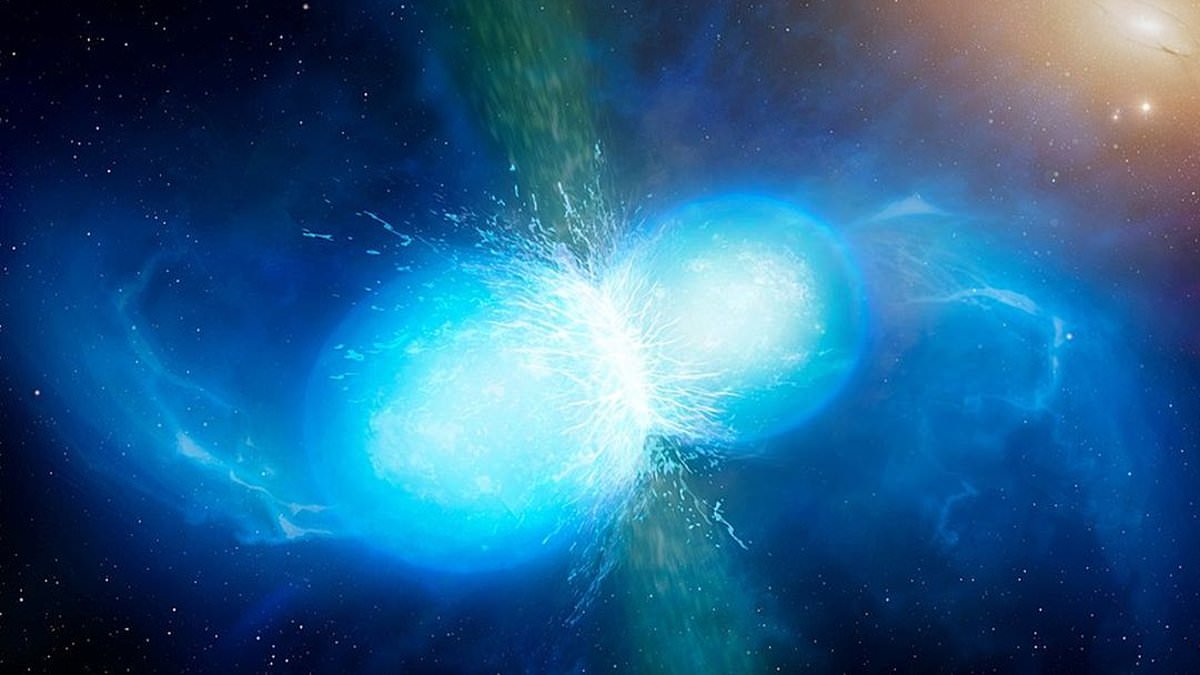
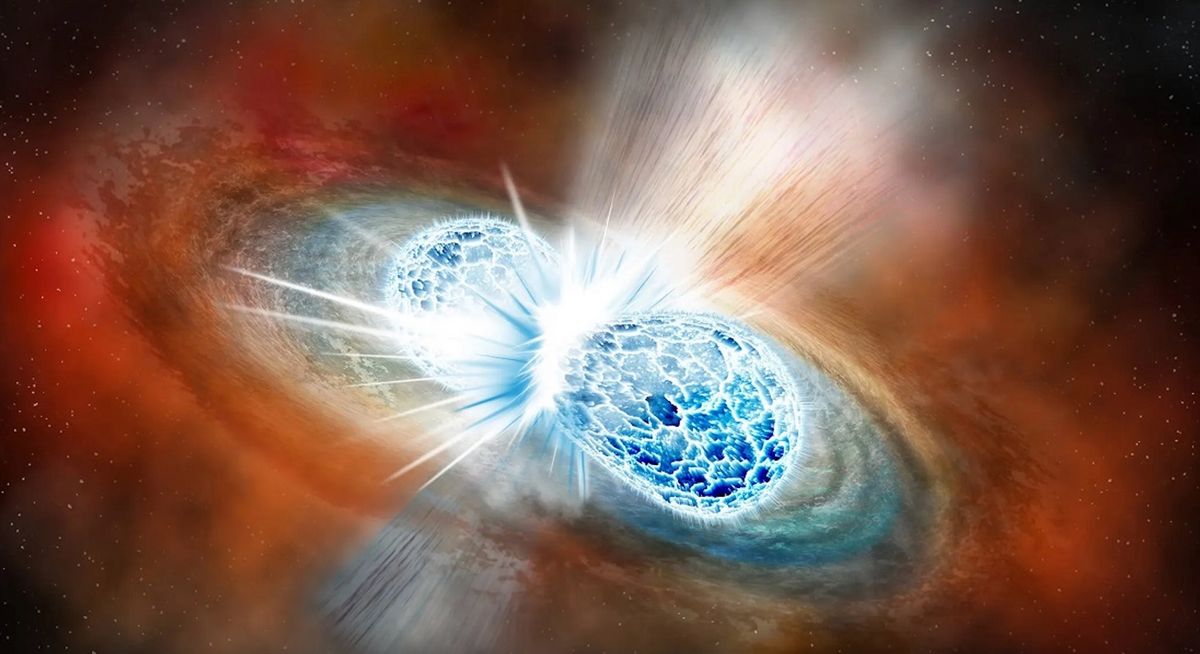
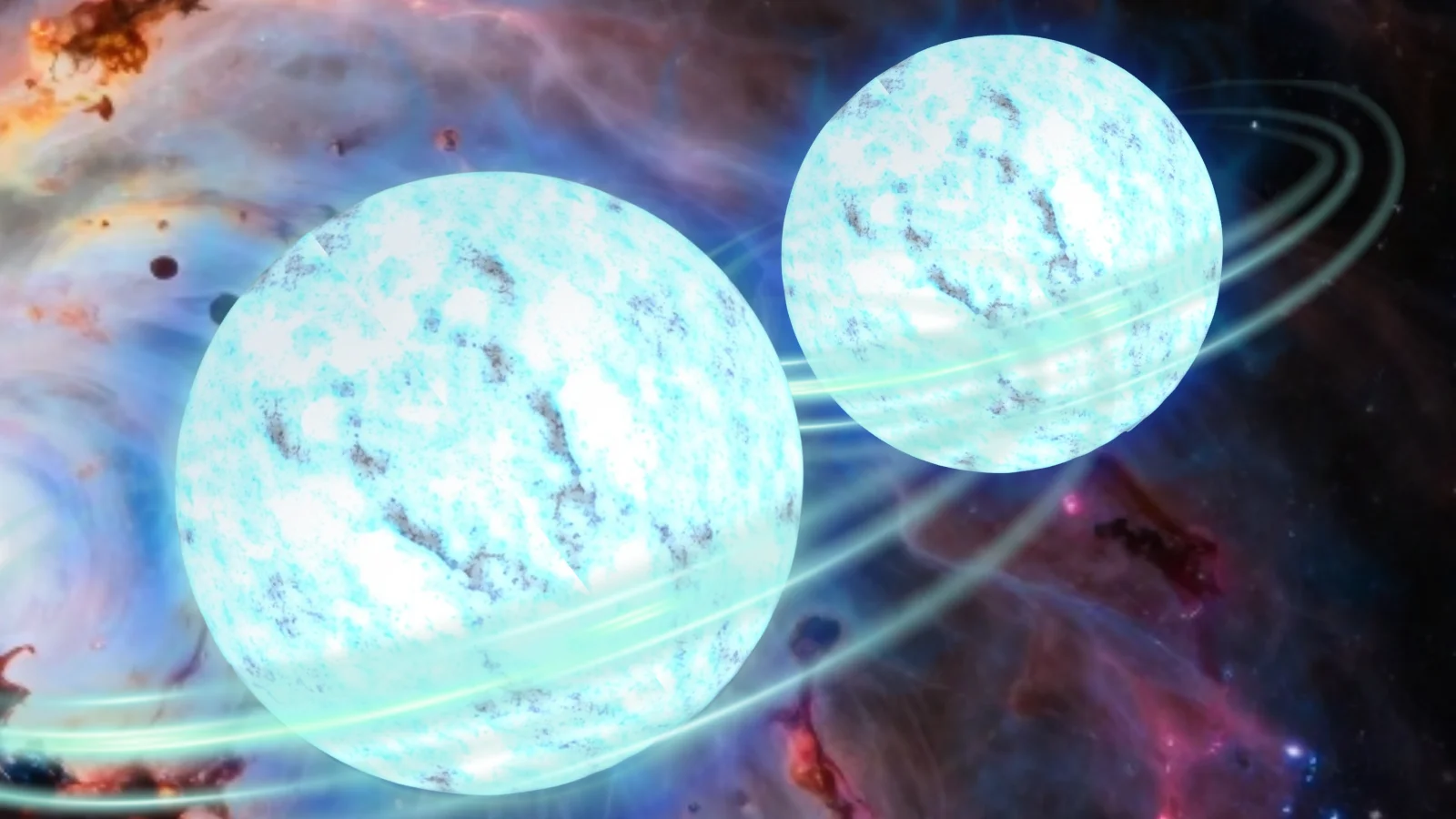
In 2017, scientists observed a kilonova explosion from colliding neutron stars, providing insights into the creation of heavy elements like strontium and yttrium. This event, similar to the Big Bang, involved a hot, expanding fireball where particles combined to form atoms, akin to the Universe's Epoch of Recombination. By analyzing data from multiple telescopes, researchers have detailed the kilonova's evolution, confirming its role as a source of heavy elements and offering a miniature model for studying early Universe processes.

astronomy1 year ago

"Neutron Star Mergers: Unveiling the Cosmic Gold Foundry"

A study published in Nature reveals that the bright gamma-ray burst GRB 230307A was caused by the merging of two neutron stars, not from a collapsing massive star as previously believed. This finding challenges existing theories about the origins of gamma-ray bursts and provides insight into the creation of heavy elements in the universe. The study, which analyzed data from the Hubble Space Telescope and the James Webb Space Telescope, suggests that further research on the formation of these elements could enhance our understanding of the universe's origins.

astronomy1 year ago

"James Webb Telescope Discovers Cosmic Gold Forge in Neutron Star Merger"

The James Webb Space Telescope and Hubble have observed a super-long gamma-ray burst resulting from the collision of two dense neutron stars, producing pure gold and other heavy elements. This discovery challenges conventional understanding of gamma-ray bursts and sheds light on the formation of heavy elements in the universe, providing valuable insights into nucleosynthesis and the origins of the cosmos.

astronomy1 year ago

"James Webb Space Telescope Discovers Thrilling Evidence of Neutron Star Mergers Creating Gold in the Cosmos"

The James Webb Space Telescope and Hubble Space Telescope observed a gamma-ray burst (GRB) originating from the collision of two neutron stars, confirming that these mergers create elements like gold. This discovery challenges previous theories about the origins of long GRBs and sheds light on the process of nucleosynthesis, where heavier elements are forged. The research, published in Nature, provides new insights into the cosmic alchemy of neutron star mergers and the creation of heavy elements in the universe.

astronomy1 year ago

"Threat of a Nearby Kilonova Explosion: Earth's Life at Risk"

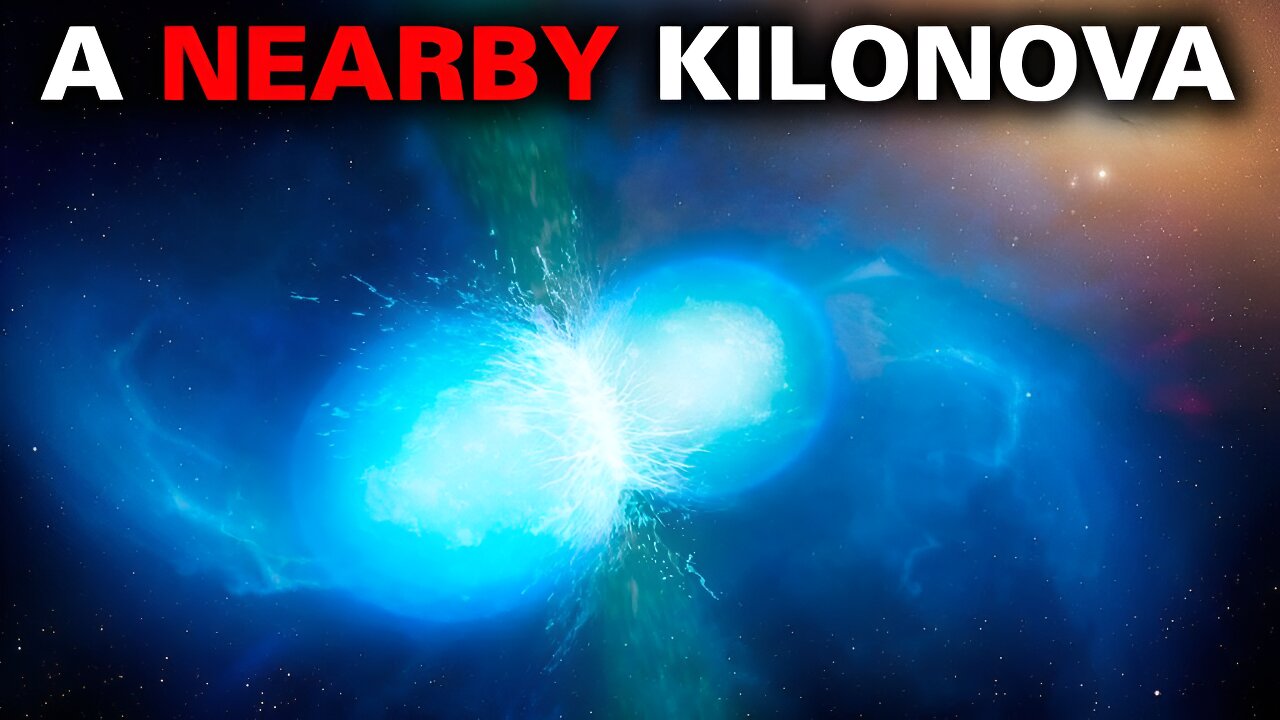
Scientists have calculated that being too close to a kilonova, a massive explosion resulting from the collision of two neutron stars, could be catastrophic for a planet like Earth due to the release of high-energy electromagnetic radiation and cosmic rays. The study, published in The Astrophysical Journal, suggests that Earth would have to be within 3 light-years of a kilonova to be affected by X-ray afterglow and within 13 light-years for gamma rays to have a catastrophic impact. However, the likelihood of a kilonova occurring within these distances from Earth is very low, and the authors conclude that such events are probably not significant threats to life on Earth.

science-and-technology2 years ago

"Simultaneous Modeling of Kilonova Explosion Signatures Achieved by Research Team"

A research team has developed a method to simultaneously model the observable signals of a kilonova, which occurs when two neutron stars merge. By analyzing the data coherently and simultaneously, the team can obtain more precise results and gain insights into the behavior of nuclear matter under extreme conditions. This method will help understand the expansion of the universe, the formation of heavy elements, and the properties of matter at extreme densities. The researchers are eagerly waiting to apply this tool to future detections of neutron star mergers.

astronomy2 years ago

Ancient Evidence Unveils Nearby Kilonova 3.5 Million Years Ago

Scientists have discovered evidence of a nearby kilonova event that occurred approximately 3.5 million years ago. The presence of isotopes Fe-60 and Pu-244 in ocean sediments suggests the occurrence of a cataclysmic event, such as the merger of two neutron stars or a neutron star with a black hole. The specific ratio of these isotopes, along with simulations, indicates that the kilonova was located about 500-600 light years away from Earth. While this event did not pose a threat to life on Earth, it serves as a reminder of the potential dangers present in the universe.

astronomy2 years ago

Ancient Kilonova Unearthed: Evidence of a Nearby Cataclysmic Event 3.5 Million Years Ago

Scientists have discovered evidence of a kilonova, a cataclysmic event involving the merger of neutron stars or a neutron star and a black hole, that occurred 3.5 million years ago in our galactic backyard, about 500-600 light years away. The discovery was made through the analysis of isotopes, specifically Fe-60 and Pu-244, found in ocean sediments. The presence of Pu-244, which is only created in certain types of supernovae, suggests that a kilonova was the most likely source. The research also indicates that the kilonova had a specific debris ejection pattern and a certain tilt during the merger event. While the event did not pose a threat to life on Earth, it serves as a reminder of the dangers present in the universe.

science-and-technology2 years ago

Impending Catastrophe: Kilonova Space Explosion Threatens Earth's Existence

Scientists have discovered that kilonova explosions, resulting from violent star collisions, could pose a catastrophic threat to Earth due to the release of lethal radiation, including gamma rays and cosmic rays. If a neutron star merger occurs within 36 light-years of Earth, it could cause an extinction-level event by annihilating the ozone layer and exposing the planet to ultraviolet radiation for 1,000 years. Cosmic rays are identified as the most significant threat, while gamma rays and ionizing X-ray emissions also pose dangers. However, kilonovas are rare, and other events like solar flares and asteroid impacts are more likely to be harmful.

science-and-technology2 years ago

Impending Kilonova Space Explosion Poses Threat to Earth's Existence

Scientists have determined that a neutron star collision, known as a kilonova, could pose a serious threat to life on Earth if it occurs within approximately 36 light-years of our planet. The collision would release lethal radiation, including gamma rays, cosmic rays, and x-rays, which could decimate the ozone layer and expose Earth to ultraviolet radiation for the next 1,000 years. However, the researchers reassured that kilonovas are rare events, and there are other more common events, such as solar flares and asteroid impacts, that have a higher chance of being harmful.

science2 years ago

Impending Doom: Rare Space Explosion Threatens Earth's Existence for Millennia

Scientists have warned that a rare type of space explosion known as a kilonova, which occurs when two neutron stars or a neutron star and a black hole collide and merge, could potentially eradicate life on Earth for thousands of years. The explosion would release gamma rays that could strip electrons from atoms, destroy the ozone layer, and expose the planet to lethal doses of ultraviolet radiation. However, the chances of such an event occurring within a dangerous distance of Earth are very low. Researchers are still studying kilonovas due to their rarity and rapidity.

science-and-astronomy2 years ago

Scientists Reassure: Nearby Kilonova Explosion Poses No Threat to Earth's Existence

Scientists have determined that a neutron star collision, known as a kilonova, could potentially cause an extinction-level event if it occurred within 36 light-years of Earth. The resulting radiation, including gamma rays and cosmic rays, could strip the Earth's ozone layer and expose the planet to lethal doses of ultraviolet radiation. However, such a close collision is extremely rare, and other events like solar flares and asteroid impacts are more likely to be harmful. This research has implications for understanding the conditions necessary for supporting life elsewhere in the universe.

space2 years ago

"Webb Telescope Uncovers Rare Cosmic Explosion, Shedding Light on Universe's Origins"

The James Webb Space Telescope detected a powerful space explosion known as a gamma-ray burst, which was 1,000 times brighter and lasted longer than typical bursts. Researchers believe that the explosion was caused by the collision of two neutron stars, resulting in a kilonova. The Webb telescope detected the rare element tellurium in the kilonova, providing insights into the formation of heavy metals in cosmic explosions. This discovery opens the door to further exploration of rare elements and metals in the universe. The Webb telescope's advanced capabilities, including its giant mirror and infrared view, allow it to peer into the deepest cosmos and study distant exoplanets.