A new theoretical study suggests that dark matter, the mysterious substance that dominates the universe, may be detectable using gravitational wave detectors. The study proposes that ultralight dark matter particles could behave like waves, causing random fluctuations in space-time that could be detected by future space-borne gravitational wave detectors such as LISA. While current detectors may not have the sensitivity to detect these fluctuations, future projects could potentially test the hypothesis of ultralight dark matter and shed light on the elusive entity's properties.
A new theoretical study suggests that dark matter, a mysterious substance that dominates the universe, may be detectable using gravitational wave detectors. The study proposes that ultralight dark matter particles could behave like waves, causing random fluctuations in the density of dark matter within galactic halos. These fluctuations could potentially be detected by future space-borne gravitational wave detectors, such as the Laser Interferometer Space Antenna (LISA), offering a way to test the hypothesis of ultralight dark matter. While this theory may be more than a decade away from being testable, it presents an intriguing possibility for detecting the elusive nature of dark matter.
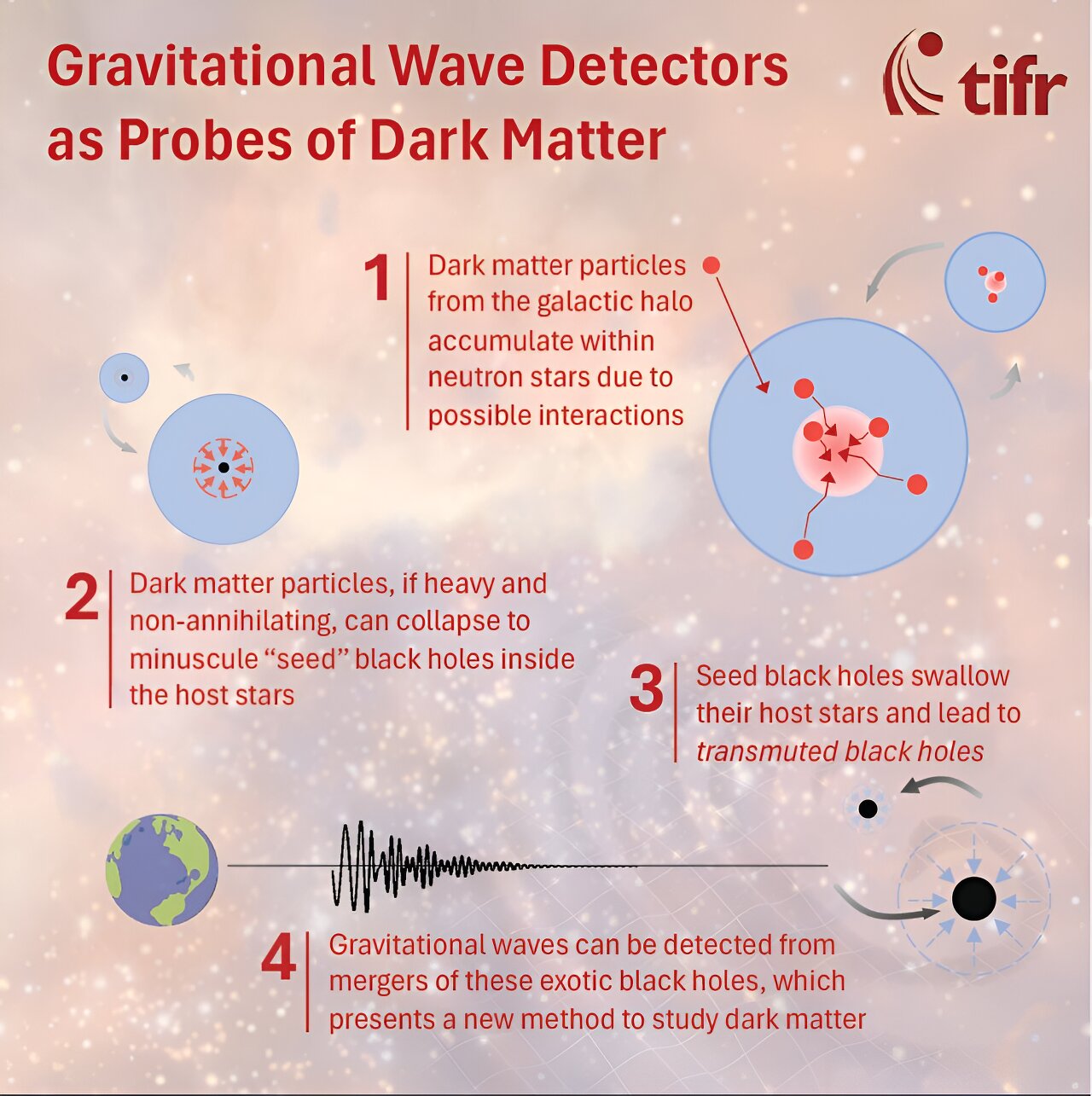
Physicists have developed a new method to investigate dark matter using gravitational wave detectors, focusing on its potential effects on neutron stars. This approach expands our understanding of dark matter beyond current detectors and could lead to future discoveries with advanced gravitational wave observatories. The study explores the accumulation of dark matter particles in neutron stars, which can collapse into low-mass black holes. By analyzing gravitational wave observations, researchers can place constraints on the properties of dark matter and potentially uncover its nature. This method offers insights into the connection between dark matter and black holes and could provide valuable hints about the nature of dark matter in the future.
A team of theoretical physicists has proposed a new method to probe dark matter using gravitational wave detectors. The method focuses on the effects of dark matter on neutron stars, suggesting that dark matter particles can accumulate in neutron stars and potentially collapse into low-mass black holes. By studying binary black hole systems and the non-detection of low-mass mergers, the researchers aim to place constraints on the properties of dark matter. This approach explores parameter space beyond the reach of current terrestrial dark matter detectors and could provide valuable insights into the nature of dark matter.
Researchers from Cal Tech's Walter Burke Institute for Theoretical Physics propose using next-generation gravitational wave detectors to study dark matter. These detectors could potentially detect signals affected by ultra-heavy dark matter particles, which interact with gravity. The researchers calculate the effects of the Doppler effect, Shapiro delay, and Einstein delay on gravitational waves caused by dark matter. They suggest that upcoming GW observatories, such as the GQuEST experiment at CalTech, could detect transiting dark matter if it is considered "ultra-heavy." Additionally, these detectors may also help constrain the existence of a theoretical fifth fundamental force known as the Yukawa interaction, which operates between dark matter and traditional particles.
Researchers from Cal Tech's Walter Burke Institute for Theoretical Physics propose using next-generation gravitational wave detectors to study dark matter. Dark matter, which makes up the majority of mass in the universe but is invisible to electromagnetic waves, interacts with gravity. The researchers suggest that ultra-heavy dark matter particles could affect the characteristics of gravitational waves, such as the Doppler effect and the Shapiro and Einstein delays. These detectors could potentially detect transiting dark matter and help constrain the existence of a theoretical fifth fundamental force known as the Yukawa interaction. This research opens up new possibilities for understanding dark matter and advancing gravitational astronomy.
Researchers at the University of the West of Scotland have developed a breakthrough in thin film technology that could enhance the sensitivity of gravitational wave detectors, allowing for a deeper understanding of the universe. The technique involves producing thin films with reduced thermal noise, which could also benefit high-precision devices like atomic clocks and quantum computers. The development of coatings with low thermal noise will make future generations of gravitational wave detectors more precise and sensitive to cosmic events.