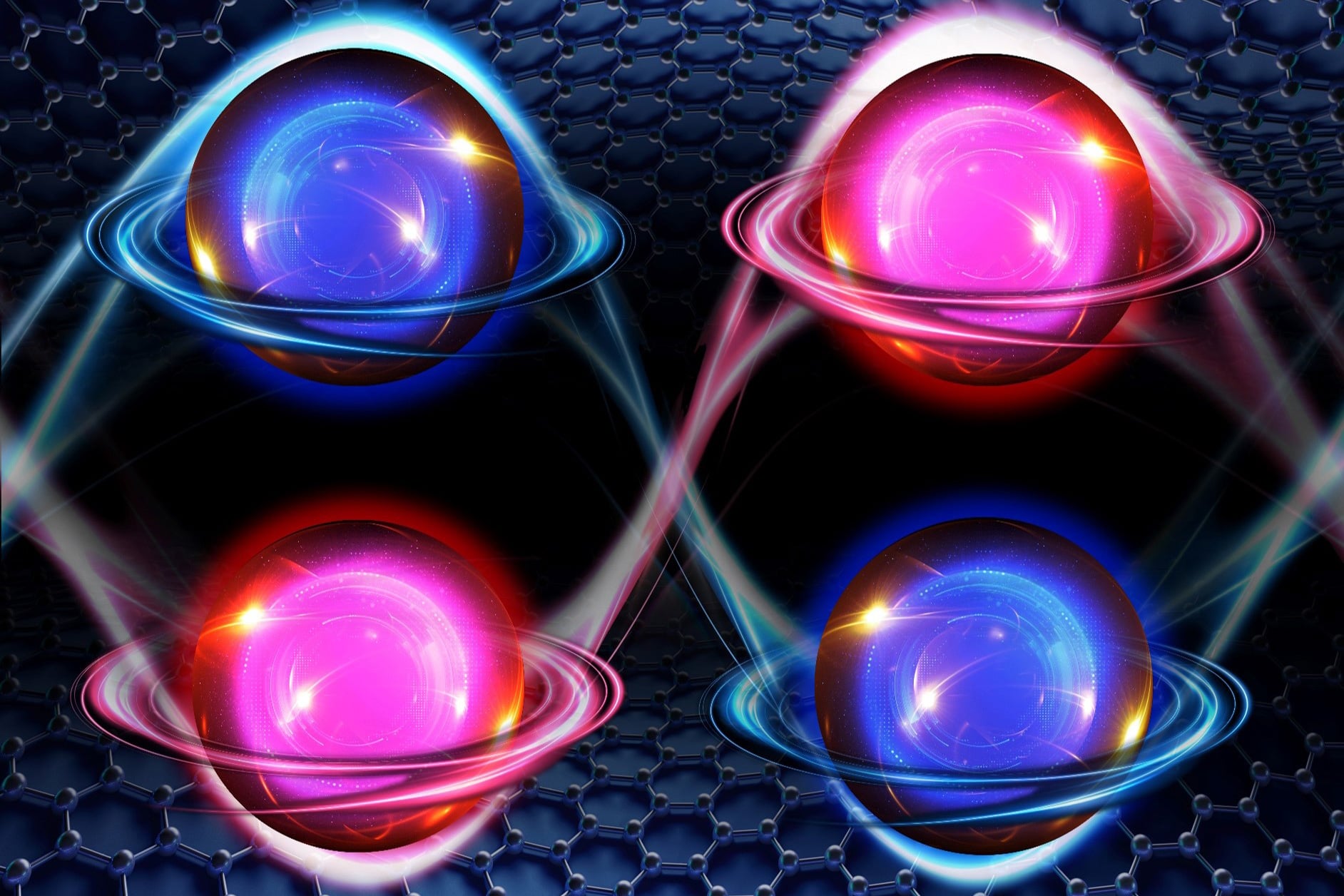
Researchers have achieved quantum entanglement between two atomic nuclei separated by 20 nanometres using electrons as 'telephones', a breakthrough that could enable scalable, integrated quantum computers based on silicon technology.
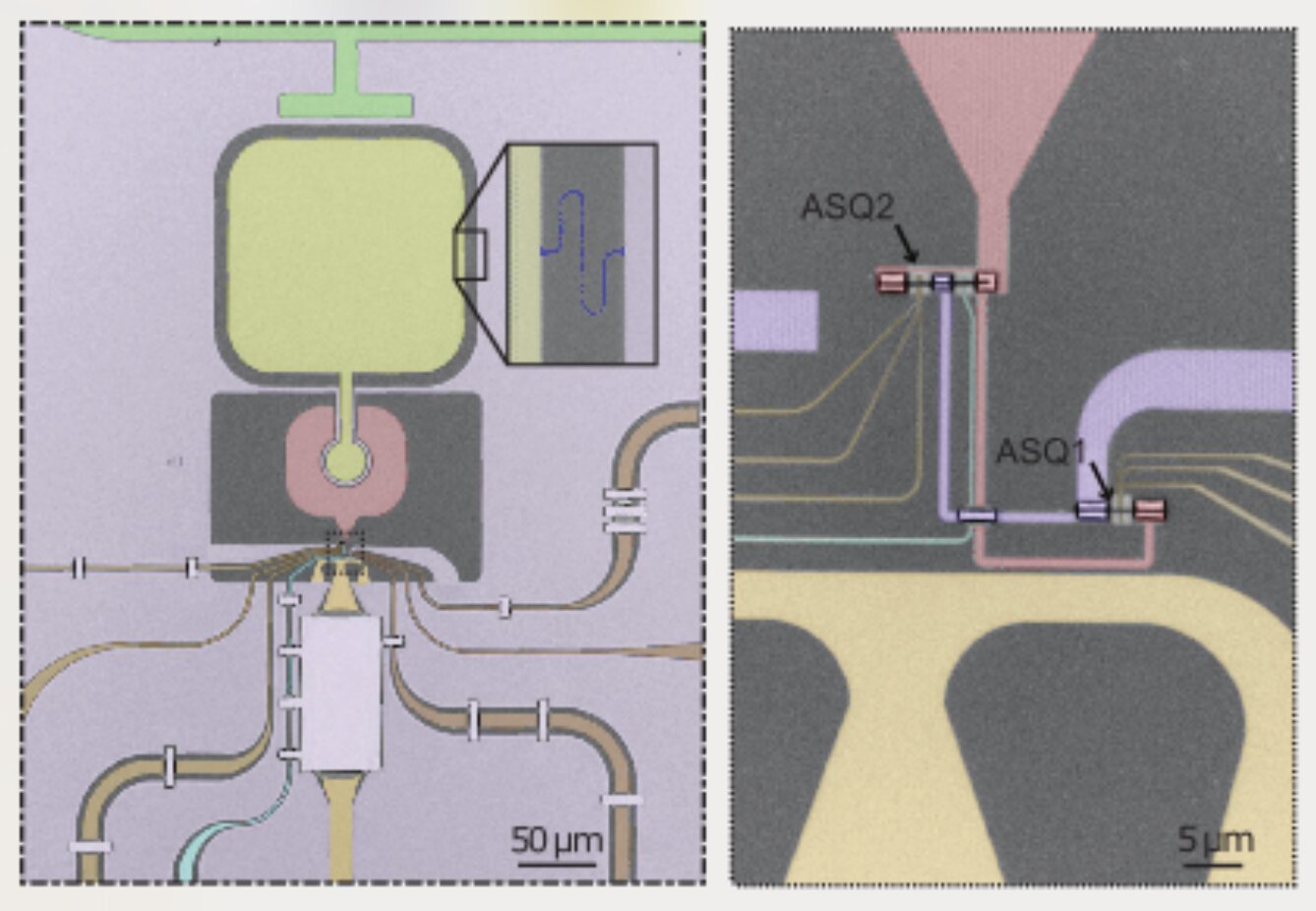
Researchers at Delft University of Technology have demonstrated strong and tunable coupling between two distant Andreev spin qubits, leveraging superconducting and semiconductor materials. This breakthrough could enhance the design flexibility and performance of quantum computers by enabling long-distance qubit coupling and closer packing of qubits. Future studies aim to improve coherence times by using cleaner semiconductor platforms.
Scientists are proposing a new "space encryption" technology that uses light particles beamed around the world via satellites to protect sensitive communications from potential decryption by future quantum computers. This approach, known as "quantum cryptography," leverages the principles of quantum mechanics to secure data transmission. A mission called "Quick3" aims to use photons to transmit data through a massive satellite network, with the system set to be tested in space in 2025. This technology could potentially provide a secure means of communication that is resistant to interception and decryption by quantum computers.
Scientists are proposing a new "space encryption" technology that uses light particles beamed around the world via satellites to protect sensitive communications from potential decryption by future quantum computers. This quantum cryptography system, known as "Quick3," encodes information into individual light particles, making it impossible to intercept without detection. The system involves transmitting data through a massive satellite network and is set to be tested in space with a satellite launch scheduled for 2025.
Physicists have long sought a problem that only quantum computers can solve, and now a team led by John Preskill may have found one. By studying the energy of certain quantum systems, they discovered a specific question that is easy for a quantum machine to answer but difficult for a classical one, providing a potential quantum advantage. This problem relates to determining a system's local minimum energy state, which has implications for chemistry and material sciences. While the result is still theoretical and requires testing on an actual quantum computer, it represents a promising step forward in the field of quantum algorithms.
Scientists at the University of California, Irvine and Los Alamos National Laboratory have developed a method to convert everyday materials into conductors for quantum computers, potentially overcoming the limitations of silicon-based computing. Quantum computers, which can compute in seconds what supercomputers would take years to complete, could revolutionize computing if built with easier-to-work materials. This research opens up possibilities for obtaining high-quality quantum materials from everyday resources.
Cybersecurity experts predict that "Q-Day," the day when quantum computers can crack codes protecting our digital data, could arrive as soon as 2025. Quantum computers are significantly more powerful than regular computers, capable of performing calculations that are currently impossible. However, the key processing units of quantum computers, known as qubits, are not yet stable enough to decrypt large amounts of data. Despite this, countries like the United States and China are investing heavily in quantum research, with North America currently leading in quantum computing development. The race to achieve quantum computing capabilities has significant implications for global security.
Physicists at Princeton University have successfully entangled individual molecules for the first time, a breakthrough that has significant implications for quantum information processing. Quantum entanglement allows molecules to remain correlated and interact simultaneously, even when separated by large distances. This achievement opens up possibilities for applications such as quantum computers, quantum simulators, and quantum sensors. The researchers used a carefully controlled experiment involving laser cooling and optical tweezers to manipulate and entangle the molecules. This research demonstrates the potential of molecules as a viable platform for quantum science.
This article highlights 10 of the most complex machines ever built, including quantum computers, the Tokamak Fusion Test Reactor, the Z Machine, the Antikythera Mechanism, the James Webb Space Telescope, the International Thermonuclear Experimental Reactor (ITER), the Deepwater Horizon, the Apollo Guidance Computer (AGC), the International Space Station (ISS), and the Large Hadron Collider (LHC). These machines have pushed the boundaries of human knowledge and technological capabilities, enabling advancements in various fields such as computing, energy, space exploration, and particle physics.
Researchers at the University of Duisburg-Essen have developed a method for extracting data from noisy signals, which could have implications for quantum computers. By analyzing the noise generated by a quantum dot sample exposed to an exciting laser, the researchers were able to determine the lifetime of spin states. This technique allows for the re-evaluation of older data and the discovery of previously hidden signals.
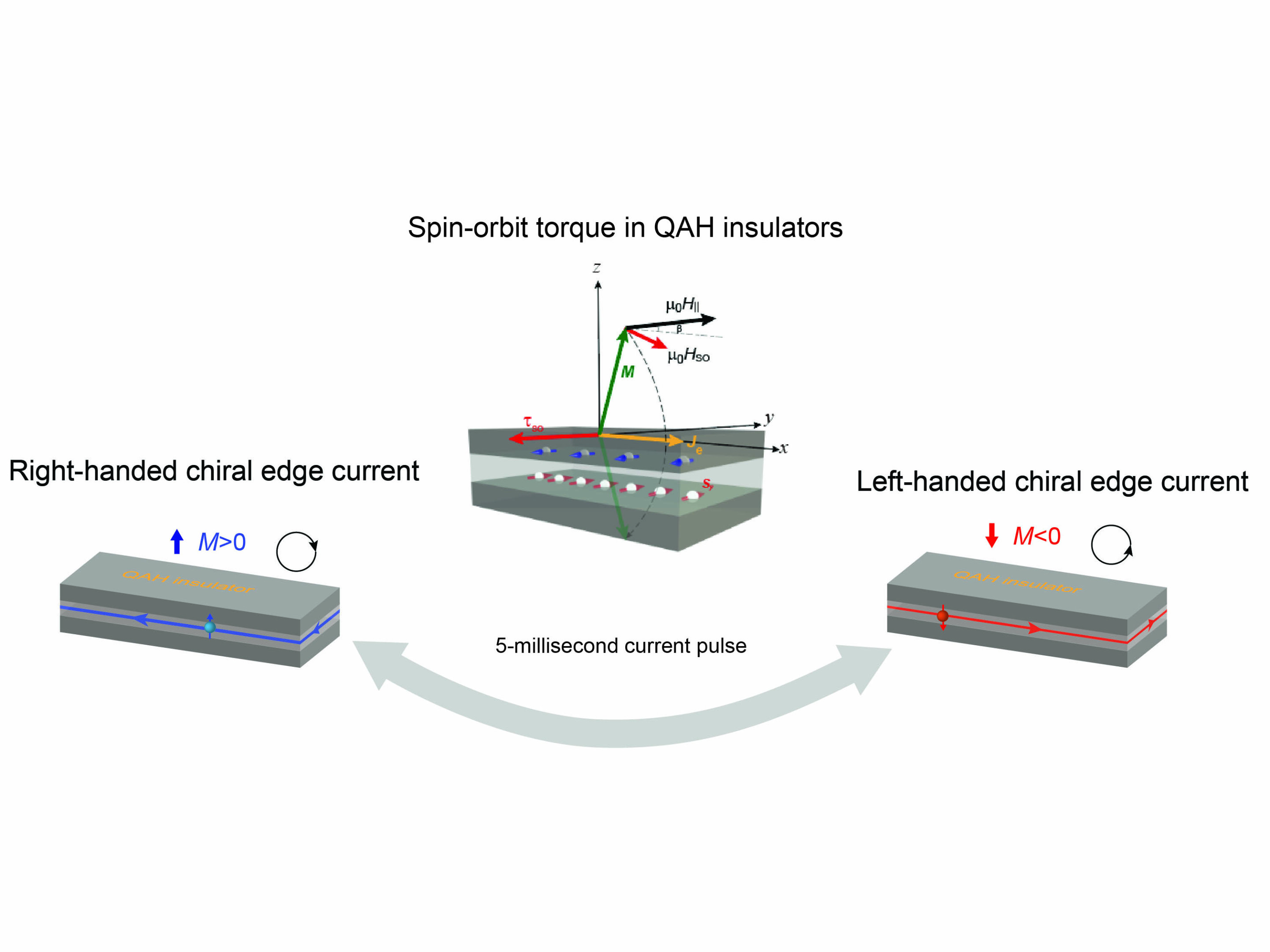
Researchers at Penn State have developed a new electrical method to control the direction of electron flow in quantum materials that exhibit the quantum anomalous Hall (QAH) effect. By applying a five-millisecond current pulse, the internal magnetism of the material is impacted, causing the electrons to change directions. This method could have implications for the development of next-generation electronic devices and quantum computers, improving the efficiency of information transfer and storage in quantum technologies. The researchers are also exploring how to pause electrons on their route and replicate the QAH effect at higher temperatures.
MIT physicists have discovered that when graphene is stacked in five layers in a rhombohedral pattern, it exhibits a rare "multiferroic" state called ferro-valleytricity, which combines unconventional magnetism and an exotic type of electronic behavior. This discovery could have implications for designing ultra-low-power, high-capacity data storage devices for classical and quantum computers, potentially doubling the amount of information that can be stored compared to conventional devices.
A cryptography expert at the University of Illinois Chicago has accused the US National Institute of Standards and Technology (NIST) of potentially weakening new encryption standards for post-quantum cryptography (PQC) with the involvement of the National Security Agency (NSA). The expert claims that NIST has made errors in calculations, artificially inflating the security of the upcoming PQC standard, Kyber512. NIST denies the allegations and states that Kyber512 meets their security criteria. However, they recommend using a stronger version, Kyber768. NIST plans to release the final PQC standards next year, but concerns remain about the influence of the NSA on encryption algorithms.
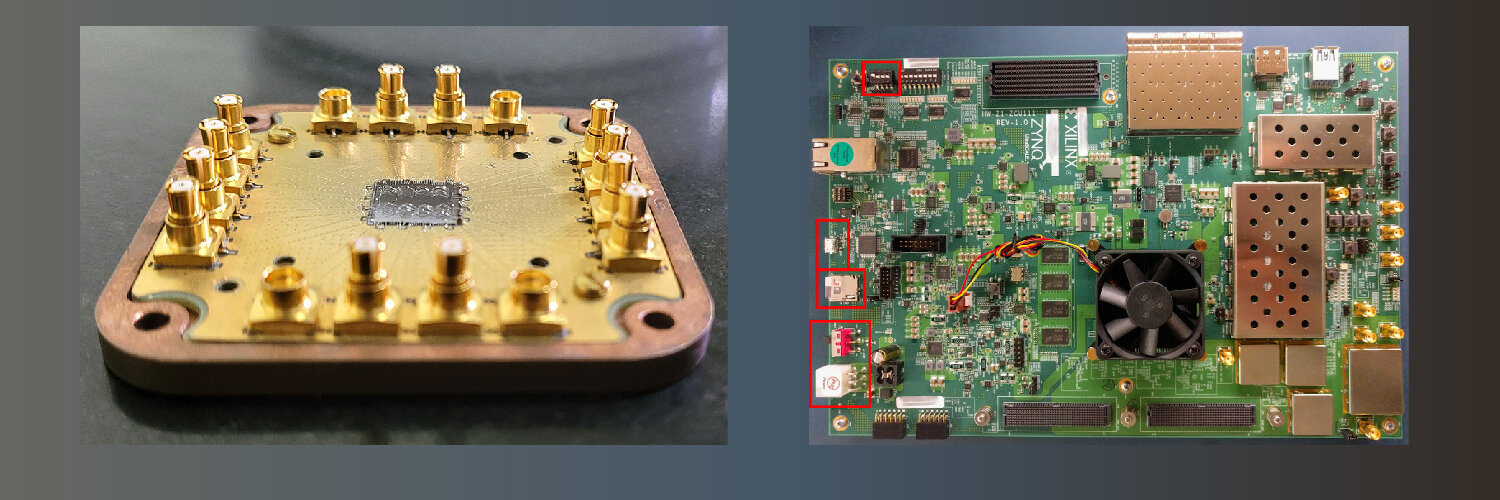
Researchers from the Indian Institute of Science (IISc) have developed a Scalable Quantum Control and Readout System (SQ-CARS) using an FPGA-based system, addressing the challenges of generating and capturing high-fidelity microwave signals for quantum computers. The SQ-CARS platform offers scalability, a user-friendly interface, and a significant reduction in cost and size, enabling physicists to carry out advanced quantum experiments at a fraction of the cost. This development lays the foundation for indigenous quantum processors and marks a deep-tech effort from India.
A recent study by Ramis Movassagh, a researcher at Google Quantum AI, mathematically demonstrates the difficulty of simulating random quantum circuits and estimating their outputs for classical computers. The study shows that this task is highly challenging, known as #P-hard, and provides computational barriers for the classical simulation of quantum circuits. Movassagh's proof, based on new mathematical techniques, is direct and does not involve approximations, allowing for explicit error bounds and quantification of robustness. The research contributes to ongoing efforts to explore the advantages of quantum computers over classical computers and could inform future studies in quantum cryptography and complexity theory.