Last week, some of the world's most precise atomic clocks were off by about five-millionths of a second due to a wind-induced power outage, highlighting the sensitivity of high-precision time standards used globally.
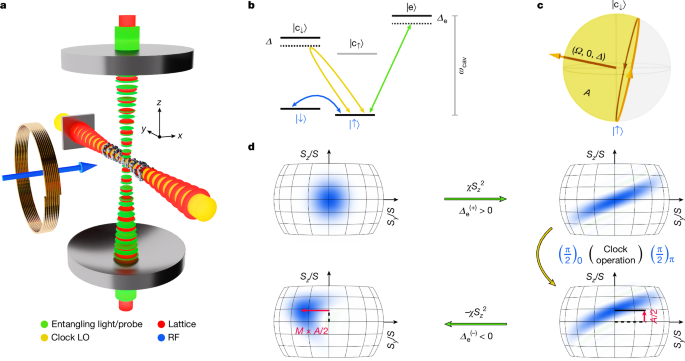
The article discusses advancements in quantum-amplified global-phase spectroscopy on optical clock transitions, highlighting recent developments in quantum metrology and atomic clock technology, including enhanced stability and precision through quantum entanglement and squeezing techniques.
A new experiment involving entangled atomic clocks could provide crucial insights into how quantum mechanics and general relativity interact, potentially advancing the quest for a unified theory of everything. The proposed experiment uses quantum networks to test the effects of gravity on quantum superpositions, which could reveal how spacetime curvature influences quantum phenomena.
Earth experienced one of its shortest days on record on July 9, 2025, due to the moon's gravitational effects, with two more such days expected this summer. This phenomenon is linked to the moon's position and gravitational pull, which can temporarily speed up Earth's rotation. Scientists monitor these variations using atomic clocks, and if the trend continues, it could lead to the need for a negative leap second to keep civil time aligned with Earth's rotation.
On July 9, 2025, Earth will experience one of its shortest days since 1960, finishing about 1.3 to 1.6 milliseconds early due to the planet's accelerated rotation, influenced by factors like the Moon's orbit and shifts in Earth's mass distribution. This short-term change is part of a series of days in 2025 with slightly faster spins, prompting scientists to monitor future data for potential negative leap seconds to keep atomic time aligned with Earth's rotation. The phenomenon is scientifically significant but poses no practical risk to daily life, aiding in climate modeling and satellite navigation research.
Timekeeping scientists are considering subtracting a leap second from atomic clocks to adjust for the Earth's faster-than-expected rotation due to climate change, marking the first instance of removing a second rather than adding one. The Earth's rotation has been gradually slowing, leading to the addition of 27 leap seconds between 1972 and 2016, but now the melting poles are causing the need for a negative leap-second correction as early as 2026. This adjustment has implications for systems reliant on precise timekeeping, such as GPS satellites and financial transactions, and highlights the complex relationship between atomic timekeeping and our understanding of time.
Earth's rotation is speeding up, potentially necessitating the subtraction of a second from world clocks around 2029, a phenomenon known as a "negative leap second." This change is attributed to the planet's hot liquid core and rapid melting of ice at the poles. The discrepancy between astronomical and atomic time, which has been managed through leap seconds, poses challenges for computer systems and technology. While some advocate for eliminating leap seconds altogether, others argue for maintaining the current system.
Earth's changing spin may necessitate the subtraction of a second from world clocks around 2029 due to the planet rotating faster than before, a situation described as "unprecedented" by scientists. The Earth's slowing rotation, caused by tides, has been counteracted by the melting of ice at the poles, delaying the need for a "negative leap second." This complex issue involves physics, global politics, climate change, and technology, with implications for timekeeping systems and computer operations. While some experts believe a negative leap second is inevitable, others argue that long-term predictions about Earth's rotation are uncertain.
Physicists have discovered a method to create highly entangled spin-squeezed states in multilevel atoms by harnessing superradiance inside an optical cavity, leading to the generation of dark states that are immune to superradiance and emit light at a much slower pace. This breakthrough could significantly enhance the precision of atomic clocks and quantum metrology, offering opportunities for quantum-enhanced measurements and potential applications in noise reduction.
Researchers at JILA and NIST have observed millihertz-level cooperative Lamb shifts in an optical atomic clock, shedding light on the intricate interactions within atomic clocks and their potential impact on clock accuracy. By using a cubic lattice to measure specific energy shifts within an array of strontium-87 atoms, the team demonstrated the influence of dipole-dipole interactions on clock performance and the importance of understanding and controlling these interactions at high density. The study's findings could lead to improved timekeeping precision and further exploration of quantum physics in clock systems.
Delegations from around the world will gather in Dubai to discuss the issue of reconciling two different ways of keeping time: Universal Time (UT1) based on Earth's rotation, and International Atomic Time (TAI) based on cesium atoms. The divergence between these two times has created a headache for technology companies and timekeepers, leading to the proposal of a new solution called the leap minute. This would involve syncing the clocks less frequently, allowing atomic time to diverge from astronomical time for 60 seconds or longer. The proposal will be discussed at the upcoming international conference, but consensus among all attending nations, including Russia, is required for any change to be implemented.
Scientists have identified scandium as a promising element for the development of nuclear clocks, which could offer accuracy up to 1 second in 300 billion years. Unlike atomic clocks that rely on electron shell oscillation, nuclear clocks use the oscillation of the atomic nucleus for enhanced timekeeping. Scandium's atomic resonances are more acute than those of electrons, making it a potential candidate. However, generating the necessary oscillation in scandium requires X-rays with high energy levels. The researchers demonstrated a resonant width of only 1.4 femtoelectronvolts, suggesting an accuracy of 1:10,000,000,000,000. This advancement could have applications in extreme metrology, nuclear clock technology, and ultra-high-precision spectroscopy.
An international research team has made a significant breakthrough in the development of atomic clocks by creating a pulse generator based on scandium that is a thousand times more precise than the current standard atomic clock based on cesium. Using the X-ray laser at the European XFEL, the team achieved an accuracy of one second in 300 billion years, compared to the current standard of one second in 300 million years. Atomic clocks have numerous applications, including precise positioning using satellite navigation, and the breakthrough opens up possibilities for ultrahigh-precision spectroscopy and the measurement of fundamental physical effects.
A new study suggests that atomic clocks, known for their incredible precision, could be used to detect certain low-mass particles theorized to be part of dark matter. By measuring variations in atomic clock timings, researchers from the University of Sussex and the National Physical Laboratory propose a method to observe the effects of ultralight particles, such as axions, on fundamental constants. This approach could provide insights into the elusive nature of dark matter and potentially extend to other unexplained phenomena. The research, published in the New Journal of Physics, offers a promising avenue for further exploration in particle physics.
Scientists are using atomic clocks to investigate the nature of dark matter and search for new physics beyond the Standard Model. Atomic clocks measure time using atoms with two energy states, and any variation in their resonance frequencies could indicate the presence of ultra-light particles associated with dark matter. By comparing two clocks, one sensitive to changes in fundamental constants and the other less sensitive, researchers can set constraints on these particles. This technique could also potentially be used to study dark energy. The results of this research are set to be published in the New Journal of Physics.