The US and UK have signed a Memorandum of Understanding to collaborate on advancing science and technology in areas like AI, nuclear energy, and quantum computing, aiming to lead global innovation, enhance security, and promote economic growth through joint research, policy development, and strategic initiatives.
Researchers at Kyoto and Hiroshima Universities have developed a new method to measure the W state of three entangled photons, enabling more efficient quantum state identification and advancing quantum communication and computing technologies.
Researchers have developed a new ultra-thin, tunable optical device inspired by butterfly wings, enabling dynamic control of nonlinear optical processes at visible wavelengths, with potential applications in camouflage, biosensing, and quantum computing.
Scientists have used a blue laser and an enhanced optical technique to detect the elusive optical Hall effect in everyday metals like copper and gold, revealing hidden magnetic behaviors and opening new avenues in spin physics, quantum tech, and electronics without extreme conditions or wires.
A team of European physics educators is advocating for a new approach to teaching quantum physics in schools by focusing on two-state systems, or qubits, which are fundamental to modern quantum technologies like quantum cryptography and computing. This method, which emphasizes understanding through the quantum measurement process, is believed to be more effective than traditional historical approaches. The research, led by Professor Philipp Bitzenbauer, suggests that this focus could make quantum technologies more accessible to students, aligning with the upcoming International Year of Quantum Science and Technology in 2025.
Researchers at ETH Zurich have detected topological effects in an artificial solid using cold atoms, demonstrating a surprising reversal in quantum systems. By creating an artificial solid with controllable interactions, the team observed topological pumping, where particles were transported in a specific direction, and a reversal occurred when encountering an obstacle. The researchers also found that repulsive interactions between atoms created an invisible barrier, leading to further unexpected behavior. These findings could contribute to a better understanding of interacting topological systems and potentially be applied in quantum technologies, such as creating a qubit highway for quantum computers.
Researchers have achieved a historic breakthrough by creating an interface that allows two machines to connect and share stored quantum information, marking the first tangible steps towards a "quantum internet." By matching the properties of light emitted by semiconductor quantum dots with the requirements of atomic quantum memories, the team demonstrated the storage and retrieval of single photons with high efficiency and quantum character. This achievement paves the way for hybrid quantum networks, enabling applications such as unhackable communication, distributed quantum computing, enhanced sensing, and fundamental tests of quantum mechanics over large scales. Despite challenges, the potential payoff is immense, and the future of quantum networking looks promising.
Physicists at Princeton University have discovered a new quantum state, "hybrid topology," in arsenic crystals, merging edge and surface states in a unique quantum behavior. This groundbreaking finding, published in Nature, has significant implications for developing new quantum devices and technologies. The discovery opens up possibilities for engineering new topological electron transport channels and designing future nanodevices and spin-based electronics. The observation of the combined topological edge mode and the surface state may enable the development of quantum information science and quantum computing devices. This finding also paves the way for potential applications in quantum technologies and "green" technologies.
Physicists at the University of Regensburg have observed the shift of a quantized electronic energy level with atomic oscillations faster than a trillionth of a second, using an ultrafast microscope to directly control and observe the process. This breakthrough discovery could be crucial for the development of super-fast quantum technologies, as it enables the local control of discrete energy levels in the most direct way, potentially leading to new functionalities in materials and the unraveling of key processes behind phase transitions like high-temperature superconductivity.
LSU researchers have made a breakthrough in understanding the fundamental properties of plasmonic waves, revealing new behaviors that challenge existing understanding. By isolating multiparticle subsystems, the team observed non-classical behaviors in surface plasmons, such as exhibiting characteristics of both bosons and fermions. This discovery has significant implications for the development of more sensitive and robust quantum technologies, with potential applications in fields such as medical diagnostics, drug development simulations, environmental monitoring, and quantum information science. The study marks a milestone in quantum plasmonics research and is poised to impact quantum simulations worldwide.
An international research team has made a pivotal discovery in high-temperature superconductivity by quantifying the pseudogap pairing in fermionic lithium atoms, deepening our understanding of quantum superfluidity and holding promise for enhancing global energy efficiency through advancements in computing, storage, and sensor technologies. The study, published in Nature, observed and quantified the pseudogap in a strongly attractive interacting cloud of fermionic lithium atoms, shedding light on the microscopic mystery of high-temperature superconductivity and potentially leading to applications in future quantum technologies.
Scientists have discovered a new quantum state of matter with chiral currents, a breakthrough with potential applications in electronics, quantum technologies, sensors, biomedicine, and renewable energy. This discovery, confirmed through direct observation using the Italian Elettra synchrotron, enriches our understanding of quantum materials and could lead to the development of new types of electronics and optoelectronic devices. The research group's findings, published in Nature, have verified the existence of this quantum state, previously only theorized, and could revolutionize the development of new ultra-thin electronic devices.
Quantum physicist Mickael Perrin is using graphene nanoribbons to build nanoscale power plants that can convert waste heat from electrical equipment into electricity with minimal loss, aiming to revolutionize the practical application of quantum technologies. His research has garnered prestigious awards and recognition, and he leads a research group at Empa while also serving as an Assistant Professor of Quantum Electronics at ETH Zurich. Perrin's work focuses on combining thermodynamics and quantum mechanics to achieve electricity production with almost zero energy loss, utilizing graphene nanoribbons with unique properties that allow for efficient conversion of thermal energy into electricity even at higher temperatures. However, there are still challenges to overcome before this technology can be practically implemented in devices like smartphones.
The DarkQuantum consortium, consisting of global institutions, is embarking on a six-year project to detect the elusive axion particle and unravel the mysteries of dark matter. Led by researchers at Aalto University, the consortium will utilize quantum technologies to develop highly sensitive detectors, including a high-frequency sensor called a haloscope. The project aims to capitalize on quantum phenomena to filter out noise and repeat experiments with greater fidelity, potentially leading to a significant discovery comparable to the Higgs boson. The European Research Council has awarded the consortium €12.9 million to support their research.
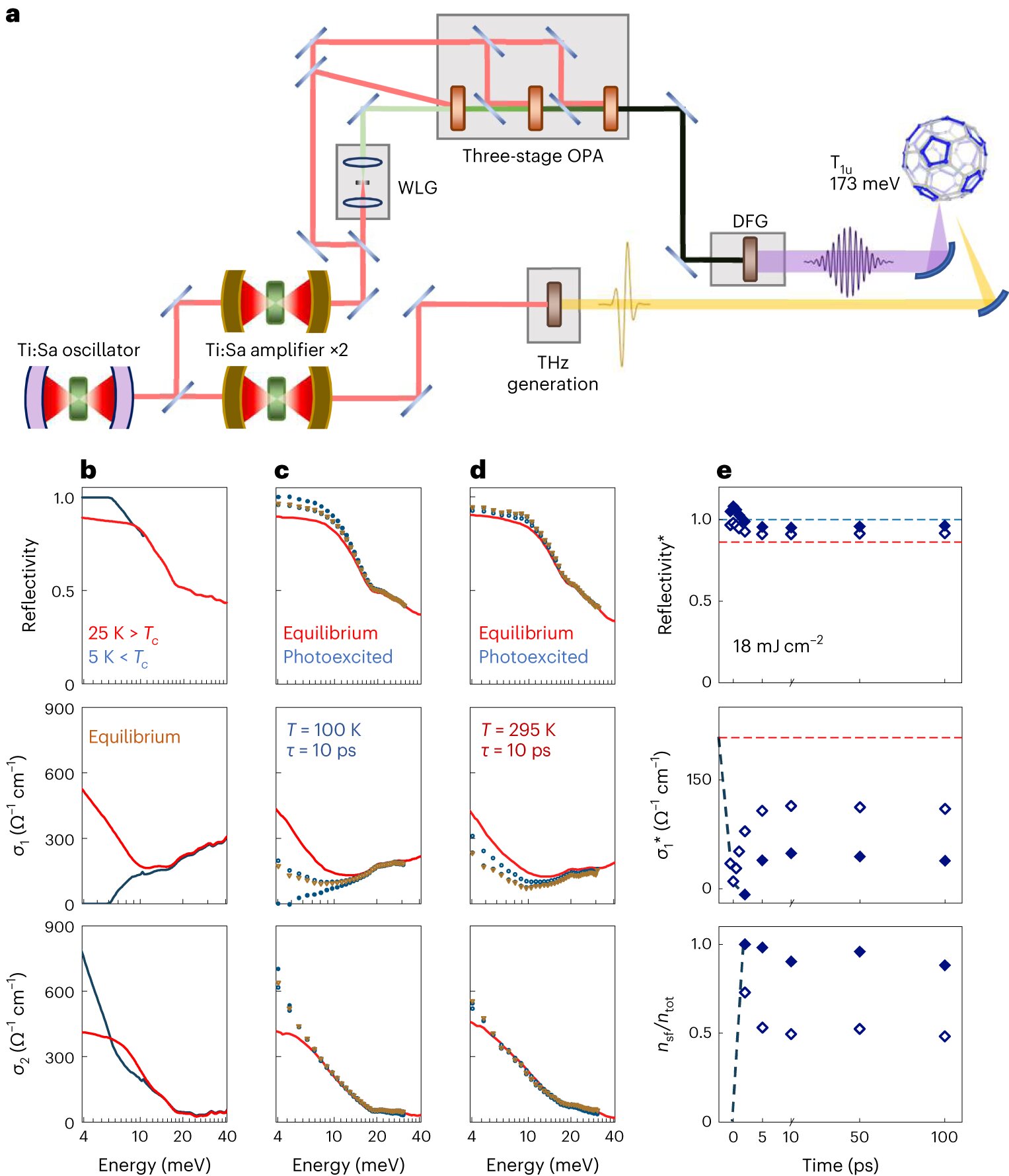
Researchers have identified a strategy to enhance the light-induced superconductivity of the material K3C60. By using a special optical source that is more tunable, they were able to increase the photo-susceptibility of this superconducting material by two orders of magnitude. This strategy could have implications for the development of light-driven quantum technologies and prolonging photo-induced superconductivity for longer periods of time.