Lower UK productivity forecasts by the OBR are expected to lead to increased government borrowing, which may force the government to raise taxes to meet its fiscal rules, especially since productivity growth has been weak since 2010 and has been downgraded from optimistic forecasts, making tax hikes more likely in the upcoming budget.

Rachel Reeves, the UK Chancellor, publicly addressed her emotional moment in the House of Commons, attributing her tears to personal issues. Despite the incident, she expressed confidence in her role and was supported by Prime Minister Rishi Sunak and Labour leader Keir Starmer. The event temporarily affected government borrowing costs, but market confidence was restored after her colleagues' support. Reeves emphasized her commitment to her job amid ongoing political and financial challenges.
The head of the Congressional Budget Office warns that the unprecedented levels of US government borrowing could trigger a damaging market reaction, with federal debt projected to surpass World War II levels by 2029. Both Democrats and Republicans are blamed for fiscal profligacy, and economists are concerned about the potential impact of renewing the 2017 tax cut program. While Congress needs to act quickly to address the federal debt pile, cooperation from a divided Congress may be challenging, and a fiscal crisis could come as early as next year if there is no course correction.
Treasury yields faced pressure as European bonds experienced a selloff, raising concerns among investors about interest rates and government borrowing needs. U.S. bond markets were closed for Thanksgiving and had an early finish on Friday.
Concerns are mounting over the possibility of a financial market crisis in major developed economies due to record debts, high interest rates, and escalating spending needs. Developed economies, including the United States, Italy, and Britain, are particularly worrisome, with investors demanding higher compensation for holding long-term bonds. Governments must deliver credible fiscal plans, raise taxes, and stimulate growth to manage their finances effectively. The risk of a policy misstep triggering a market rout is heightened by geopolitical tensions and the withdrawal of central bank support. Efficient spending, reforms, and growth plans are crucial to address the mounting debt and avoid a crisis in the next decade.
Economists at the Kansas City Federal Reserve's annual central banking symposium in Jackson Hole, Wyoming, have concluded that the sharp rise in public debt loads over the past decade and a half is likely irreversible. Despite concerns about the growth-crimping implications of high debt, reducing debt-to-GDP ratios is unlikely in practice due to factors such as population aging, the need for public financing in areas like healthcare and pensions, rising interest rates, political divisions, and the broadening pool of creditors. Governments will have to live with high inherited debts and will need to implement spending limits, consider tax hikes, and improve bank regulation to manage the situation.
The bond market inversion, where investors charge the government more to borrow for two years than for 10 years, has reached its steepest level since 1981. While this is often seen as a sign of an impending recession, it may not necessarily indicate one.
The US Treasury Department has asked federal agencies if they can delay upcoming payments as senior Biden officials search for ways to conserve cash and prevent the US government from facing an unprecedented default. Without additional borrowing, a fresh burst of tax revenue or new ways to slow spending, the federal government expects to miss a payment for the first time in modern history in early June. The White House is looking for ways to buy more time for President Biden and House Speaker Kevin McCarthy to cut a deal to raise the federal debt ceiling, which sets a legal limit on government borrowing.
The US government's deadline to raise the $31.4tn debt ceiling could be sooner than expected, with weaker-than-expected tax receipts for the April filing season pulling forward the risk of a debt default that could have wide repercussions across global financial markets. The Treasury can use cash on hand and extraordinary measures to generate cash once the debt limit is reached. Some Treasury bills are featuring a premium in their yields that may be tied to an elevated default risk, according to some analysts. An actual US debt default would likely send shockwaves through global financial markets, as investors would lose confidence in the US ability to pay its bonds, which are seen as among the safest investments and serve as building blocks for the world's financial system.
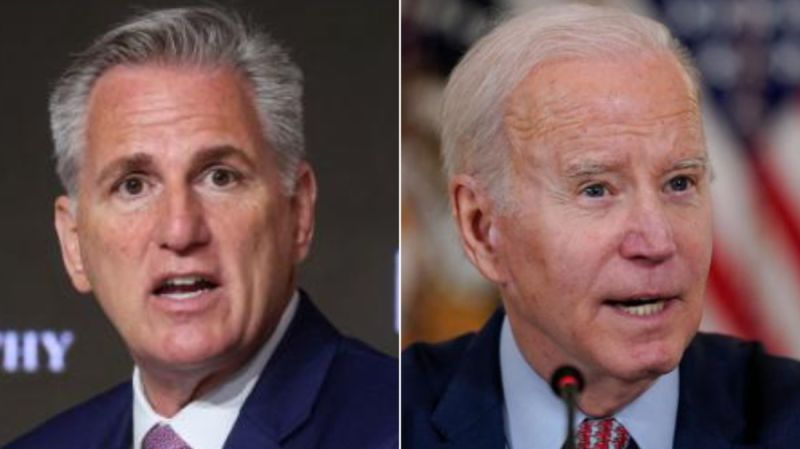
House Speaker Kevin McCarthy warns that the House GOP majority will refuse to lift a cap on government borrowing unless President Biden agrees to spending cuts that would effectively neutralize his domestic agenda. McCarthy traveled to Wall Street to deliver his message.