In 2026, Americans generally consider a net worth of around $2.3 million to be wealthy, with perceptions influenced by inflation and the need for sustainable income from investments, highlighting that wealth thresholds are evolving and depend on individual goals and age.
President Trump proposed a one-year cap of 10% on credit card interest rates, targeting a highly profitable banking sector, but industry groups warn this could significantly reduce credit availability and harm consumers, especially riskier borrowers. The move has sparked debate over the impact on banks' profitability and consumer access to credit, with potential adjustments including higher fees and reduced rewards. The proposal faces resistance from banking trade groups and lawmakers, amid ongoing discussions about regulating interest rates.
The S&P 500 reached a new intraday high on Friday, supported by a mixed jobs report showing 50,000 new jobs in December and a slight decrease in the unemployment rate to 4.4%. Major indices are on track for a weekly gain, with the market reacting positively to economic stability and government actions like Trump's mortgage bond purchase plan. Several stocks hit 52-week highs, and the market opened in the green, reflecting investor optimism amid ongoing economic and political developments.
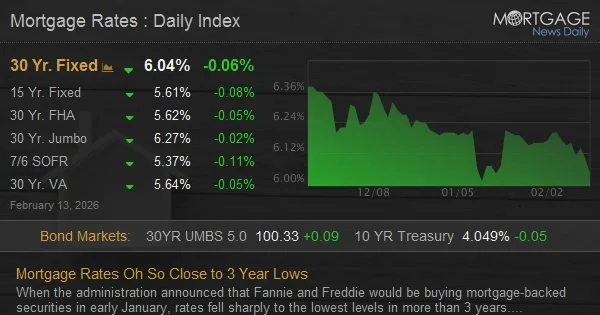
Mortgage rates have been relatively stable but could decrease below 6% if government mortgage agencies buy $200 billion in bonds, with current averages around 6.16% for 30-year fixed mortgages. Experts predict rates will stay near these levels through 2026 and into 2027, with some variation depending on economic factors.
Goldman Sachs Research predicts the S&P 500 will rally 12% in 2026, driven by moderate economic growth, continued AI investment, and strategic sector rotations, despite concerns about market concentration and valuation levels.
Research shows that following Dave Ramsey's advice to claim Social Security at 62 is financially disadvantageous, as it results in significantly lower benefits compared to delaying until 70, which increases benefits by 24%. Early claiming incurs penalties that reduce monthly benefits by 30%, making it a costly mistake for most retirees.
Despite geopolitical turmoil and President Trump's aggressive actions, the US dollar has remained resilient, reaching a one-month high due to strong job market data and doubts about the extent of upcoming Federal Reserve interest rate cuts, highlighting the unpredictable nature of markets in the Trump era.
U.S. Treasury yields increased ahead of the key jobs report, with investors monitoring economic data and geopolitical events. The upcoming nonfarm payrolls report is expected to show job growth, influencing Federal Reserve decisions. Initial jobless claims were slightly below estimates, and markets remain cautious amid ongoing geopolitical concerns.
Stock futures are nearly unchanged after the S&P 500 and Dow hit new highs, with the market reacting positively to recent geopolitical events and strong earnings, while geopolitical tensions and potential military actions remain a concern for future market stability.
In response to the unprecedented events in Venezuela involving U.S. military actions and political charges, investors are advised to consider safe-haven assets like gold and cash, monitor oil prices and oil company stocks, but generally maintain a long-term, steady investment approach without making drastic changes.
The IRS advises taxpayers to prepare early for the 2026 filing season by reviewing new tax laws, using online accounts, opting for direct deposit, and reporting income from digital assets and online sales to ensure a smooth tax filing process.
The US dollar edged higher against major currencies amid mixed signals on Federal Reserve interest rate policy, with some officials advocating for aggressive cuts and others emphasizing data-driven adjustments. Currency markets showed limited impact from recent geopolitical tensions, while the euro and pound experienced slight declines following softer inflation data in Europe and the UK. The Australian dollar reached over a one-year high, reflecting positive global sentiment, and overall market movements remained subdued amid ongoing economic data releases.
Wall Street analysts have issued a series of upgrades and downgrades for various companies, with notable upgrades for Medtronic, Saia, Allegiant Travel, Stryker, and Brinker, and downgrades for Shopify, Chevron, Exxon Mobil, Halliburton, Phillips 66, Lennar, D.R. Horton, and Wells Fargo, reflecting changing market sentiments and outlooks for 2026.