Tag

Dark Energy Survey

All articles tagged with #dark energy survey

science1 year ago

Einstein's Theories Reinforced by Latest Space-Time and Dark Energy Discoveries

Researchers using data from the Dark Energy Survey have found slight discrepancies between the predicted and observed curvature of space-time, as described by Einstein's general relativity. While measurements from 6 and 7 billion years ago align with predictions, those from 3.5 and 5 billion years ago show shallower gravity wells than expected. This could suggest a link between the Universe's accelerating expansion due to dark energy and the slower growth of gravity wells. Further observations are needed to confirm these findings, which currently show a 3 sigma incompatibility with Einstein's predictions.

science1 year ago

Einstein's Relativity Faces New Challenges from Recent Discoveries

Recent research using data from the Dark Energy Survey suggests potential deviations from Einstein's general relativity, particularly in the behavior of gravitational wells over time. While Einstein's predictions align with observations from 6-7 billion years ago, discrepancies appear closer to the present, coinciding with the universe's accelerated expansion. These findings, published in Nature Communications, indicate that gravity might operate differently on large scales, prompting further investigation with more precise data from the Euclid space telescope.

science1 year ago

Geneva Team Challenges Einstein's Relativity with New Time-Space Calculations

A team of scientists from the universities of Geneva and Toulouse III—Paul Sabatier have used data from the Dark Energy Survey to test Einstein's theory of general relativity by measuring the distortion of time and space. Their findings, published in Nature Communications, show that while Einstein's predictions align with observations from 6 to 7 billion years ago, they are slightly off for more recent periods, suggesting gravity might operate differently on large scales. Further precise measurements, including those from the Euclid space telescope, are needed to confirm these results.

science-and-technology1 year ago

"AI Reveals Insights into the Enigma of Dark Energy"

The Dark Energy Survey, led by a UCL research team, has utilized AI and simulation techniques to double the precision of dark energy measurements, providing insights into the Universe's structure and potential new cosmological models. By inferring the influence and properties of dark energy from a map of dark and visible matter in the Universe, the study suggests that the matter in the Universe is more smoothly spread out than previously thought, challenging Einstein's theory of general relativity. The use of AI and simulations has allowed researchers to refine cosmological models and may lead to a better understanding of the unexpected smoothness of the Universe.

astronomy2 years ago

Unraveling the Mysteries of Dark Energy and the Universe's Expansion

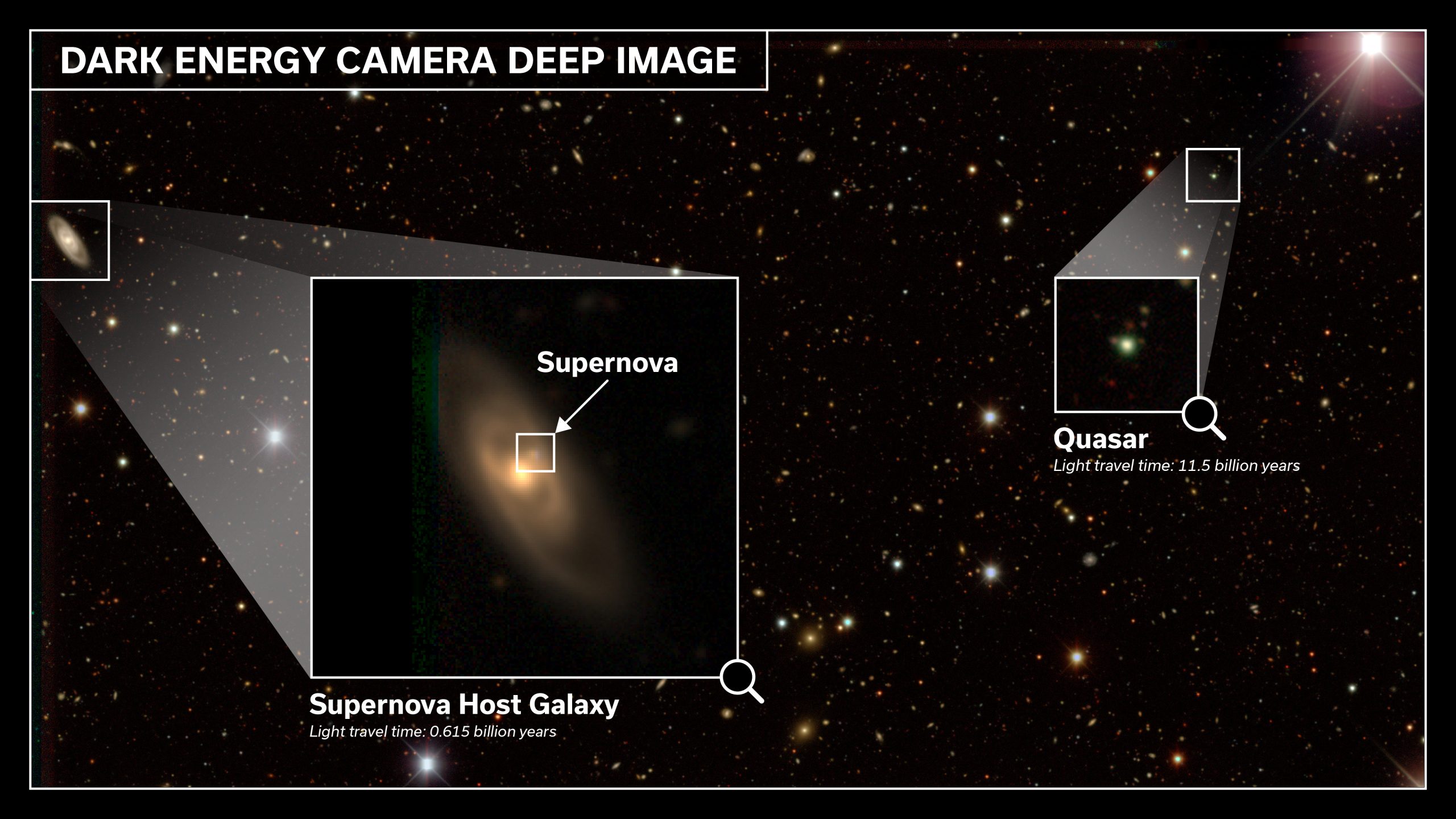
The Dark Energy Survey, conducted over a decade, has provided new insights into the accelerating expansion of the universe. By observing over 1,500 supernovas, the survey suggests that dark energy, the force driving this expansion, may vary in density over time, challenging the standard model of cosmology. The results, presented at the American Astronomical Society meeting, indicate that the universe's expansion may not be constant, potentially requiring a more complex explanation than the current model. The survey's findings, based on the observation of Type Ia supernovas, triple the known number of supernovas at certain distances, shedding light on the nature of dark energy and its role in cosmic evolution.

science2 years ago

"Unraveling the Mystery of Dark Energy: New Insights and Discoveries"

The Dark Energy Survey (DES) has released its final measurement at the 243rd American Astronomical Society meeting, providing one of the best measurements yet of the elusive parameter "w" that describes the nature of dark energy. This measurement, which gives a value of -0.8, challenges the predicted value of -1, indicating that dark energy may not be the cosmological constant proposed by Einstein. However, the uncertainty in the measurement leaves room for the predicted value. The results may signal the end of "Big Rip" models and pave the way for future supernova experiments with next-generation telescopes, shedding more light on the nature of dark energy.

astronomy2 years ago

"Unraveling the Mystery of Dark Energy: Decade-long Discovery Sheds New Light on Universe's Expansion"

The Dark Energy Survey (DES) has released results from a decade-long study involving over 400 scientists, revealing that the density of dark energy in the universe may have varied over time. This challenges previous understandings and offers new insights into the expansion of the universe. Using pioneering methods and machine learning, the study analyzed over 1,500 supernovae, providing the strongest constraints on the expansion of the universe to date. The findings, consistent with the accelerated expansion model, represent a significant leap in supernova cosmology and pave the way for future discoveries about dark energy.

astronomy2 years ago

"Unveiling Dark Energy: Insights into the Universe's Expansion and Stability"

The Dark Energy Survey (DES) has released its final measurement at the 243rd American Astronomical Society meeting, providing one of the most precise measurements yet of the elusive parameter "w" for dark energy. This measurement, which gives a value of -0.8, challenges the predicted value of -1, potentially indicating that dark energy may not be the cosmological constant proposed by Einstein. However, the uncertainty in the measurement leaves room for the possibility of it still being the cosmological constant. The results may signal the end of "Big Rip" models, and future telescopes like ESA's Euclid mission and the Vera Rubin Observatory are expected to provide more data for further understanding of dark energy.

astronomy2 years ago

"Unveiling the Universe's Expansion: New Insights on Dark Energy from Supernova Study"

The Dark Energy Survey (DES) has released the results of a comprehensive analysis using the supernova technique, placing the strongest constraints on the expansion of the universe ever obtained with the DES supernova survey. The findings are consistent with the standard cosmological model of a universe with accelerated expansion, but not definitive enough to rule out a more complex model. The DES collaboration, comprising over 400 astrophysicists, astronomers, and cosmologists, used advanced techniques to analyze data from 1,500 new high-redshift type Ia supernovae, making it the largest, deepest supernova sample from a single telescope ever compiled. The results suggest that dark energy may vary with time, and while more data is needed for a definitive conclusion, the pioneering techniques developed by DES will shape future astrophysical analyses.

astronomy2 years ago

"AI-assisted Insights: Unraveling the Mystery of Dark Energy in the Expanding Universe"

Astronomers have used the Dark Energy Survey (DES) to make a precise measurement of the amount of dark energy in the Universe over the last 9 billion years, finding that it likely remains constant. By studying supernovae and using advanced AI techniques, they determined that the density of dark energy is probably constant, with a parameter value of (w = -0.80) and an uncertainty range. This measurement is crucial for predicting the future evolution of the cosmos and will be refined with future observations.