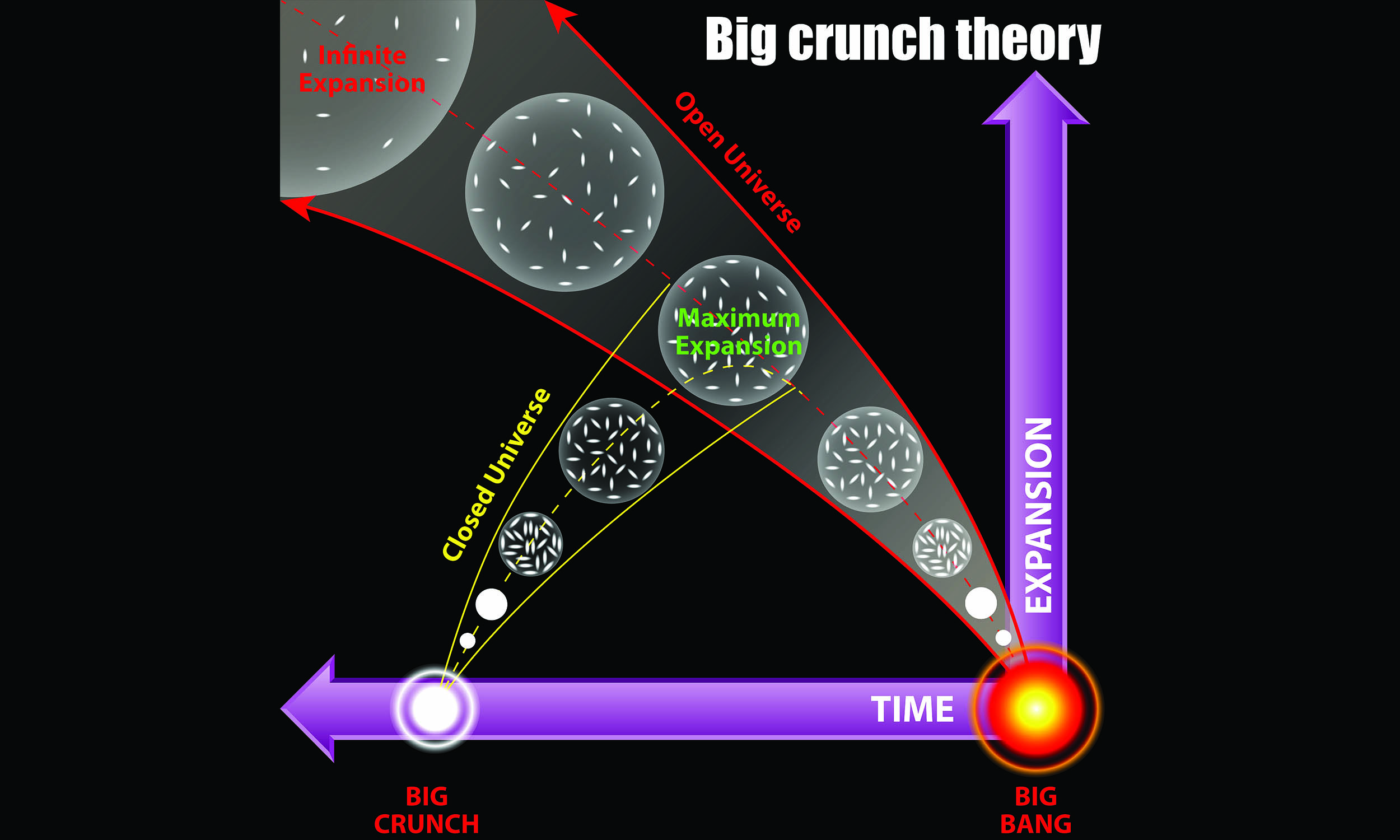
A Cornell physicist suggests that based on new dark energy data, the universe will stop expanding in about 11 billion years and eventually collapse in a 'big crunch' roughly 20 billion years from now, indicating a possible end to the universe's lifespan.
Scientists propose a model where the universe could stop expanding and collapse into a Big Crunch in about 20 billion years, based on new data suggesting dark energy might be changing over time and a potential negative cosmological constant, challenging the idea of eternal expansion.
Physicists suggest that if dark energy is evolving as recent data indicates, the universe may end in a Big Crunch in about 33.3 billion years, reversing its expansion due to a negative cosmological constant and the influence of ultralight axion particles, though this remains a hypothesis pending further data.
Physicists suggest that if dark energy is evolving as recent data indicates, the universe may end in a Big Crunch in about 20 billion years, reversing its expansion due to a negative cosmological constant and the influence of ultralight axion particles, though this remains a hypothesis pending further data.
A new study suggests the universe may not expand forever but could eventually reverse and collapse in a 'big crunch' in about 33 billion years, based on a model involving a negative cosmological constant and dark energy dynamics, challenging previous assumptions of endless expansion.
A Cornell physicist's new analysis suggests that the universe, currently expanding, will eventually reverse and collapse in a 'big crunch' about 20 billion years from now, based on recent dark energy data indicating a negative cosmological constant.
Recent evidence suggests that dark energy, previously thought to be a constant, may actually be evolving over time, but the data is still inconclusive and interpretations vary among scientists. The debate revolves around whether dark energy is changing, which could impact our understanding of the universe's expansion, or if current measurement discrepancies are due to errors or biases. Future missions are expected to clarify whether dark energy is indeed dynamic or remains a cosmological constant.
Recent surveys suggest dark energy may be evolving, potentially leading to a future universe collapse in about 33 billion years, much sooner than previously thought, due to a complex model involving a negative cosmological constant and axions, though these findings are preliminary and speculative.
New observations from the Dark Energy Spectroscopic Instrument (DESI) suggest that dark energy, the force driving the universe's accelerated expansion, may be weakening, challenging the standard Lambda Cold Dark Matter (LCDM) model. This finding could lead to a paradigm shift in cosmology, potentially indicating a "Big Crunch" end for the universe instead of a "Big Rip" or "Big Chill." The discovery of evolving dark energy would be as revolutionary as the initial discovery of the universe's accelerated expansion. Further observations from DESI and the Euclid space telescope are expected to provide a more comprehensive understanding of dark energy and the universe's fate.
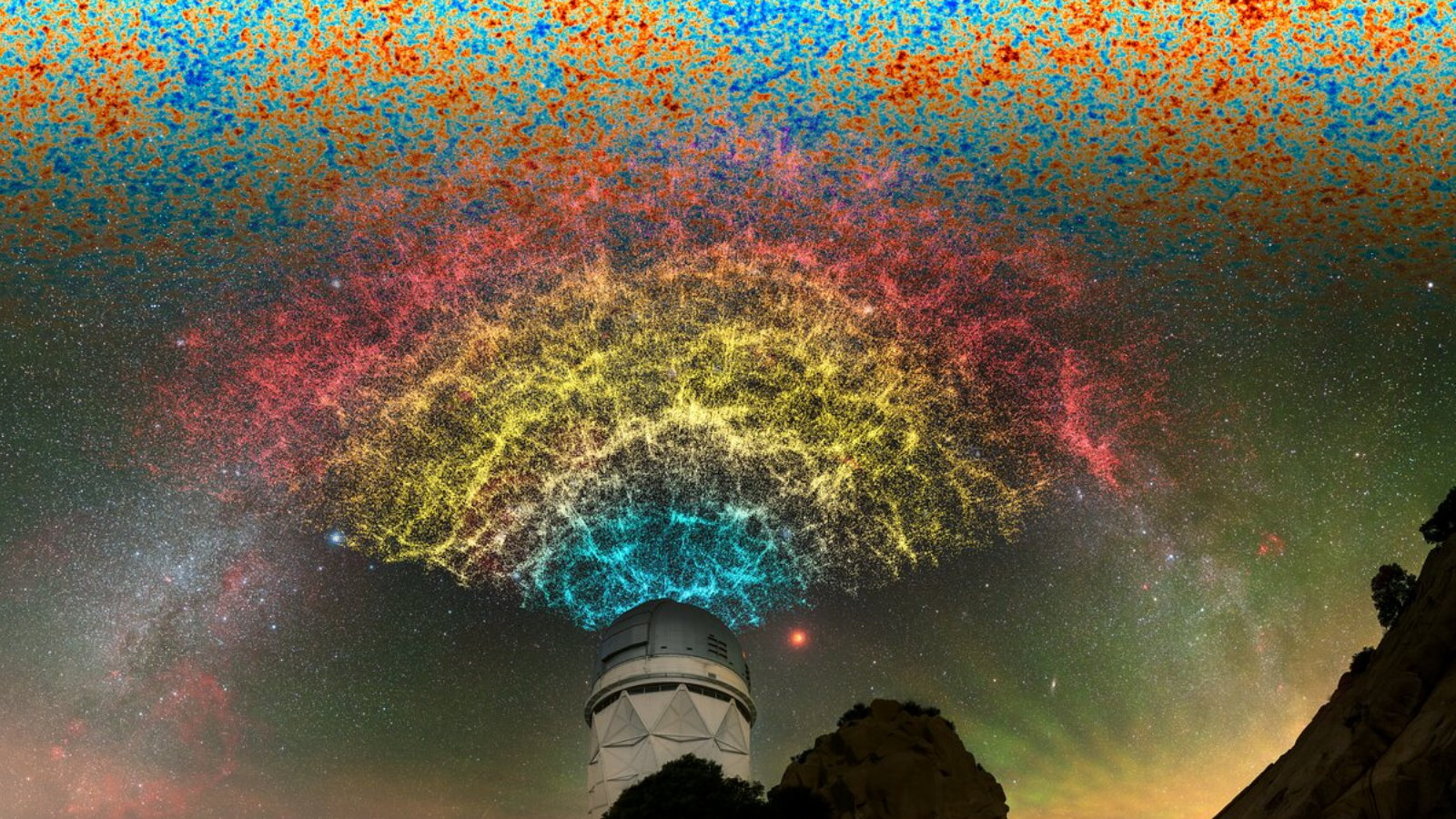
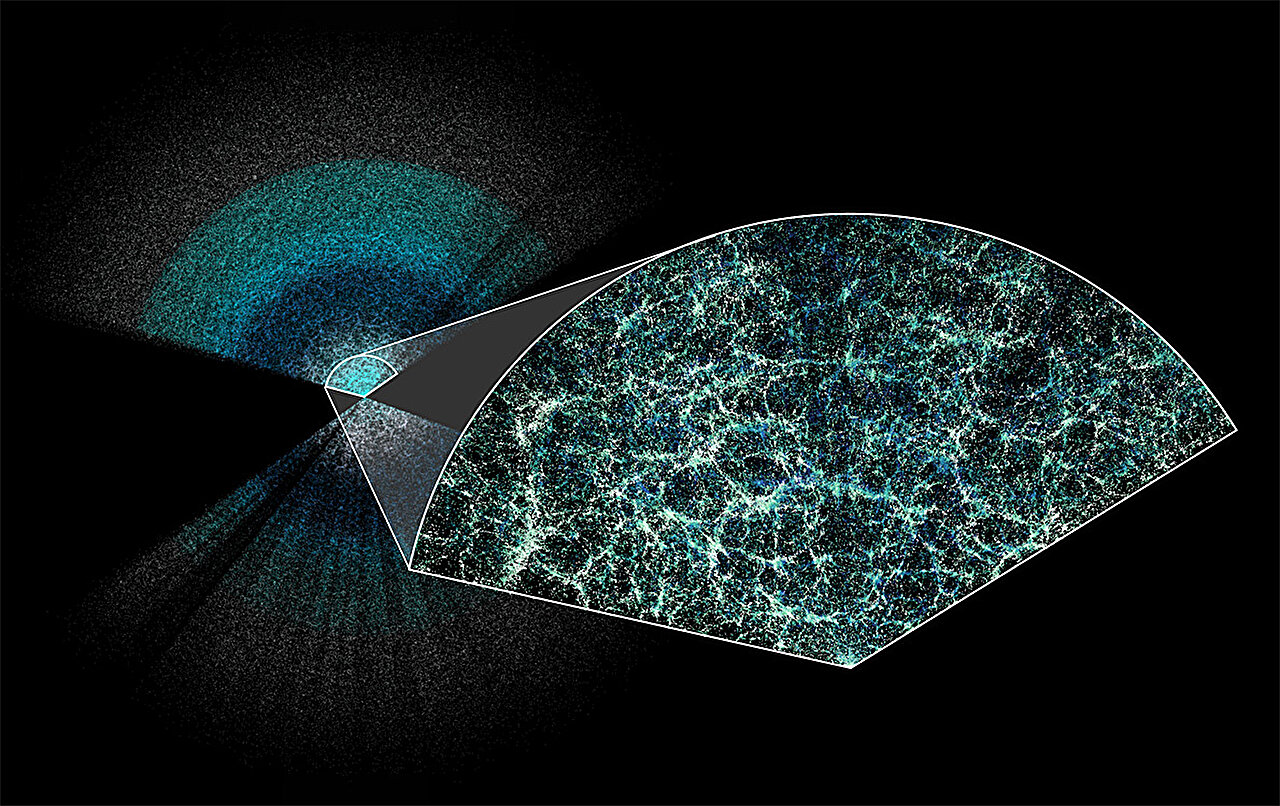
Early results from the Dark Energy Spectroscopic Instrument (DESI) suggest that the universe's accelerated expansion may be slowing down, challenging our understanding of dark energy and the cosmos. DESI has created the largest 3D map of the universe to date, observing six million galaxies and quasars up to 11 billion years into the past. If confirmed, these findings could indicate that dark energy is evolving over time, potentially requiring a reevaluation of our current understanding of the universe and its expansion.
A new paper by University of Ottawa physics professor Rajendra Gupta challenges the existence of dark matter, suggesting that the universe is twice as old as current models suggest and doesn't require dark matter to exist. Gupta's theory, which builds on his previous work about the universe's age, proposes a revised model based on a "covarying coupling constant" and the tired light hypothesis, arguing that dark matter doesn't have to be part of the equation at all. This controversial claim directly contradicts prevailing theories and is expected to face pushback from Gupta's peers.
Physicist Alexander Vilenkin discusses the fine-tuning of the universe and the cosmological constant, suggesting that the universe's constants appear to be finely tuned for life and mind. He introduces the idea of a multiverse to explain this fine-tuning but acknowledges the failure to derive the constants from a fundamental theory. Vilenkin rejects the notion of a designed universe, citing the cosmological constant's lack of a special value and its role in entropic selection. However, the cosmological constant's nature and its theoretical support remain unclear, leading to debates about the universe's potential design.
Physicists are exploring the concept of a "dark dimension" within the framework of string theory to explain the minuscule value of the cosmological constant and the potential emergence of lightweight, weakly interacting particles. This theory posits the existence of dark gravitons, which could serve as candidates for dark matter and have implications for the distribution of galaxies. While the idea is intriguing, some physicists remain skeptical, but upcoming experiments, including cosmological surveys and laboratory tests, may provide evidence to support or refute the dark dimension hypothesis and shed light on the nature of dark matter and the forces of gravity.
The Dark Energy Survey (DES) has released its final measurement at the 243rd American Astronomical Society meeting, providing one of the most precise measurements yet of the elusive parameter "w" for dark energy. This measurement, which gives a value of -0.8, challenges the predicted value of -1, potentially indicating that dark energy may not be the cosmological constant proposed by Einstein. However, the uncertainty in the measurement leaves room for the possibility of it still being the cosmological constant. The results may signal the end of "Big Rip" models, and future telescopes like ESA's Euclid mission and the Vera Rubin Observatory are expected to provide more data for further understanding of dark energy.
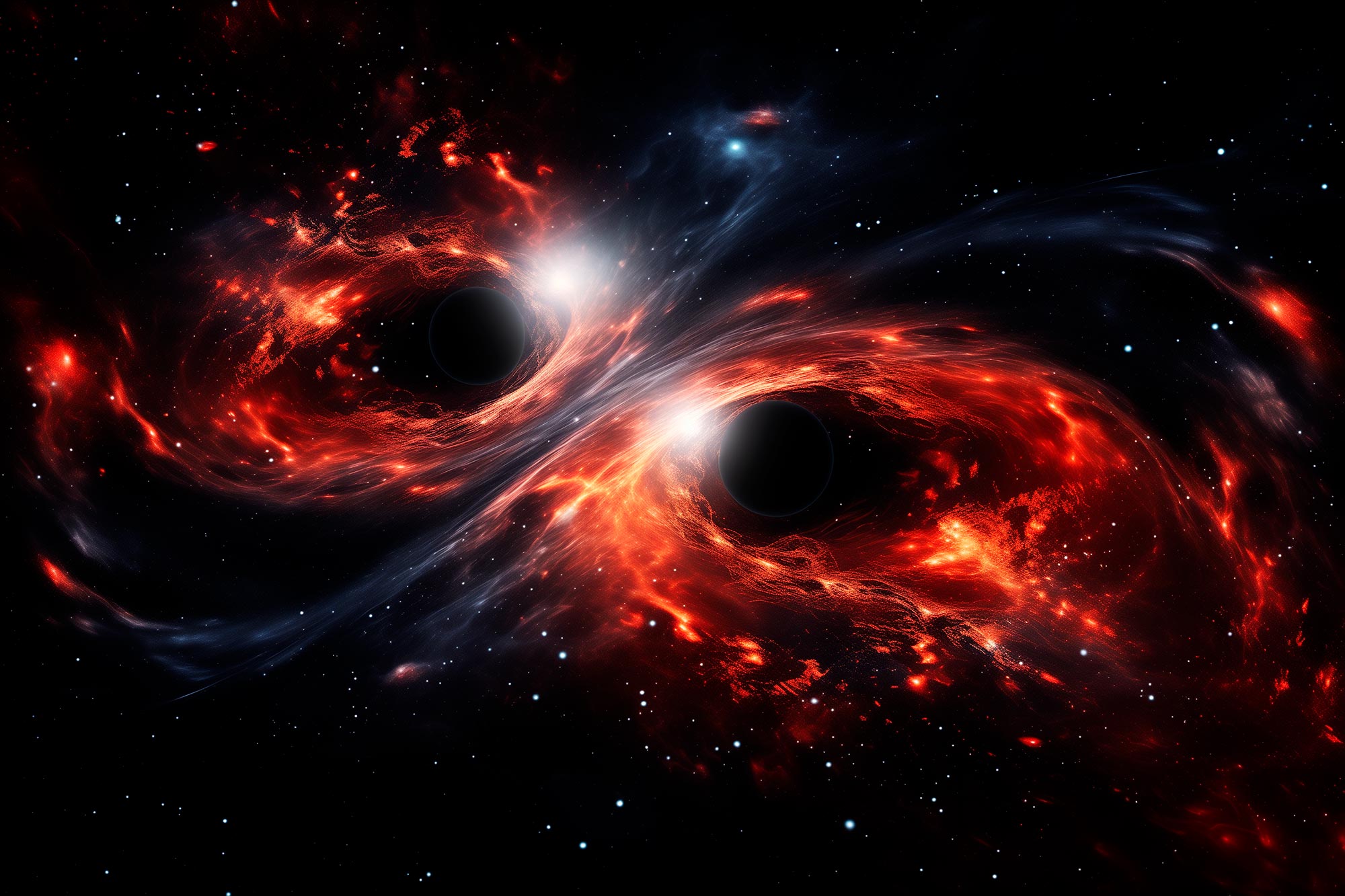
A new theory suggests that black holes can exist in balanced pairs, appearing as one due to a force called the 'cosmological constant'. This force, combined with gravitational attraction, keeps the black holes at a fixed distance despite the Universe's expansion. Researchers have shown that it is theoretically possible for black holes to exist in perfectly balanced pairs, held in equilibrium by the cosmological constant, mimicking a single black hole. This challenges conventional theories and opens up possibilities for understanding the behavior of black holes in an ever-expanding Universe.