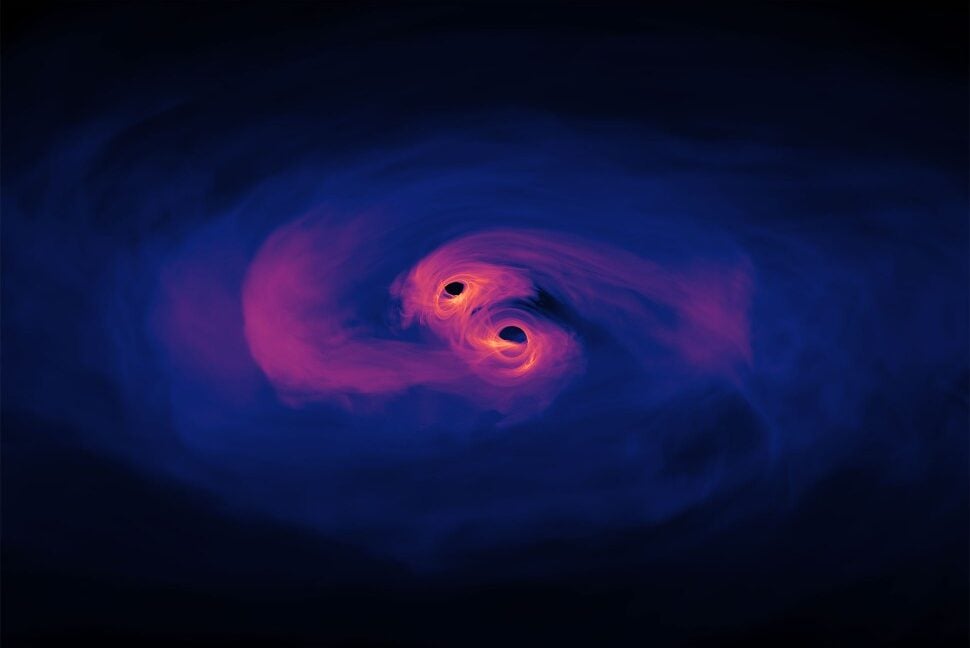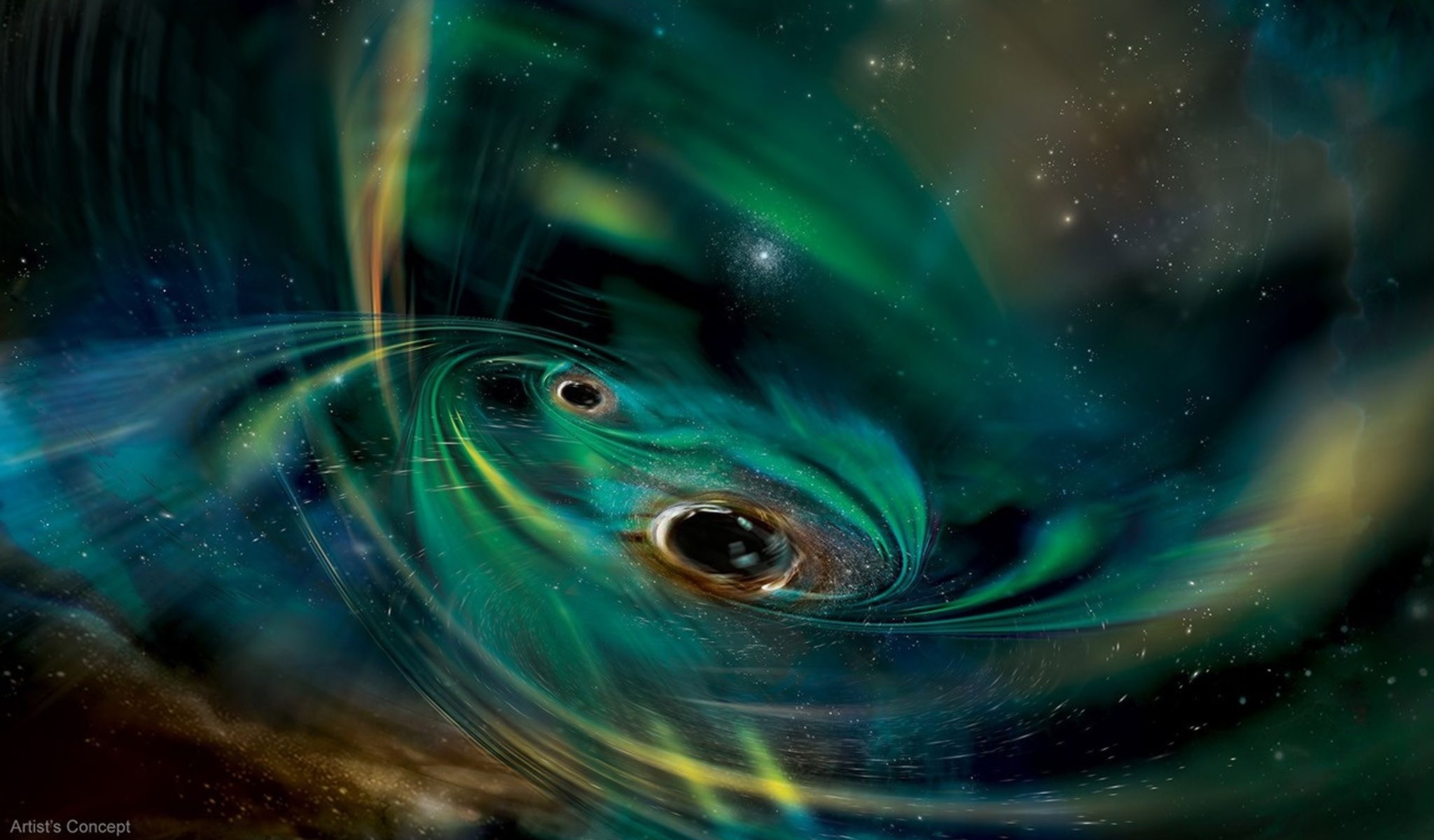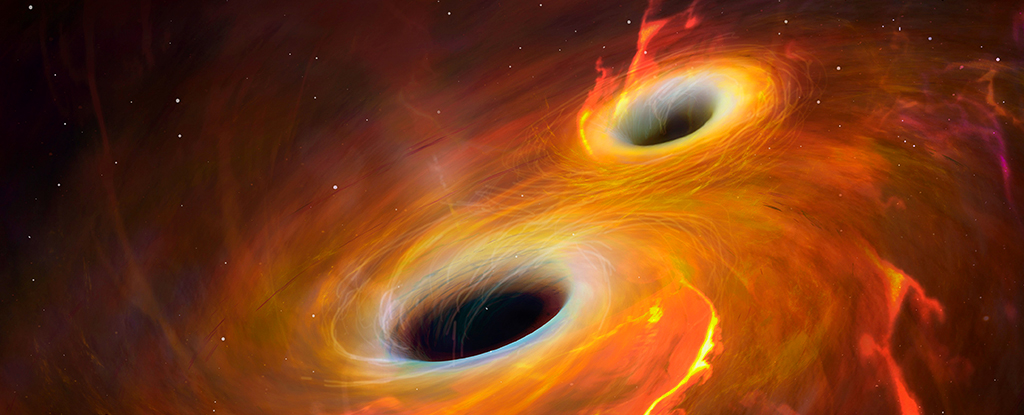
Researchers have observed unusual flares from a binary supermassive black hole system, AT 2021hdr, located in the Cygnus constellation. These flares, occurring every 60 to 90 days, are believed to be caused by the black holes passing through and disrupting a massive gas cloud, rather than consuming a star. This discovery, made using NASA's Zwicky Transient Facility and Neil Gehrels Swift Observatory, challenges previous assumptions about such phenomena and suggests that the black holes are accreting large amounts of gas from the cloud.
Astronomers have identified a pattern of high-energy bursts from a distant galaxy, initially thought to be a supernova, as emissions from a pair of supermassive black holes on the verge of merging. Observations using the Neil Gehrels Swift Observatory revealed periodic ultraviolet and X-ray light bursts, consistent with simulations of binary black holes interacting with a gas cloud. The black holes, with a combined mass of 40 million Suns, orbit each other every 130 days and are expected to merge in about 70,000 years. Further observations are planned to refine the model and study their interaction with the galaxy.
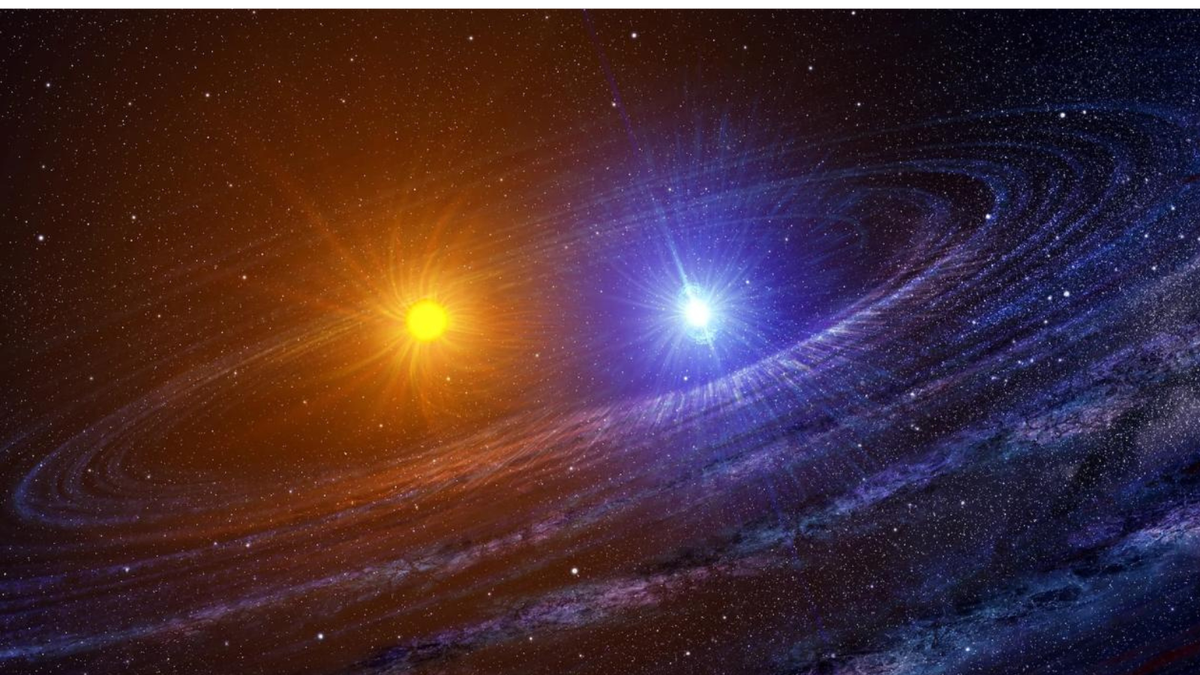
The fate of a star is primarily determined by its initial mass and metallicity, but the presence of a companion star can significantly alter its evolutionary path. In binary systems, interactions such as mass transfer can lead to phenomena like novae, supernovae, or the formation of exotic objects like Thorne–Żytkow objects. Companions can also prevent supernovae by siphoning mass, leading to the creation of unusual white dwarfs or direct black hole formation. These interactions highlight the complex dynamics in multi-star systems and their impact on stellar evolution.
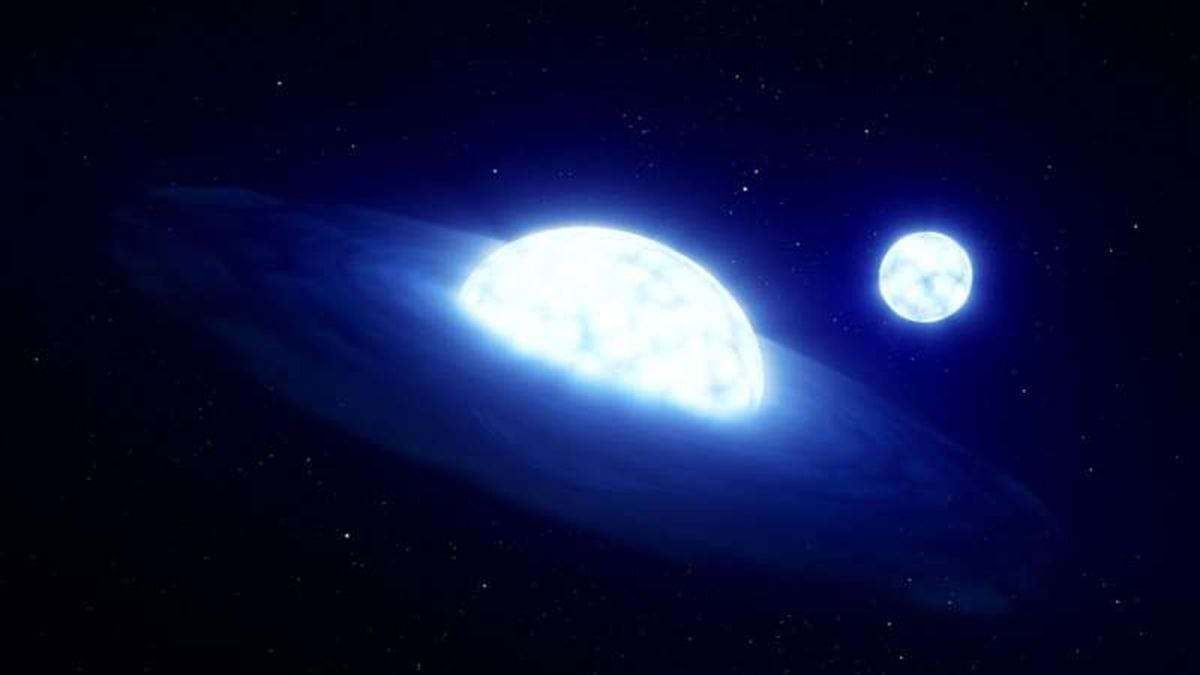
Astronomers may have discovered that blue supergiant stars are formed when two stars in a binary system merge, solving a long-standing mystery. The team of researchers analyzed 59 early B-type blue supergiants and conducted stellar simulations, finding that mergers may be the dominant channel for producing these extreme stars. This discovery could have significant implications for understanding the birth of blue supergiant stars and the role of binary star mergers in shaping galaxies. The next step for the researchers is to investigate how the supernova explosions of blue supergiant stars create neutron stars and black holes.
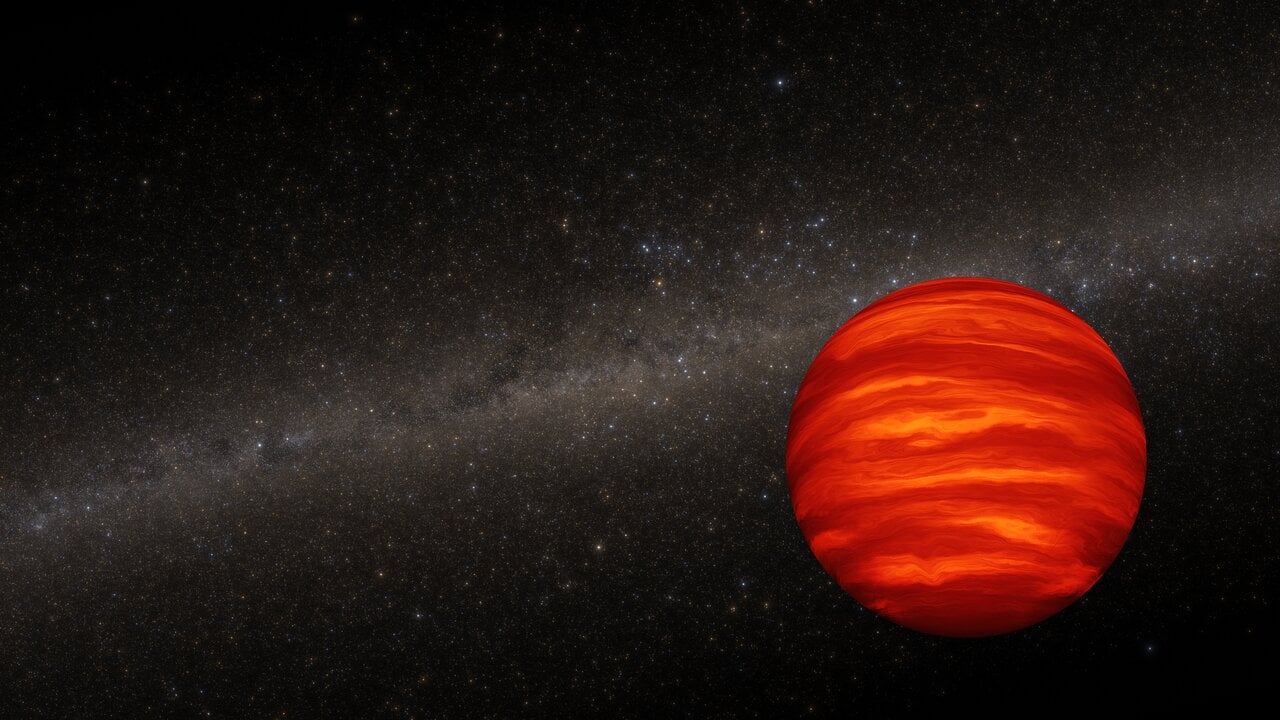
A recent survey using the Hubble Space Telescope has found that ageing brown dwarfs, which are larger than Jupiter but smaller than stars, are less likely to have companions as they get older. This suggests that binary pairs of brown dwarfs do not survive over time, likely due to the weak gravitational hold between them and the disruptive influence of passing stars. The survey provides evidence that most brown dwarfs remain single for the majority of their long existence, supporting the theory that they are born the same way as stars but do not have enough mass to sustain nuclear fusion.
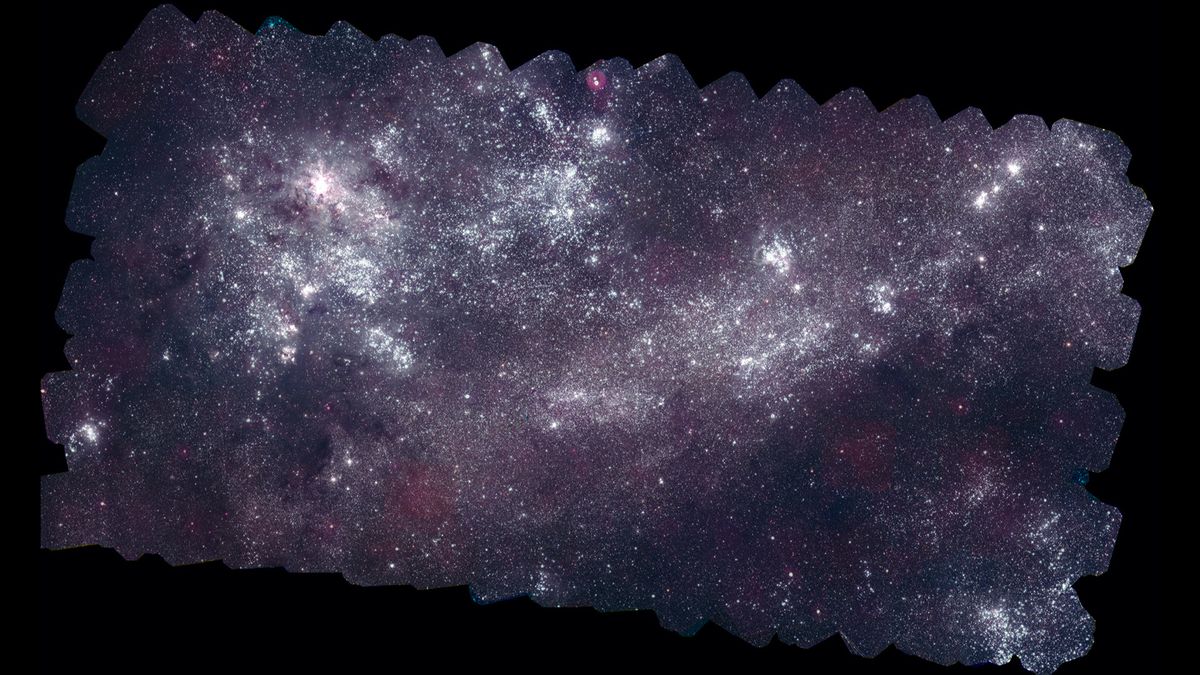
Astronomers have discovered a population of stars in nearby dwarf galaxies that are the long-sought progenitors of a specific type of supernova. These stars, which have been theorized but not observed until now, are stripped of their outer hydrogen layers, leaving behind hydrogen-poor environments. The researchers have identified 25 stars in the Large and Small Magellanic Clouds that appear to be stripped of their hydrogen envelopes, many of which are part of binary systems. The discovery has implications for our understanding of supernovas, gravitational waves, and the light from distant galaxies.
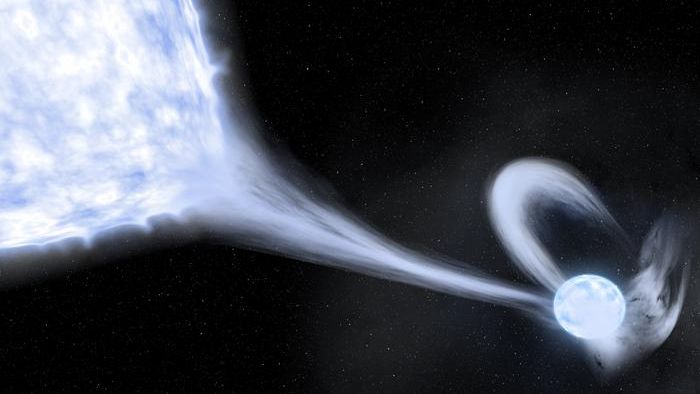
Astronomers have discovered 25 stars in two satellite galaxies of the Milky Way that have had their hydrogen-rich outer layers stripped away by a binary companion, leaving them as exposed helium stars. These hydrogen-stripped stars represent the progenitors of a special type of supernova and fill in a gap in our understanding of these powerful cosmic events. The discovery of these stars in the Large Magellanic Cloud and the Small Magellanic Cloud confirms models of stellar evolution and provides insights into the social lives of binary systems. Further study will be conducted to identify possible kilonova progenitor systems and search for hydrogen-stripped stars in other galaxies and within the Milky Way.
A new study suggests that the universe may be filled with more triple-star "vampire" systems than previously believed. Researchers at the University of Leeds have analyzed data from the Gaia and Hipparcos satellites and found that the strange features of type-Be stars, which spin rapidly and have rings of orbiting matter, could be explained by the influence of two additional companion stars. These triple-star systems may be more common in the universe than previously thought, shedding light on the evolution of these mysterious stars.
A new paper suggests that black holes might not be as simple as previously thought. According to the metaphorically-named 'no-hair theorem', all the information about a black hole can be described by its mass, angular momentum, and charge. However, researchers have identified scenarios where black holes could become 'hairy', violating this theorem. By considering binary black hole systems and the repulsion between charged black holes, they propose the existence of stable equilibrium and multiple horizons. This analysis also suggests that a cosmological constant, similar to dark energy, could prevent certain black holes from merging. While these findings challenge current theorems, further research is needed to test their validity.
Astronomers have discovered a population of stars that represent the "missing link" in the evolution of binary systems that eventually become colliding neutron stars, known as kilonovas. These stars, called intermediate-mass stripped helium stars, fill the helium-star mass gap and are crucial for the dispersion of heavy elements throughout the universe. The researchers detected 25 possible examples of these stars, which will eventually undergo ultra-stripped supernova explosions and merge into neutron star binaries. The study sheds light on the physical properties of these elusive stars and may help solve the puzzle of their appearance.
Astronomers have discovered a planet, named Halla, orbiting a red giant star called Baekdu, which should have been engulfed by the star's expansion. The star has already started fusing helium in its core, indicating that it should have grown large enough to consume the planet. However, two possible scenarios have been proposed to explain Halla's survival: either Baekdu was once part of a binary star system that prevented its expansion, or Halla is a relatively newborn planet formed from the collision of two stars. This discovery challenges our understanding of where exoplanets can exist.
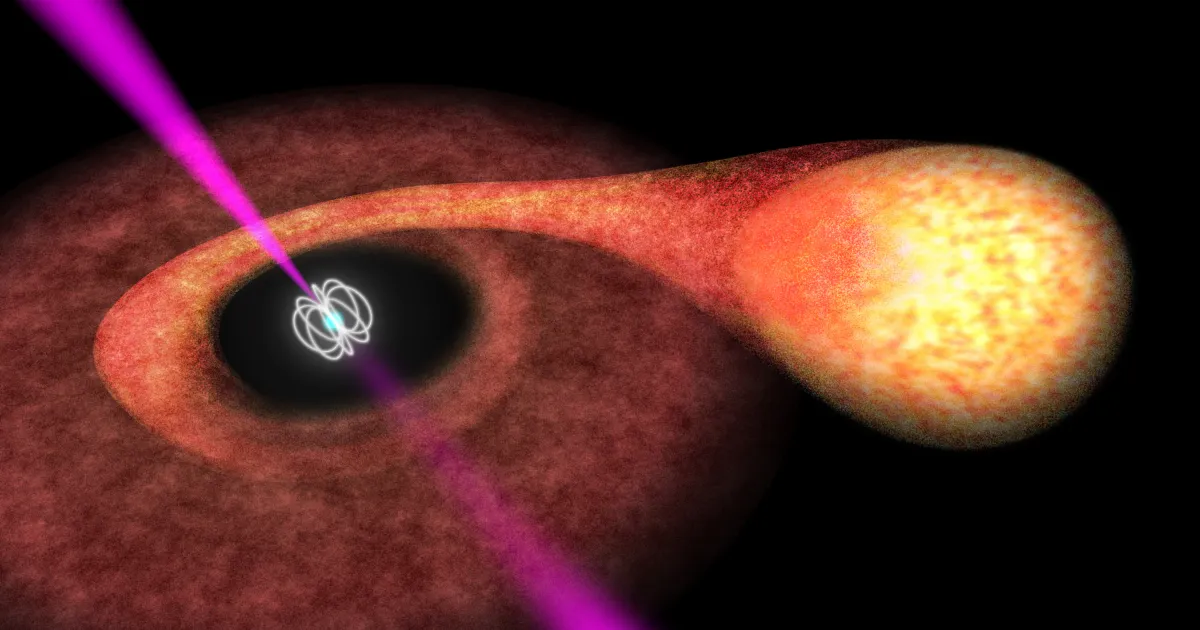
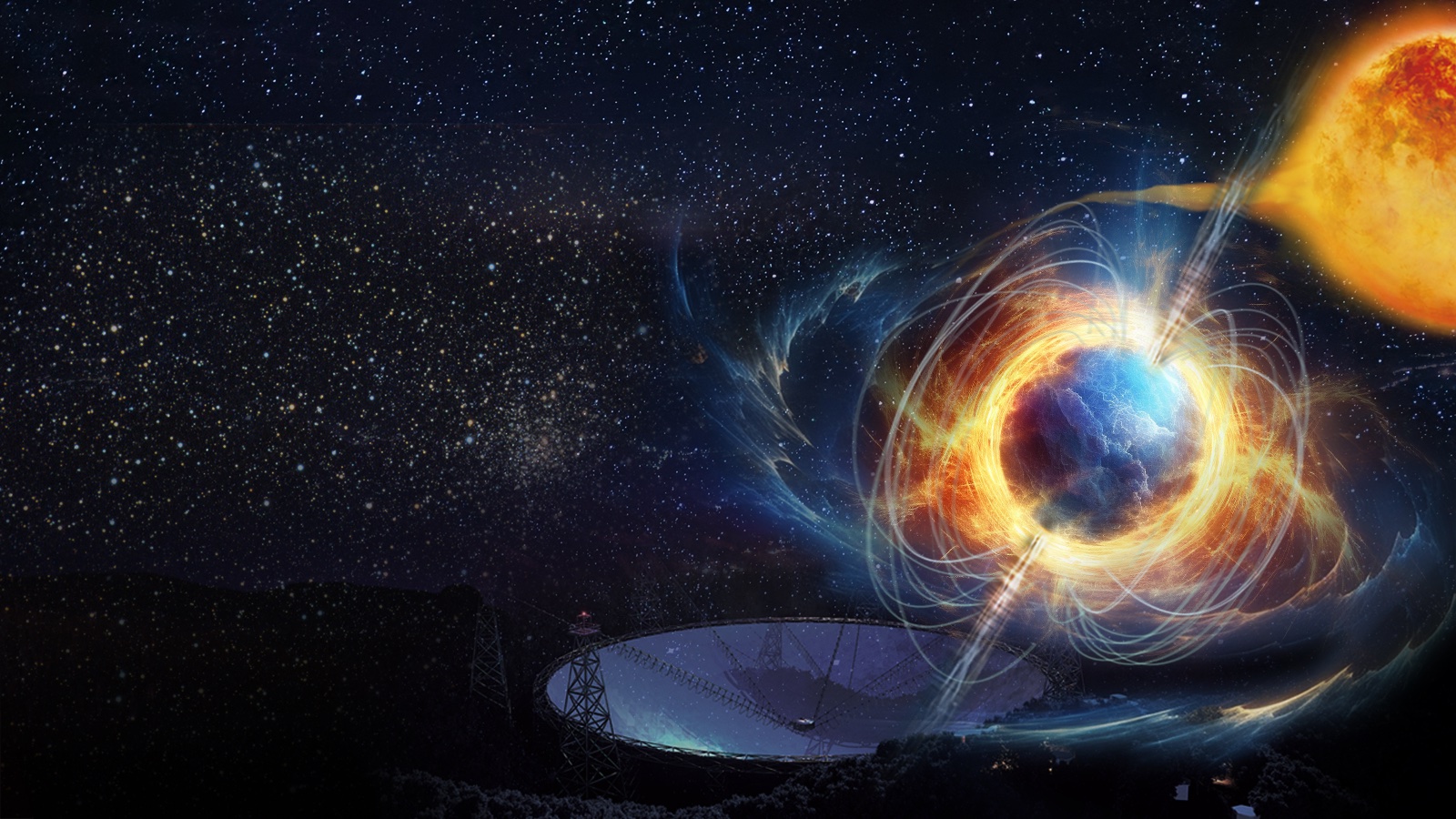
Astronomers using the Five-hundred-meter Aperture Spherical radio Telescope (FAST) in China have discovered a millisecond pulsar that orbits its companion in just 53 minutes, making it the closest spider binary ever observed. This pulsar lies between the range of redback and black widow pulsars, suggesting it is an intermediary stage in the evolution of millisecond pulsars. The discovery supports the evolutionary model of spider pulsars and highlights the need to find more pulsars like it to further validate the theory.
A 10-year survey using the W. M. Keck Observatory has found that young, massive main-sequence stars living closest to the supermassive black hole at the center of the Milky Way have no stellar companions. The S-stars, which are only about six million years old, are all single, which is surprising given that stars at this age and mass usually spend their childhood years paired with a twin in a binary system. The researchers suggest that the black hole's powerful influence causes binary star systems to either merge or become disrupted, where a companion star gets kicked out from the region.
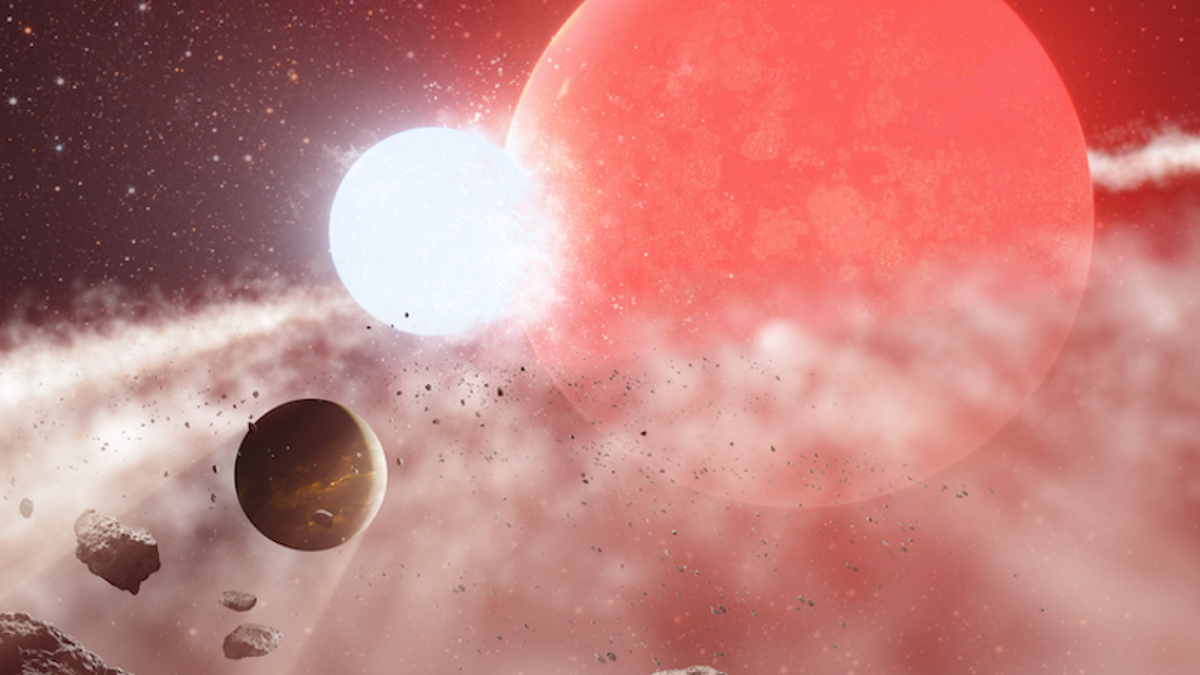
Astronomers have observed an infrared transient from a star that appears to have engulfed a planet. The event, detected by the Zwicky Transient Facility, is thought to have been caused by the tidal forces of the star tearing apart the planet as it orbited too close. The observation provides new insights into the interaction between stars and planets in binary systems and the effects of tidal forces.
Astronomers have discovered two black holes close to Earth that are much further from their stars than expected, presenting questions about their formation and detection. Unlike regular binary black holes, these "dark" black holes are not eating away at their stars, making them harder to track and discover. The discovery was fueled by data captured by the European Space Agency's Gaia spacecraft, and researchers hope to uncover more "dark" black holes within that data.