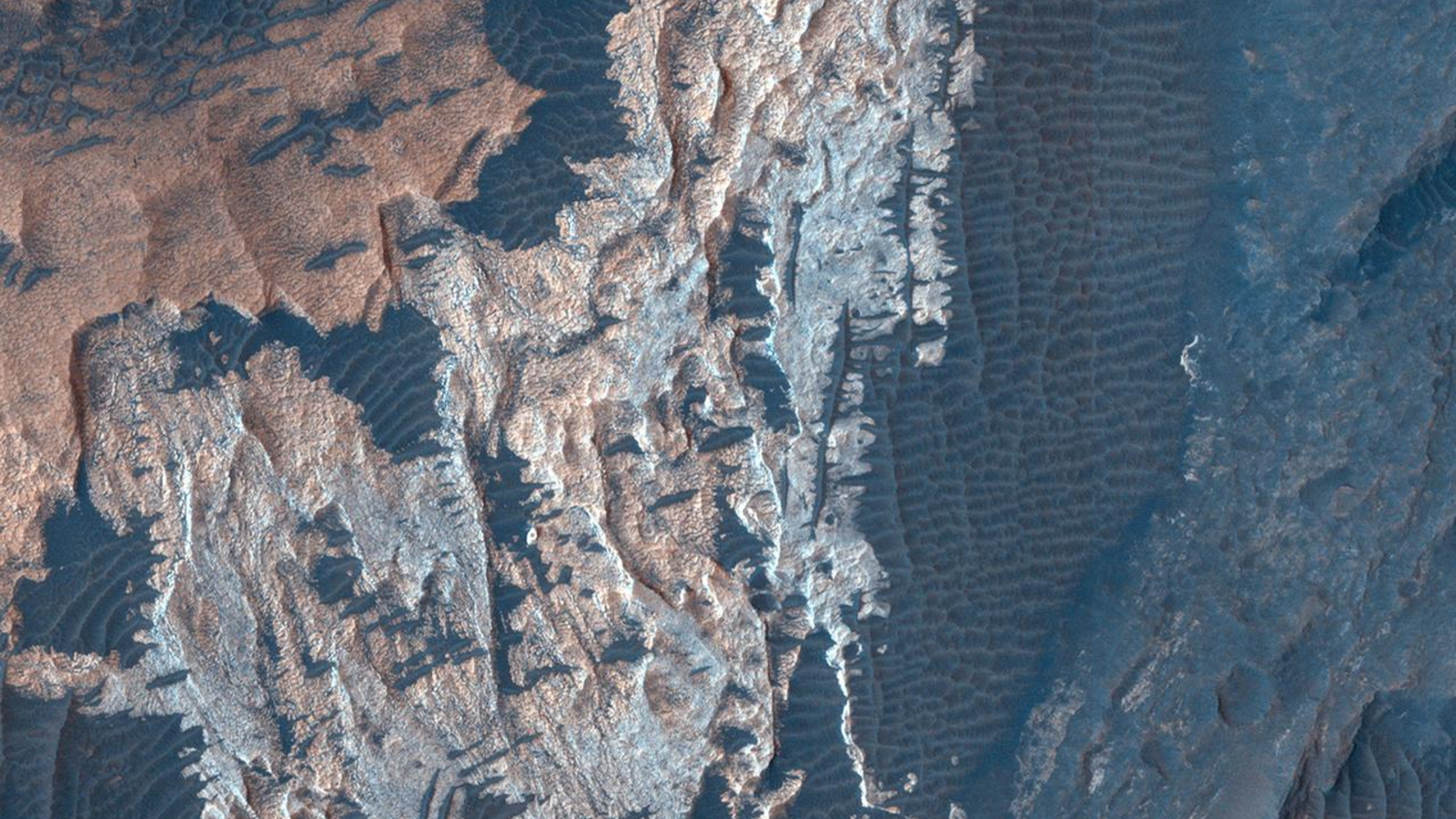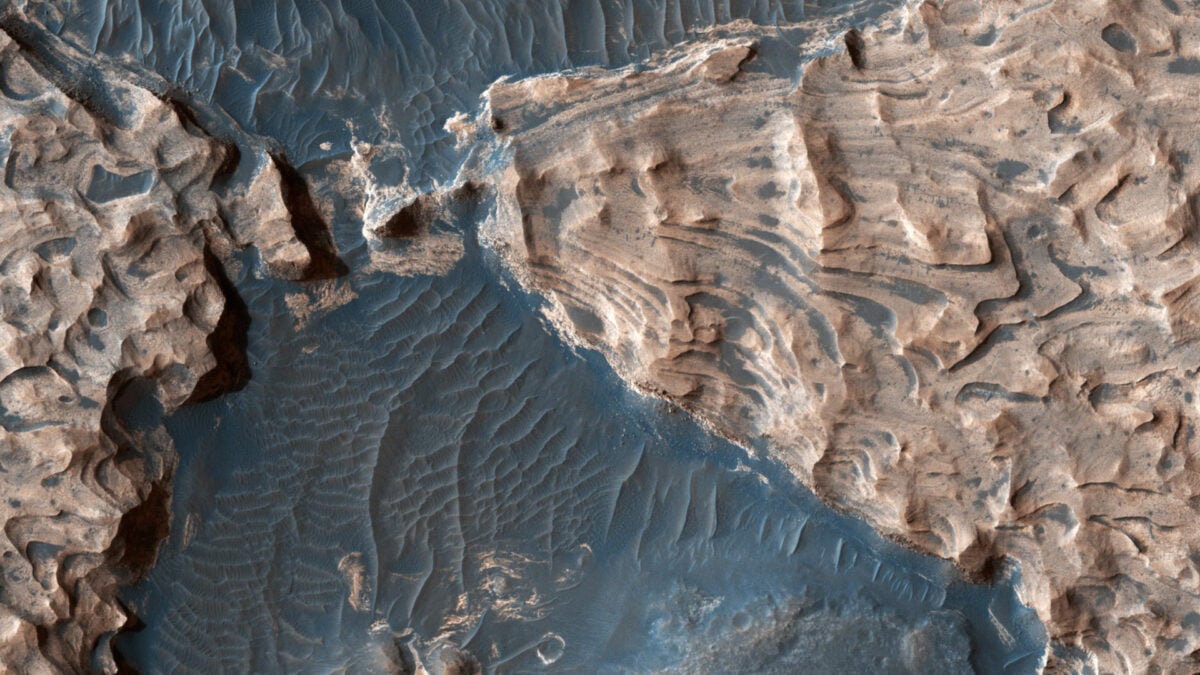
NASA's recent high-resolution image of Candor Chasma, part of the vast Valles Marineris canyon system on Mars, reveals layered sediment deposits and potential water beneath the surface, offering new insights into the planet's geological history and ancient environment.
Scientists studying Mars have identified unusual layers of iron sulfates that may represent a new mineral formed under specific conditions, providing insights into the planet's geological activity and potential habitability.
Scientists have potentially discovered a new mineral on Mars, a ferric hydroxysulfate compound found near Valles Marineris, which may have formed through volcanic activity in the presence of oxygen and water at high temperatures. This discovery could provide insights into Mars' geological history and past water activity, and further research is needed to confirm its status as a new mineral on Earth.
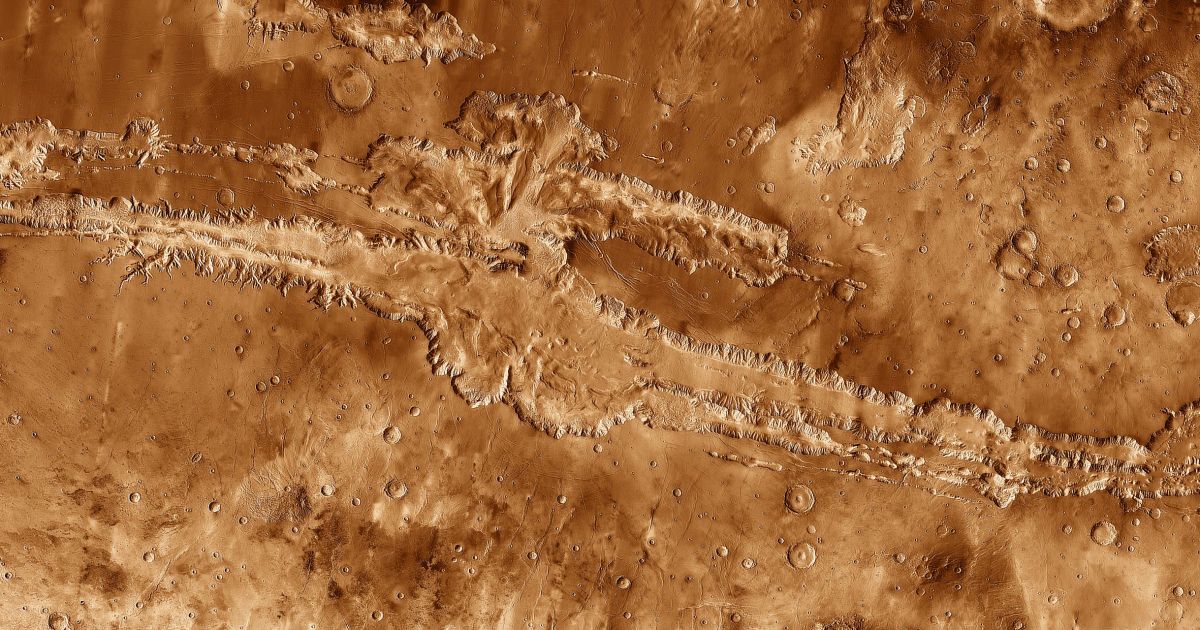
Valles Marineris on Mars, the grandest canyon in the Solar System, likely formed from a combination of processes including a giant impact that created Mars's moons, volcanic activity, and tectonic forces. The canyon, spanning 4000 kilometers across and up to 7 kilometers deep, was likely widened and deepened by erosion, landslides, and subsequent impacts. Mars's unique geological history, including the formation and destruction of a transient moon, contributed to the creation of this impressive feature, showcasing the planet's fascinating past and geological diversity.
The European Space Agency has released a stunning video showcasing the vastness of Mars' Valles Marineris, the Red Planet's equivalent of Earth's Grand Canyon. The video provides breathtaking views of the canyon's Noctis Labyrinthus, a labyrinth of night spanning 740 miles. The footage was created using detailed stereo images taken by ESA's Mars Express orbiter and existing topographic data. The canyon's valleys measure up to 18.6 miles across and 3.7 miles deep, making it larger than the Grand Canyon. Scientists believe the canyon was formed by tectonic fractures and possibly influenced by water billions of years ago.
The European Space Agency's Mars Express mission has released a flyover video showcasing Noctis Labyrinthus, a massive valley system on Mars that spans the length of Italy. The video reveals landslides, dune fields, and lowered regions of crust known as graben, indicating the planet's volcanic past. Mars Express has been operating since 2003 and, along with other spacecraft, continues to study Mars' weather and gather insights into its complex history. The thin atmosphere and high radiation on the surface make it challenging for organisms to survive, suggesting that life may exist underground.
The European Space Agency's Mars Express has released a video showcasing a flight over the eastern part of Noctis Labyrinthus, a vast system of deep valleys on Mars. The video reveals distinctive features called "graben," which are parts of the crust that have subsided in relation to their surroundings. These formations were caused by intense volcanism in the nearby Tharsis region. The video also highlights intersecting canyons, valleys, landslides, and dune fields, providing a fascinating glimpse into the martian landscape. Mars Express has been orbiting Mars since 2003, studying its surface, atmosphere, and geological phenomena.
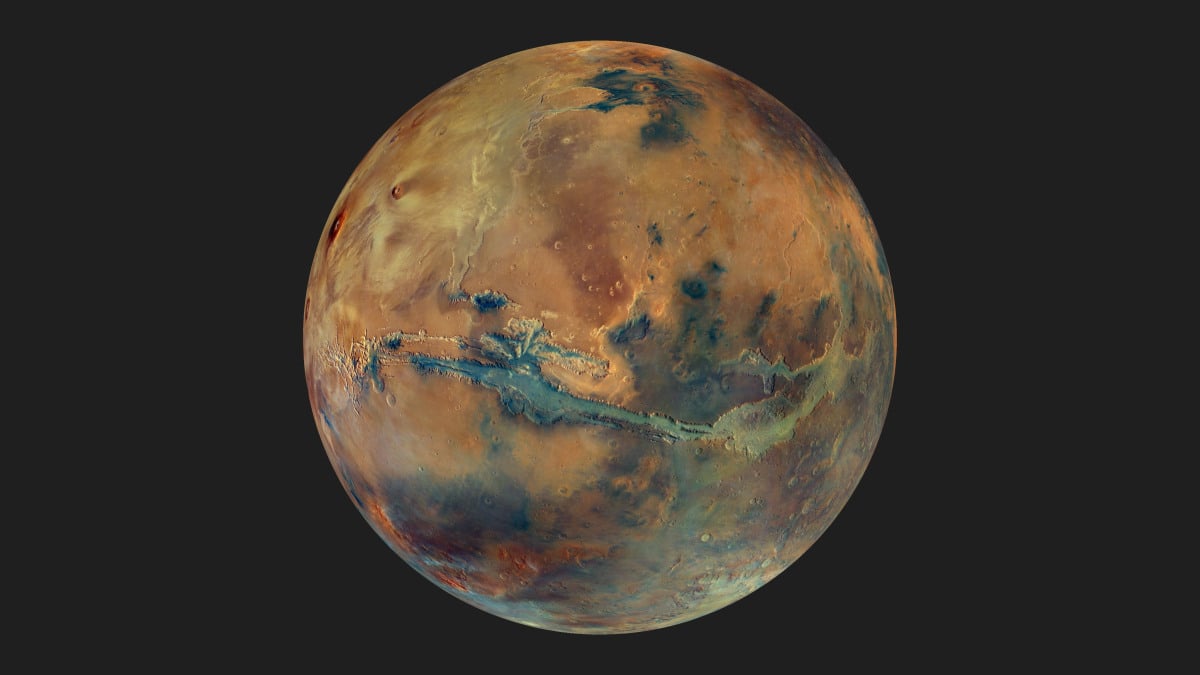
The European Space Agency has released a new mosaic image of Mars, captured by the High Resolution Stereo Camera on Mars Express, revealing a more complex and accurate view of the planet than previously possible. The image shows veins of contrasting colors, including blue, gray, and black, indicating areas of volcanic activity and water-worn minerals. The mosaic also captures immense detail in Valles Marineris, the biggest canyon in the solar system. The obsessive search for past water on Mars is a quest to prove the Red Planet was once wet, warm, and more Earth-like, and could have supported primitive Martian life.