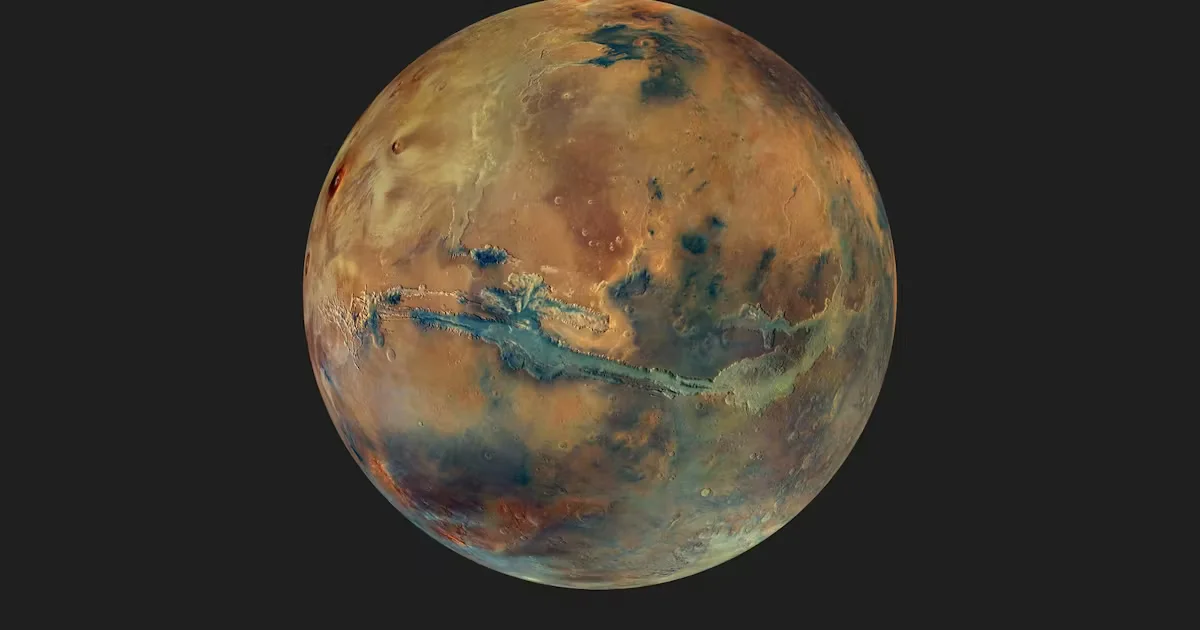
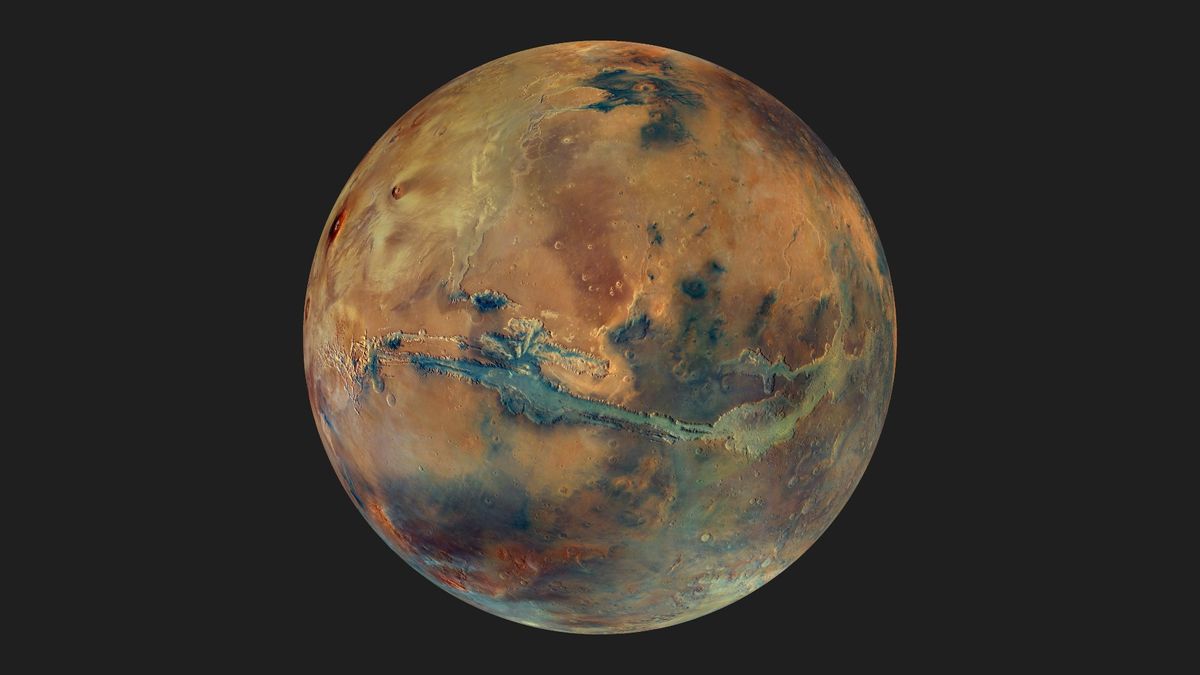
To mark the 20th anniversary of ESA's Mars Express mission, the High Resolution Stereo Camera (HRSC) team has created a new global color mosaic of Mars, revealing the planet's surface color and composition in spectacular detail. The mosaic highlights reddish oxidized iron, dark volcanic basaltic sands, and bright areas suggesting the past presence of liquid water. The mission will continue until at least 2026.
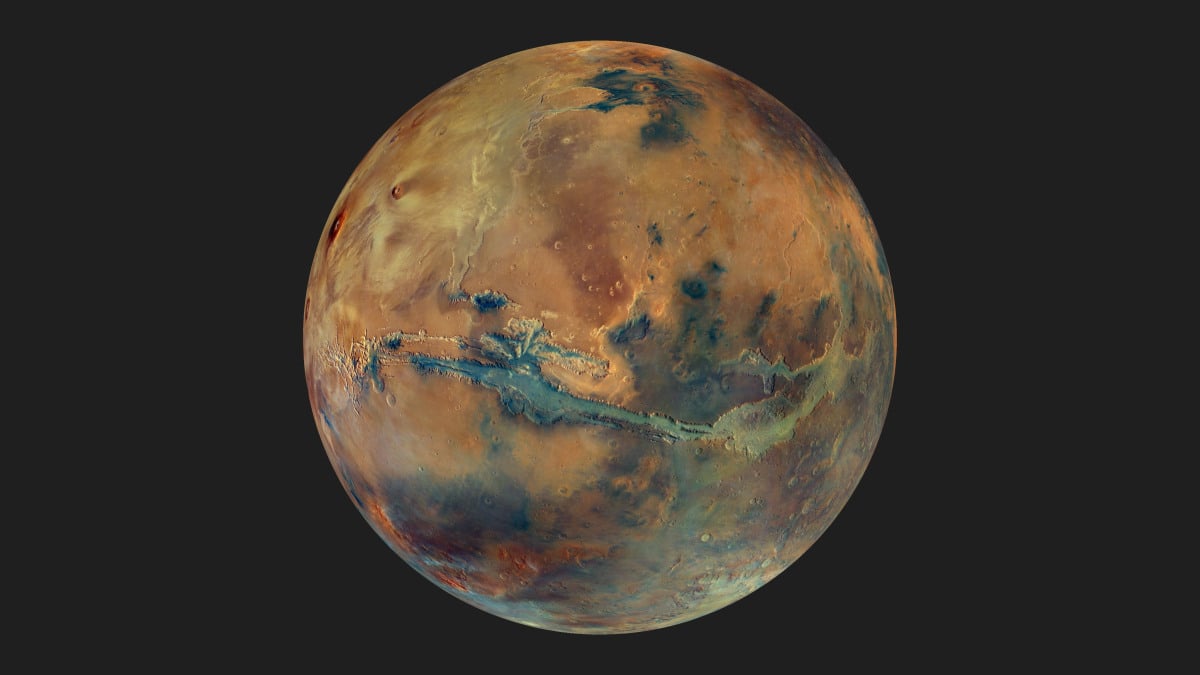
The European Space Agency has released a new mosaic image of Mars, captured by the High Resolution Stereo Camera on Mars Express, revealing a more complex and accurate view of the planet than previously possible. The image shows veins of contrasting colors, including blue, gray, and black, indicating areas of volcanic activity and water-worn minerals. The mosaic also captures immense detail in Valles Marineris, the biggest canyon in the solar system. The obsessive search for past water on Mars is a quest to prove the Red Planet was once wet, warm, and more Earth-like, and could have supported primitive Martian life.
The European Space Agency's Mars Express orbiter has mapped the Martian surface using its High-Resolution Stereo Camera (HRSC) for almost 20 years. To celebrate the mission's 20th anniversary, a series of global color mosaic images were live-streamed from the Mars Express orbiter to Earth. The mosaic is the result of a high-altitude campaign conducted by the HRSC science team and state-of-the-art image processing, providing valuable insight into the Martian environment, including revealing the surface composition, demonstrating how water once flowed there in the past, and modern meteorological phenomena.
The European Space Agency's Mars Express spacecraft has released a stunning new image of Mars to commemorate its 20th anniversary. The image was created using data collected by the spacecraft's High-Resolution Stereo Camera (HRSC) from altitudes between 2,500 miles to 31,000 miles over the Martian surface, providing a full global view that reveals unprecedented details of the planet. The image shows Mars in a multitude of colors, providing a far richer color view of the planet than ever before, with each hue offering planetary scientists information about the surface composition of the planet.
The European Space Agency's Mars Express spacecraft has released a stunning new mosaic image of Mars, created using data collected by the spacecraft's High-Resolution Stereo Camera. The image shows the Red Planet in a multitude of colors, revealing unprecedented details of the planet's surface composition. The mosaic also shows lighter and even white regions across the surface of the planet, which are the result of rocks being altered and weathered by water far back in the ancient history of the now arid planet. The lifetime of the Mars Express mission has been extended to last until at least 2026, meaning that the HRSC camera has plenty of time to deliver more stunning images of the planet.