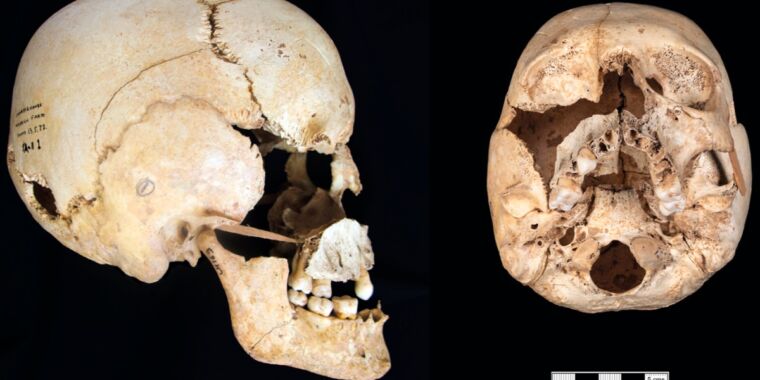
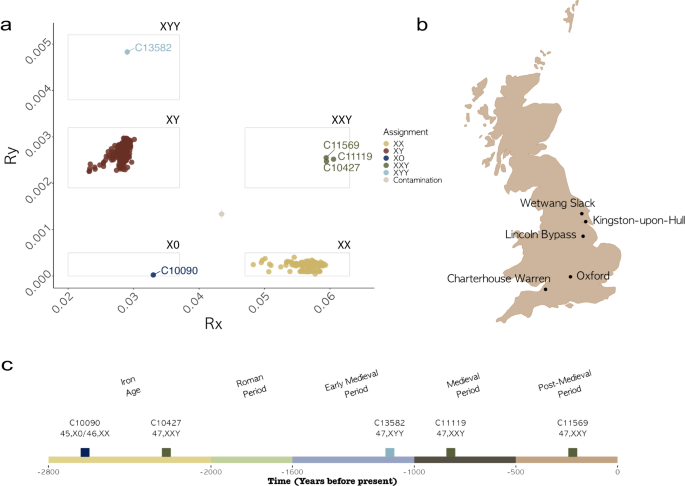
Researchers have identified the first ancient case of Turner syndrome, a genetic condition characterized by a single X chromosome, in a 2,500-year-old skeleton. The study, which analyzed DNA from skeletons in the U.K., also found individuals with Klinefelter syndrome, XYY syndrome, and Down syndrome. The findings provide insights into ancient societies' care for individuals with genetic conditions and offer a more complex understanding of social gender through the study of variations in sex chromosomes in ancient DNA.
Researchers have identified the first ancient case of Turner syndrome in a 2,500-year-old individual with just one X chromosome, using DNA from the Thousand Ancient British Genomes project. The study also revealed five other individuals with sex chromosomal conditions, including Klinefelter syndrome, XYY syndrome, and Down syndrome, shedding light on genetic diversity and social gender norms in ancient societies. The findings highlight the potential of studying variations in sex chromosomes in ancient DNA to gain a more complex understanding of human history and gender identity.
Scientists have identified the first prehistoric individual with Turner syndrome, a genetic condition characterized by having only one X chromosome, using a new computational method for measuring sex chromosomes. The study also found individuals with Jacobs syndrome, Klinefelter syndrome, and Down syndrome from various historical periods. The findings provide insight into how perceptions of gender identity have evolved over time and demonstrate the potential of ancient DNA analysis in understanding human biology and social dynamics throughout history.
Researchers have identified an Iron Age infant with Down's syndrome and the first prehistoric person with mosaic Turner syndrome using a new DNA testing method that measures the amount of chromosomes in ancient human cells more precisely. The study, conducted by the University of York, the Francis Crick Institute, the University of Oxford, and Oxford Archaeology, revealed that these chromosomal abnormalities have been present in human history for over 2,000 years. The individuals tested lived across various time periods, and the research sheds light on how sex, gender, and diversity were perceived in past societies.
A new computational method has been developed to identify chromosomal aneuploidies, including sex chromosome karyotypes and autosomal aneuploidies, in ancient genomes. The method was applied to ancient British data, revealing the oldest known instance of mosaic Turner syndrome, individuals with Klinefelter syndrome, and an individual with 47,XYY syndrome, providing insights into the historical prevalence of these conditions. The study sheds light on the societal treatment of individuals with aneuploidies in ancient societies and highlights the potential for exploring past gender variability and societal perceptions of individuals with disorders of sex development.
Researchers have identified the first prehistoric person with mosaic Turner syndrome, characterized by one X chromosome, using a new technique to measure the number of chromosomes in ancient genomes more precisely. They also identified the earliest known person with Jacob's syndrome, three individuals with Klinefelter syndrome, and an infant with Down Syndrome from ancient DNA samples. The study sheds light on the historical perspective of how sex, gender, and diversity were perceived in past societies.