Tag

Triangulum Galaxy

All articles tagged with #triangulum galaxy

"James Webb Telescope Unveils Mesmerizing Star Birth Tapestry in Triangulum Galaxy"
astronomy1 year ago

"James Webb Telescope Unveils Mesmerizing Star Birth Tapestry in Triangulum Galaxy"

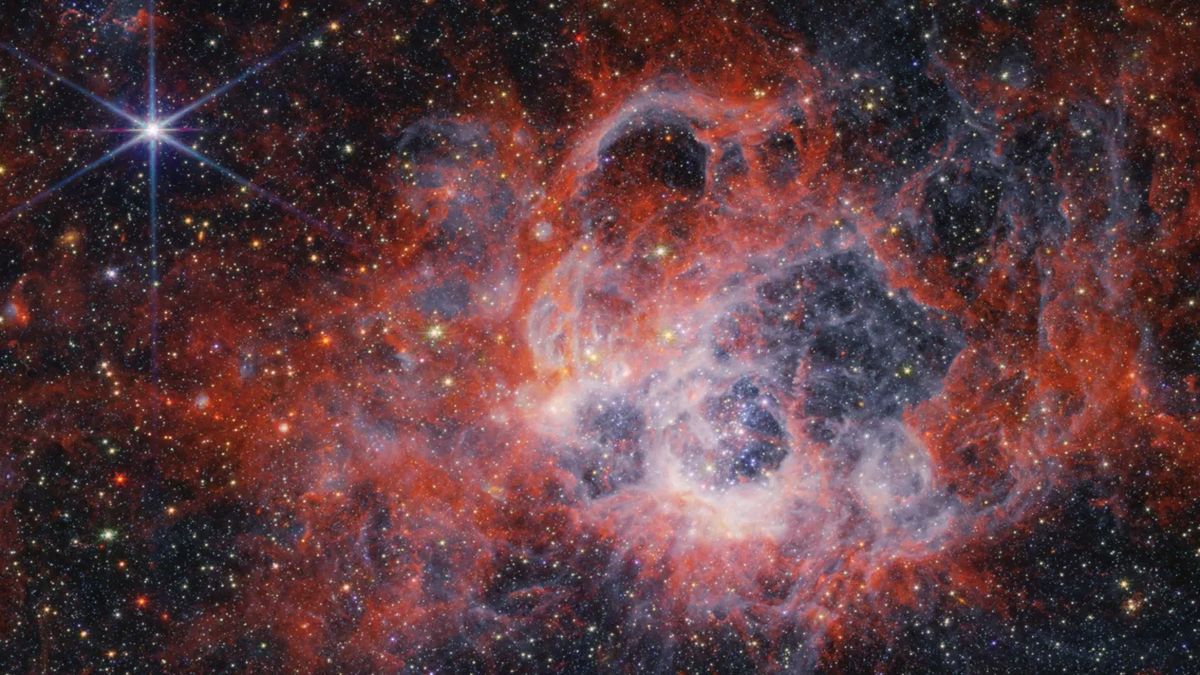
The James Webb Space Telescope captured stunning, detailed images of the star-forming region NGC 604, revealing cavities carved out by young giant stars and providing a comprehensive view of star birth. Located in the Triangulum Galaxy, this relatively young stellar nursery contains around 200 B-type and O-type stars, which are significantly larger and hotter than the sun. The images, taken using NIRCam and MIRI, showcase the region's molecular hydrogen and polycyclic aromatic hydrocarbons, shedding light on the role of these materials in star formation.
"Webb Telescope Unveils Spectacular Views of Newborn Stars and Nebulae"
astronomy1 year ago

"Webb Telescope Unveils Spectacular Views of Newborn Stars and Nebulae"

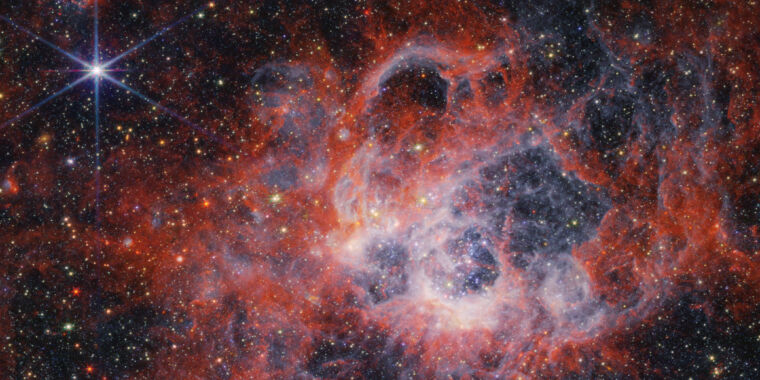
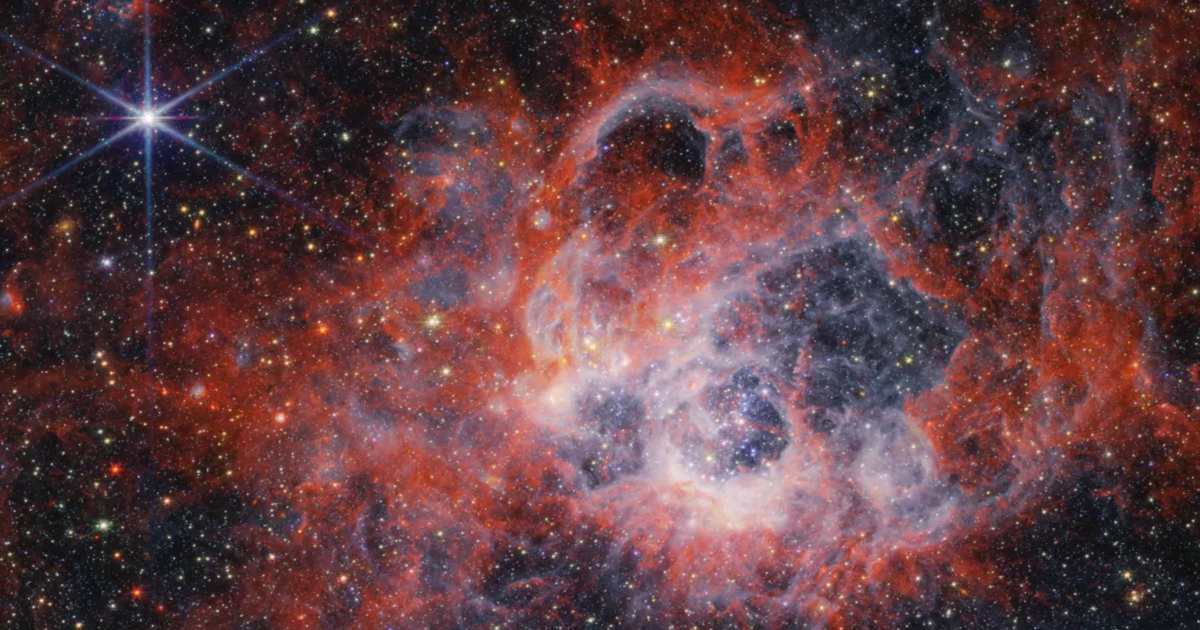
The James Webb Space Telescope has captured a stunning image of the nebula NGC 604 in the Triangulum Galaxy, revealing about 200 of the hottest and largest stars in their early stages of life, some of which are over 100 times more massive than the Sun. The nebula's vibrant colors are a result of stellar winds carving out cavities and ultraviolet radiation ionizing the surrounding gas, creating a ghostly glow of ionized hydrogen and bright orange streaks signifying the presence of carbon-based molecules. This region is unique for its density of large stars, making it a fascinating area for astronomers to study stellar formation.

"Webb Telescope Unveils Stunning Views of Newborn Stars and Galaxies"
space1 year ago

"Webb Telescope Unveils Stunning Views of Newborn Stars and Galaxies"

The James Webb Space Telescope has captured stunning new images of a stellar nursery in the Triangulum galaxy, revealing a dense region filled with hundreds of newborn stars, some of which are more than 100 times as big as the sun. The images, produced by the telescope's NIRCam and MIRI, show dusty tendrils, large bubbles, and ghostly glows created by stellar winds and ionized hydrogen. These images provide a rare opportunity for astronomers to study stars in their early stages of life, shedding light on the mysterious and complex process of star birth.

astronomy1 year ago

"Exploring NGC 604: NASA's Webb Telescope Unveils Cosmic Tendrils"

NASA's James Webb Space Telescope has captured stunning new images of the star-forming region NGC 604 in the Triangulum galaxy, revealing intricate details of star birth. The images showcase cavernous bubbles, stretched-out filaments of gas, and over 200 of the hottest, most massive stars in the early stages of their lives. The telescope's near-infrared image displays bright red tendrils and clumps of emission, while the mid-infrared view provides insights into the diverse and dynamic activity of the region. NGC 604, estimated to be around 3.5 million years old, offers astronomers a unique opportunity to study massive stars in the early stages of their lives.

astronomy1 year ago

"Exploring NGC 604 with NASA's Webb Telescope"

NASA's James Webb Space Telescope has captured stunning images of the star-forming region NGC 604 in the Triangulum galaxy, revealing intricate details of star birth, including cavernous bubbles, stretched-out filaments of gas, and over 200 of the hottest, most massive stars in the early stages of their lives. The telescope's near-infrared and mid-infrared images showcase features such as ionized hydrogen, carbon-based molecules, and molecular hydrogen, providing new insights into the dynamics of the region. NGC 604, estimated to be around 3.5 million years old, offers astronomers a unique opportunity to study massive stars in the early stages of their lives due to its relatively close distance.

Betelgeuse: A Chaotic Star Nearing Its Violent End.
science-and-astronomy2 years ago

Betelgeuse: A Chaotic Star Nearing Its Violent End.

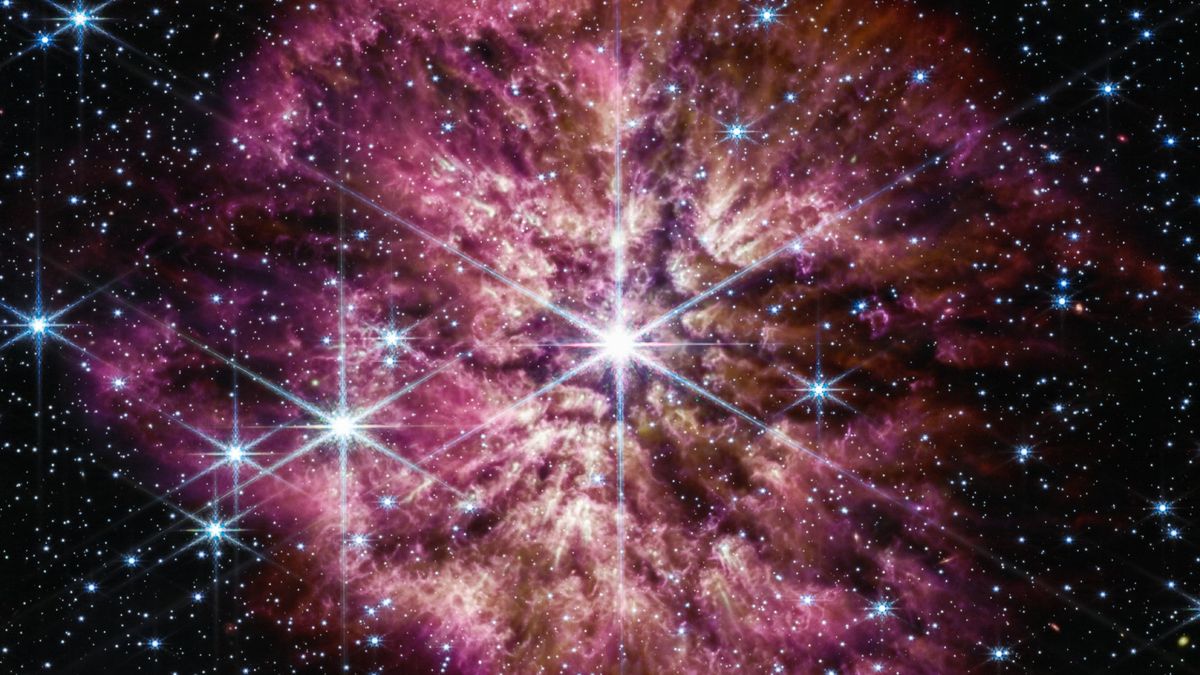
Astronomers have observed a chaotic star, BELLS 1, in the Triangulum galaxy that is transitioning into a highly unstable Wolf-Rayet star. The star has begun beaming a new signal indicating that it is churning either carbon or iron deep within it through nuclear fusion, and is inching closer to its eventual fate of exploding into a spectacular supernova. BELLS 1 is shedding about 10 solar masses' worth of star matter every million years or so, which is pumped back into the nearby universe, triggering the formation of future generations of stars and enriching them with recycled elements.

"Experts detect powerful radio bursts from neighboring galaxy, sparking alien theories"
science2 years ago

"Experts detect powerful radio bursts from neighboring galaxy, sparking alien theories"

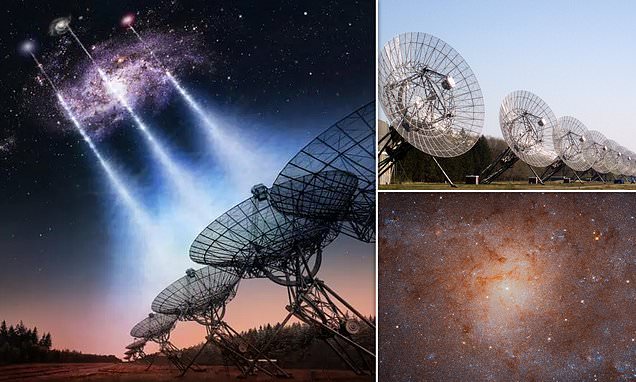
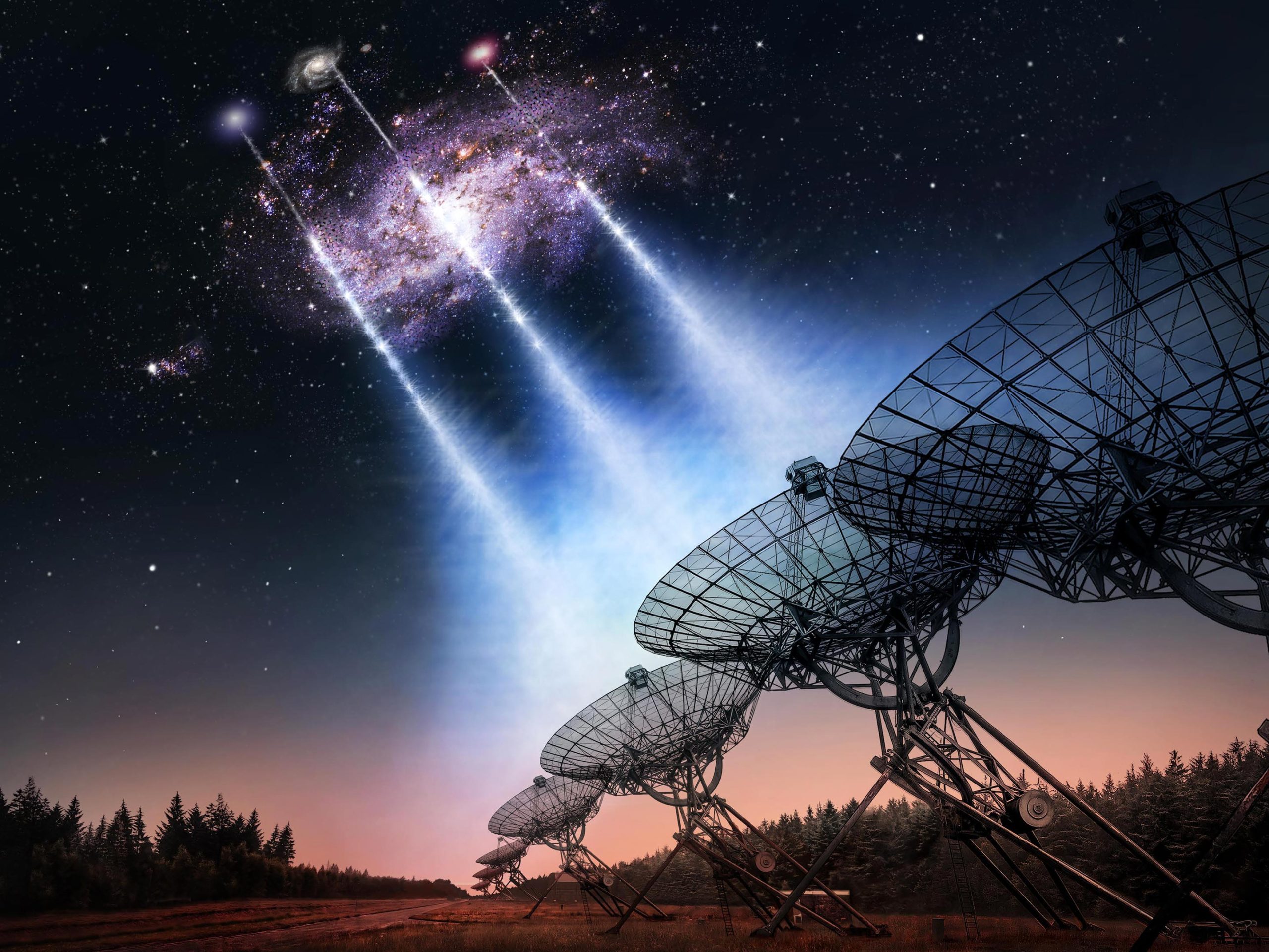
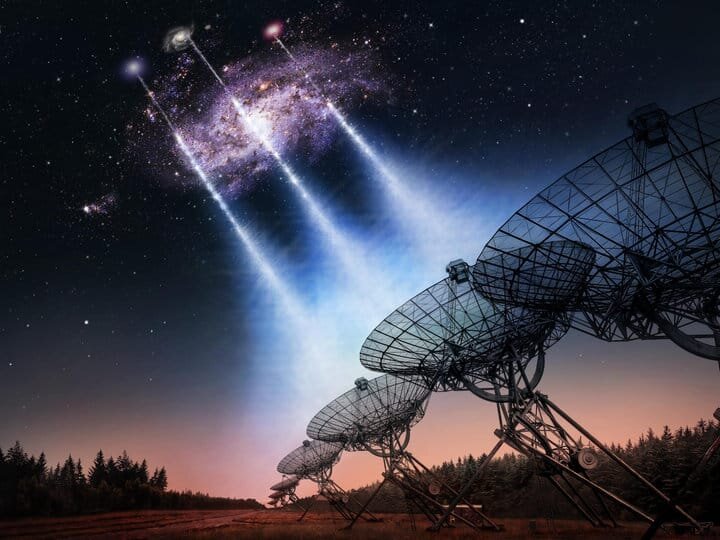
Astronomers in the Netherlands have discovered five new Fast Radio Bursts (FRBs) in the universe using an upgraded telescope. Three of the FRBs had "skewered" the neighboring Triangulum galaxy. FRBs are some of the most blindingly bright explosions in the universe, and their fleeting nature has made them difficult to study closely. The latest technology has allowed scientists to define the phenomena better and shed light on the molecular makeup of the universe.

Astronomers detect powerful fast radio bursts from distant galaxy.
astronomy2 years ago

Astronomers detect powerful fast radio bursts from distant galaxy.

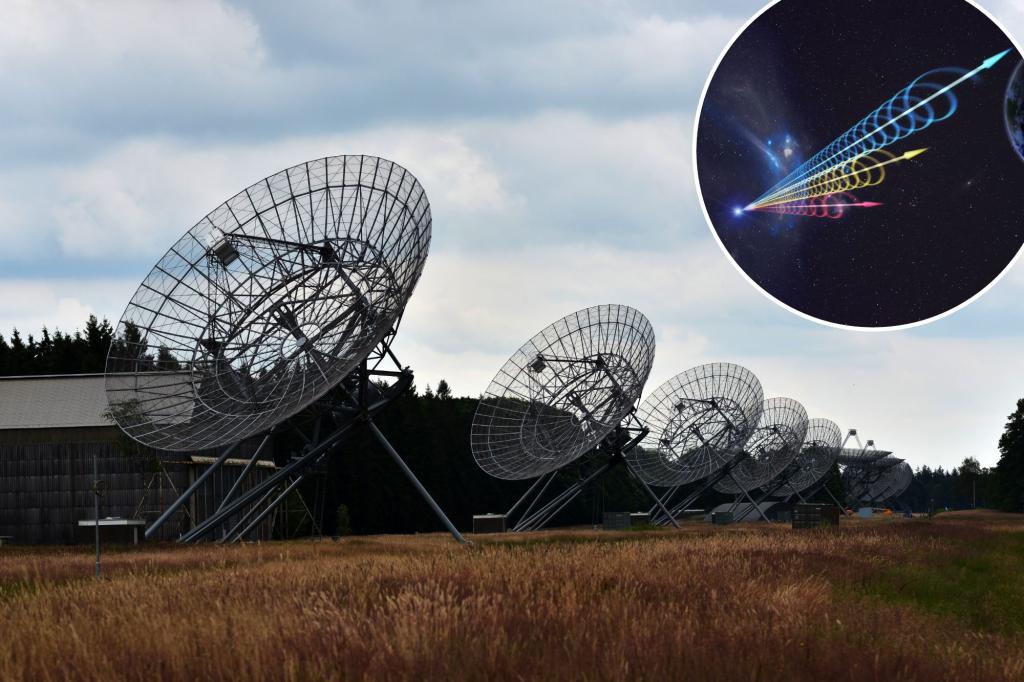
Astronomers have detected five new fast radio bursts (FRBs) from space, thanks to an upgrade to the Westerbork Synthesis Radio Telescope in the Netherlands. FRBs are bright flashes of light that appear temporarily and randomly from space, and their origin is still unknown. The new FRBs were detected in 2019, and three of them pierced the neighbouring Triangulum Galaxy, a spiral galaxy about 2.73 million light-years away. FRBs are thought to come from black holes, neutron stars, or even aliens, and their study could help us understand the structure and evolution of the universe.

Unraveling the Mystery of Fast Radio Bursts in Nearby Galaxies
astronomy2 years ago

Unraveling the Mystery of Fast Radio Bursts in Nearby Galaxies

Astronomers using the upgraded Westerbork telescope have discovered five new Fast Radio Bursts (FRBs), three of which have pierced the halo of the Triangulum Galaxy, allowing them to estimate the maximum number of invisible atoms in the galaxy for the first time. FRBs are among the brightest explosions in the universe and contain immense amounts of energy, making them highly interesting to study. The ARTS supercomputer enables Westerbork to pinpoint the exact location of an FRB very accurately, which is important for tracking down invisible electrons and their accompanying atoms, as most of the matter in the universe is dark and we still know little about it.

Unraveling the Mystery of Fast Radio Bursts in Nearby Galaxies.
astronomy2 years ago

Unraveling the Mystery of Fast Radio Bursts in Nearby Galaxies.

Astronomers using the upgraded Westerbork telescope have discovered five new Fast Radio Bursts (FRBs), with three of them piercing our neighboring Triangulum galaxy. The telescope's sharp images allowed the astronomers to estimate the maximum number of invisible atoms in the galaxy for the first time. FRBs are among the brightest explosions in the universe, emitting immense amounts of energy, and are believed to be emitted by neutron stars. The discovery of FRBs is important in understanding the fundamental properties of the universe's matter.