Ancient stone tools found on Sulawesi, Indonesia, date back over 1 million years, indicating early human presence and oceanic crossing much earlier than previously thought, possibly by Homo erectus or related species, highlighting Sulawesi's significant role in human evolution.
Archaeologists discovered the oldest stone tools on Sulawesi, Indonesia, dating back over 1 million years, suggesting early human ancestors may have inhabited the island and possibly influenced the evolution of Homo floresiensis, the 'hobbit' humans. The findings raise questions about how these early humans crossed oceans and their connection to other island populations, with ongoing research aiming to uncover more fossils and understand their origins.
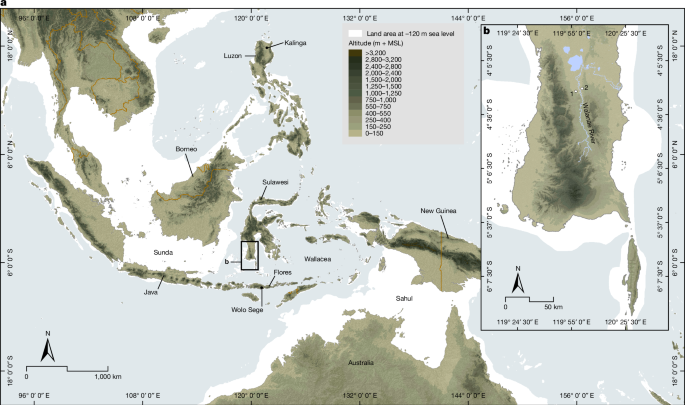
The discovery of in situ stone artifacts at Calio in Sulawesi, dated to at least 1.04 million years ago through palaeomagnetic and US-ESR dating, suggests that hominin presence on Sulawesi may have occurred earlier than previously thought, potentially predating the earliest known occupation on Flores and Luzon.
Researchers discovered 1 to 1.5 million-year-old stone tools on Sulawesi, Indonesia, indicating early human relatives occupied the region long before Homo sapiens, possibly related to Homo erectus or other archaic species, challenging previous assumptions about human migration and evolution in Wallacea.
Scientists have discovered the world's smallest frog with fangs, Limnonectes phyllofolia, in the Indonesian jungle of Sulawesi. Unlike its larger fanged frog relatives, this newly found species is an egg layer. The frogs were observed guarding their nests on leaves several feet off the ground, a behavior rarely seen in frogs. The male frogs coat their eggs with compounds to keep them moist and free of bacteria and fungi. This tiny frog species weighs only around two grams and has small fangs on its lower jaw. The researchers hypothesize that the smaller fang size is due to the lack of competition for egg-laying spots in waterways. Frog fangs have evolved independently at least four times across different species, with sexual selection playing a role in the size of the fangs.