Tag

Orion Nebula

All articles tagged with #orion nebula

space1 day ago

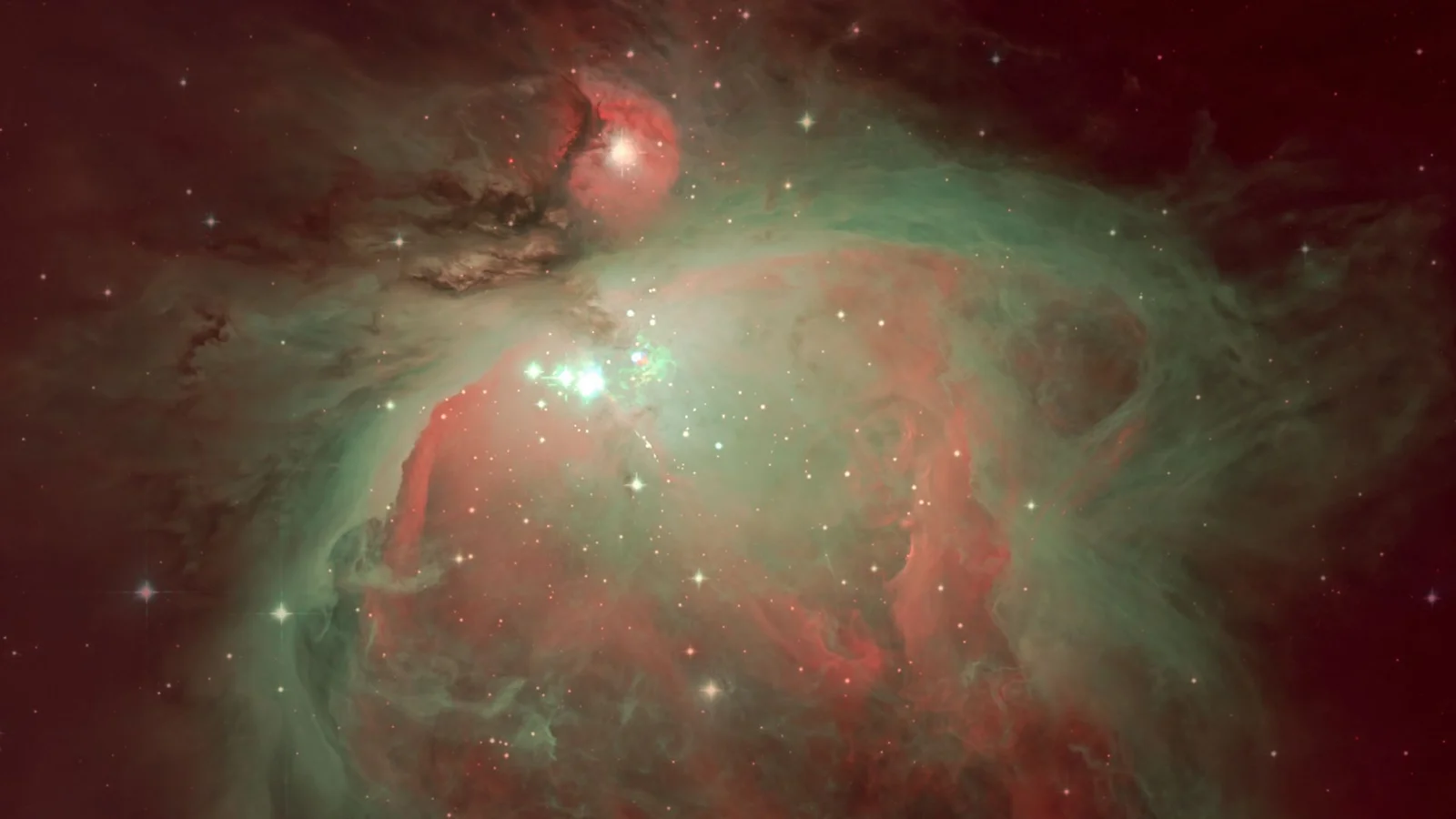
Stunning Orion Nebula image sparks winter stargazing urge

Space photographer Joel Martin captured a striking image of the Orion Nebula (M42) about 1,500 light-years away, using a 6-inch Newtonian reflector with narrow-band filters to reveal the nebula’s dust and gas shaped by the region’s young stars in the Trapezium cluster; the piece notes Orion’s visibility in mid-January skies and discusses imaging and observing the nebula, including telescope recommendations.

science1 year ago

James Webb Telescope Unveils Water Ice on Mysterious Runaway Planets

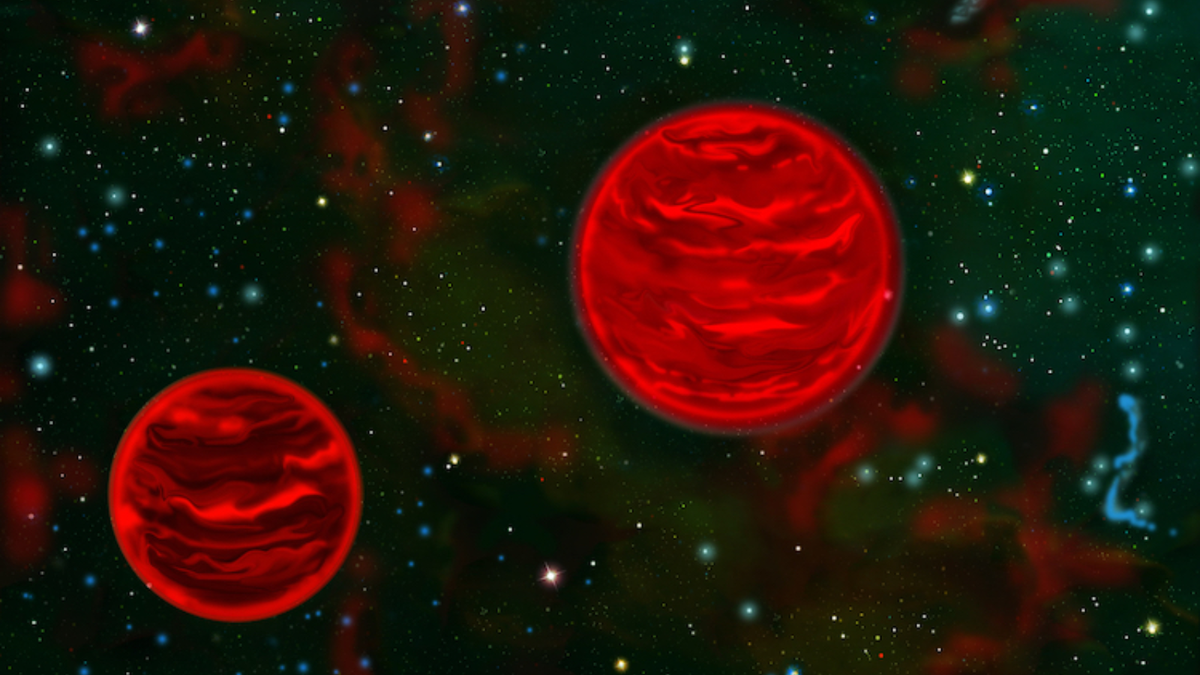
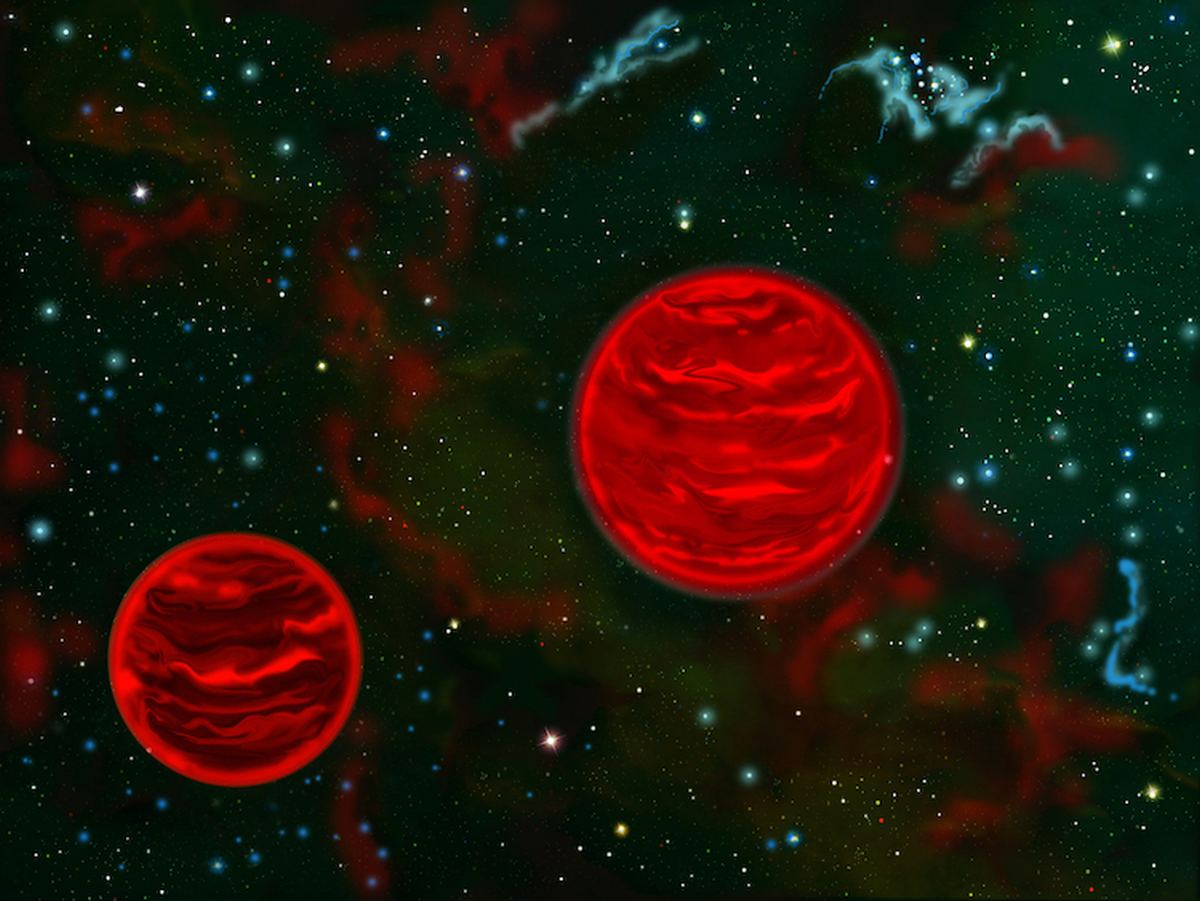
The James Webb Space Telescope has discovered mysterious Jupiter-sized binary objects, termed JuMBOs, in the Orion Nebula, which may be the remnants of embryonic stars rather than traditional planets. These JuMBOs, found orbiting each other without a parent star, could have formed from pre-stellar cores stripped by high-energy radiation from nearby massive stars, according to a new study. This theory suggests that the JuMBOs are not failed stars but rather products of a unique formation process, though more data is needed to confirm this hypothesis.

astronomy1 year ago

"Unraveling the Mystery of Free-Floating Binary Planets"

The discovery of dozens of Jupiter-sized planets drifting in pairs within the Orion Nebula challenges existing theories of planetary formation. These free-floating pairs, observed by the James Webb Space Telescope, defy conventional understanding as they are not bound to any star. Dubbed Jupiter Mass Binary Objects (Jumbos), their existence has left astronomers puzzled, prompting various hypotheses about their origins, including ejection from stars or in-situ formation from gas clouds. Further observations and studies are needed to unravel this cosmic mystery.

science-and-technology1 year ago

"ESA's Euclid Telescope Unveils Five Stunning Deep Space Images"

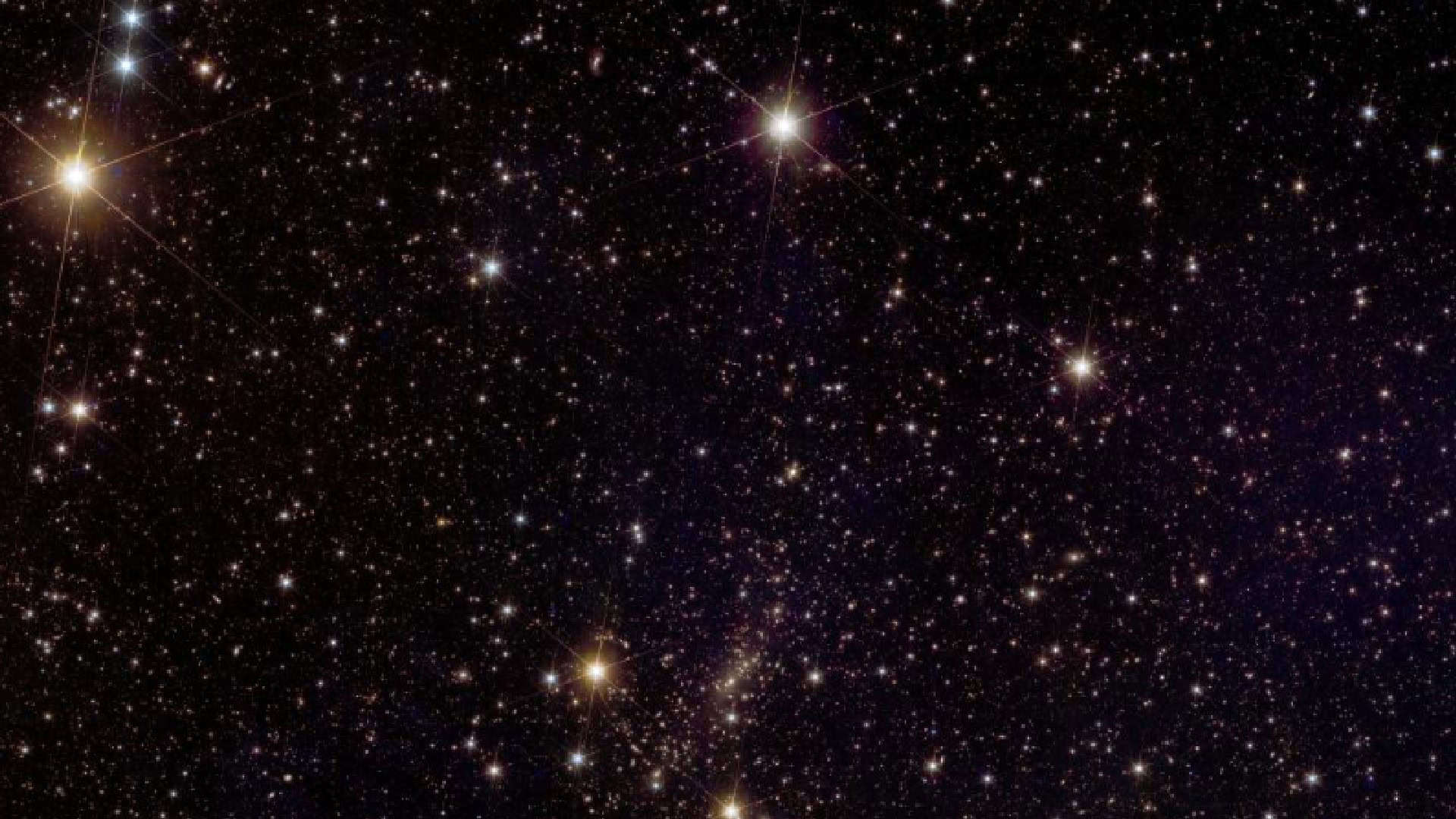
The Euclid telescope has captured a stunning image of over 50,000 galaxies, primarily in the Abell 2390 cluster and the Orion Nebula, revealing new insights into the universe's formation. The European Space Agency's project aims to create a 3D map of the Milky Way, and the telescope's high-resolution capabilities have uncovered millions of objects, some dating back to the first billion years after the Big Bang. Scientists believe these galaxies are surrounded by dark matter, and further study could provide significant information about planet formation.

astronomy1 year ago

"Unraveling the Mystery of Hundreds of 'Rogue' Planets Spotted by James Webb Telescope"

The James Webb Space Telescope has detected hundreds of mysterious free-floating planets in the Orion Nebula, including pairs of Jupiter-size worlds that orbit each other. A new study suggests that these "rogue" planets, particularly the Jupiter-mass binary objects (JuMBOs), may have formed through the cloud-collapse model rather than being pulled away from their parent planetary systems by passing stars. The research, which involved simulations of planetary systems and stellar flybys, provides insights into the formation of these enigmatic free-floating planets and could aid future observations by telescopes such as the Vera C. Rubin Observatory.

astronomy1 year ago

"James Webb Telescope Unveils Impact of Stellar Radiation on Planet Formation"

The James Webb Space Telescope has observed a protoplanetary disk in the Orion Nebula losing significant amounts of hydrogen due to intense ultraviolet radiation from nearby massive stars, potentially hindering the formation of large planets. This finding sheds light on the impact of massive stars on young planetary systems and may provide insights into the early stages of our own solar system. The observations suggest that the planet-forming material is escaping easily due to the weaker grip of the young star in the system, and further research on similar systems within the nebula is planned to gain a more comprehensive understanding of this phenomenon.

astronomy1 year ago

"Stellar Radiation's Impact on Planet Formation Uncovered by James Webb Telescope"

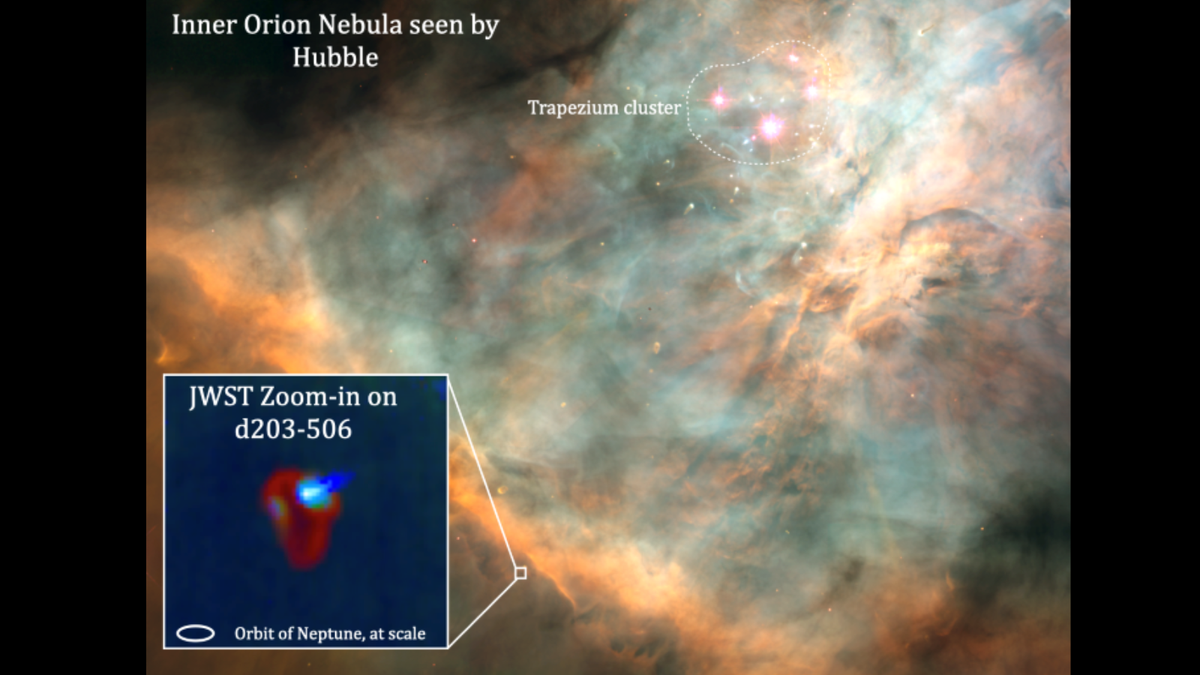
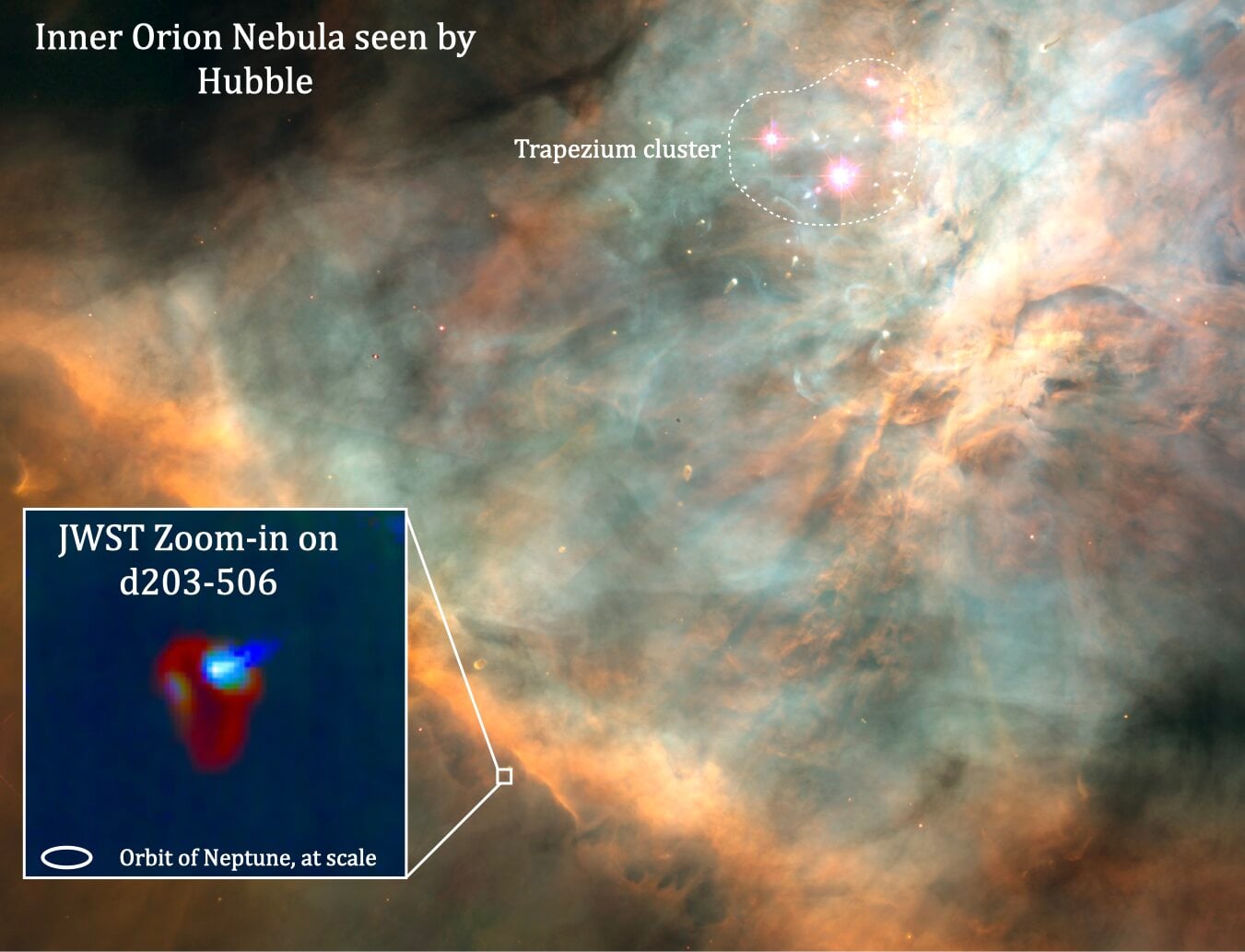
The James Webb Space Telescope has revealed the impact of radiation from massive stars on planet formation in the Orion Nebula, uncovering how the harsh radiation stunts the birth of planets in a protoplanetary disk called d203-506. The disk, surrounding a young red dwarf star, is bombarded by high-energy ultraviolet radiation from nearby massive stars, leading to the escape of gas from the disk and suppressing the formation of planets, particularly gas giants like Jupiter. This research sheds light on the complex interplay between stellar radiation and planet formation, providing insights into the conditions necessary for the birth of planetary systems.

astronomy1 year ago

"Stellar Radiation's Impact on Planetary Formation Uncovered by James Webb Telescope"

Scientists studying the Orion Nebula with the James Webb Space Telescope have found that massive stars play a crucial role in shaping planetary systems by exposing nascent planets to intense ultraviolet radiation, which can either aid or hinder their formation depending on the star's mass. This discovery sheds new light on the formation of planetary systems and will be featured in the journal Science.

astronomy1 year ago

"Orion Nebula's Monthly Destruction and Replenishment of Oceans of Water Tracked by JWST"

Scientists studying data from the JWST have discovered that a planetary disk in the Orion Nebula, d203-506, is destroying and replenishing an amount of water equivalent to all of Earth’s oceans in about a month. This process sheds light on the water cycle in the infant Solar System and suggests that Earth's water likely went through a similar process before making its way to the planetesimals and icy bodies that helped form the worlds of the Solar System. The findings provide valuable insights into planet-formation processes and the interplay between young stars and their protoplanetary disks.

astronomy1 year ago

"Uncovering the Massive Water Loss in the Orion Nebula with JWST"

Researchers, including astrophysicists Els Peeters and Jan Cami, have discovered the destruction and re-formation of a significant amount of water in a planet-forming disk at the heart of the Orion Nebula, using observations from the James Webb Space Telescope and quantum physics calculations. The intense ultraviolet radiation in the Orion Nebula leads to the destruction and re-formation of water, making it a true interstellar laboratory. The equivalent of all of Earth's oceans' worth of water is estimated to be destroyed and replenished per month in the d203-506 system, shedding light on the enigmatic recycling of water in interstellar space.

astronomy1 year ago

"JuMBOS: New Insights from Orion Nebula Radio Signals"

New research using data from the Karl G. Jansky Very Large Array (VLA) has deepened the mystery surrounding Jupiter-mass binary objects (JuMBOs) in the Orion nebula, with only one pair emitting strong radio waves. These objects challenge current star and planet formation models, as they don't fit neatly into either category. Their existence in binary pairs contradicts common observations of binary stars and raises questions about their formation. Further research and observations are needed to understand the processes creating radio waves from JuMBOs and to potentially reveal insights into the formation and evolution of stars and planets.

astronomy1 year ago

"Discovery of Free-Floating Binary Planetary Giants in Orion Nebula"

Astronomers have discovered free-floating binary planets, called JuMBOs, in the Orion Nebula using the James Webb Space Telescope (JWST) and the Karl G. Jansky Very Large Array (VLA). These Jupiter-Mass Binary Objects (JuMBOs) are not associated with stars and have masses similar to giant Jupiter-like planets. The discovery challenges current theories of star and planet formation, as these wide free-floating planetary-mass binaries do not fit within our understanding of how stars and planetary systems form. Further research is needed to understand the mechanism responsible for the unexplained radio emissions from these binary planets, and the discovery raises the possibility of these binary planets hosting moons that could potentially support life.

astronomy1 year ago

"Jupiter-sized Objects Locked in Mutual Orbit, Astronomers Discover"

Astronomers studying Jupiter-mass binary objects (JuMBOs) in the Orion Nebula have made a groundbreaking discovery, detecting radio waves originating from both components of a double system of free-floating planets, challenging existing theories on the formation of stars and planets. This finding raises new questions and provides exciting research opportunities to further understand the nature of these free-floating planets, potentially leading to insights into the potential habitability of planets beyond our solar system.