
"Stellar Radiation's Impact on Planet Formation Uncovered by James Webb Telescope"
TL;DR Summary
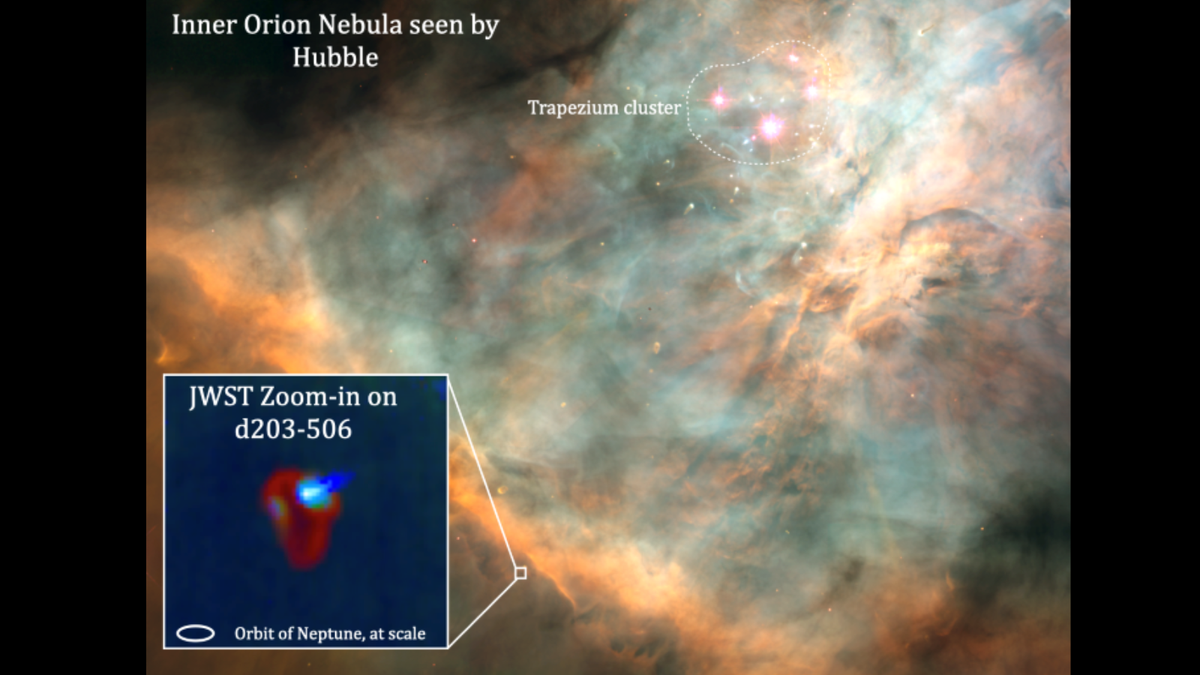
The James Webb Space Telescope has revealed the impact of radiation from massive stars on planet formation in the Orion Nebula, uncovering how the harsh radiation stunts the birth of planets in a protoplanetary disk called d203-506. The disk, surrounding a young red dwarf star, is bombarded by high-energy ultraviolet radiation from nearby massive stars, leading to the escape of gas from the disk and suppressing the formation of planets, particularly gas giants like Jupiter. This research sheds light on the complex interplay between stellar radiation and planet formation, providing insights into the conditions necessary for the birth of planetary systems.
Topics:science#astronomy#james-webb-space-telescope#orion-nebula#planet-formation#protoplanetary-disk#stellar-radiation
- James Webb Space Telescope reveals how stellar blasts of radiation stunt planet birth Space.com
- A far-ultraviolet–driven photoevaporation flow observed in a protoplanetary disk Science
- Scientists discover radiation from massive stars shapes planetary systems Phys.org
- James Webb telescope spots trouble in Orion Nebula: Stellar winds are eroding planet-forming material around a young star Livescience.com
- The Webb Telescope Just Uncovered A Possible Explanation for Why Giant Gaseous Planets Often Fail Inverse
Reading Insights
Total Reads
0
Unique Readers
9
Time Saved
4 min
vs 5 min read
Condensed
89%
904 → 101 words
Want the full story? Read the original article
Read on Space.com