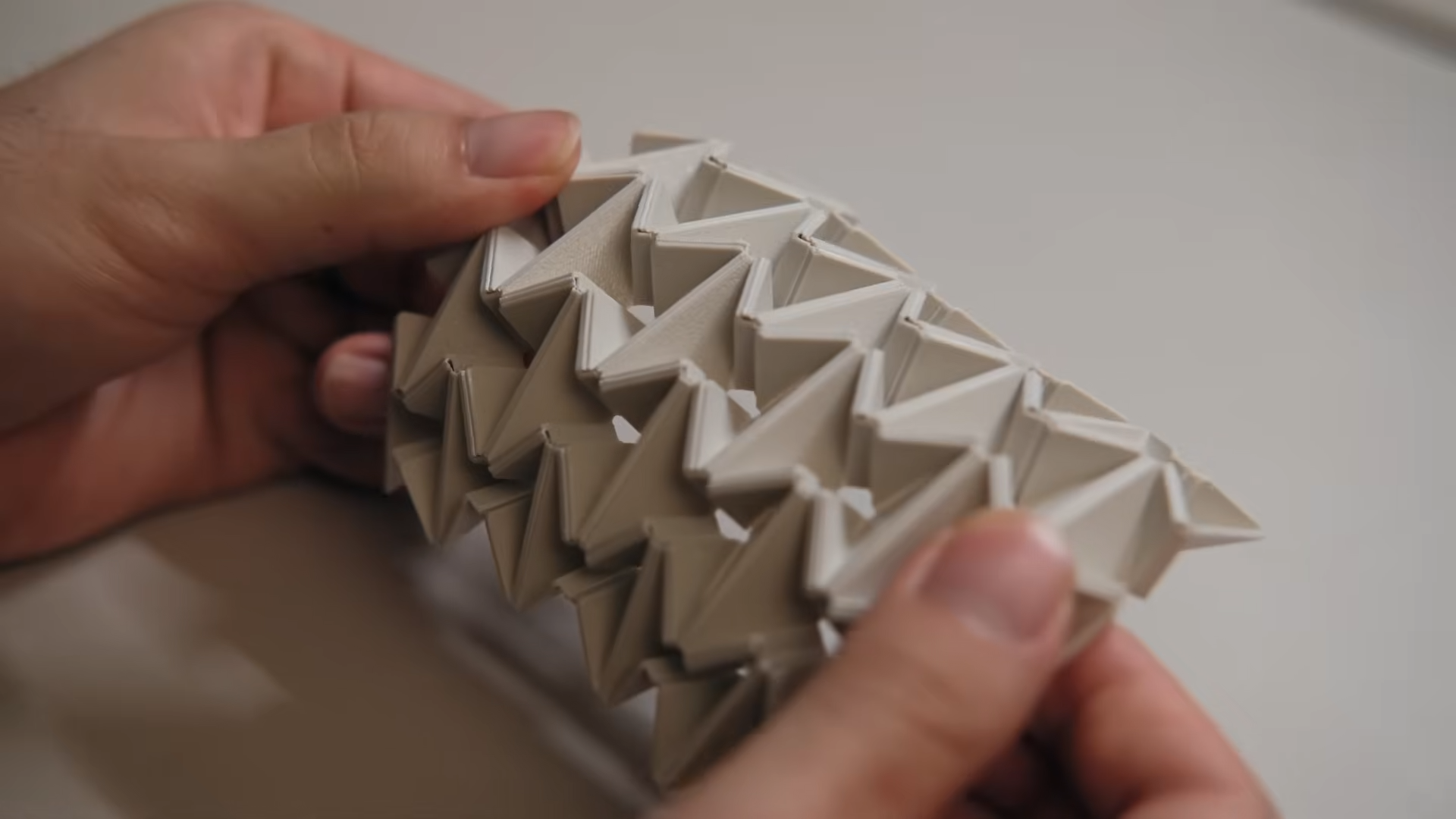
A designer explores integrating origami techniques into 3D printed parts, creating flexible and strong structures by modifying fold lines and using offset panels, pushing the boundaries of what is possible with 3D printing.
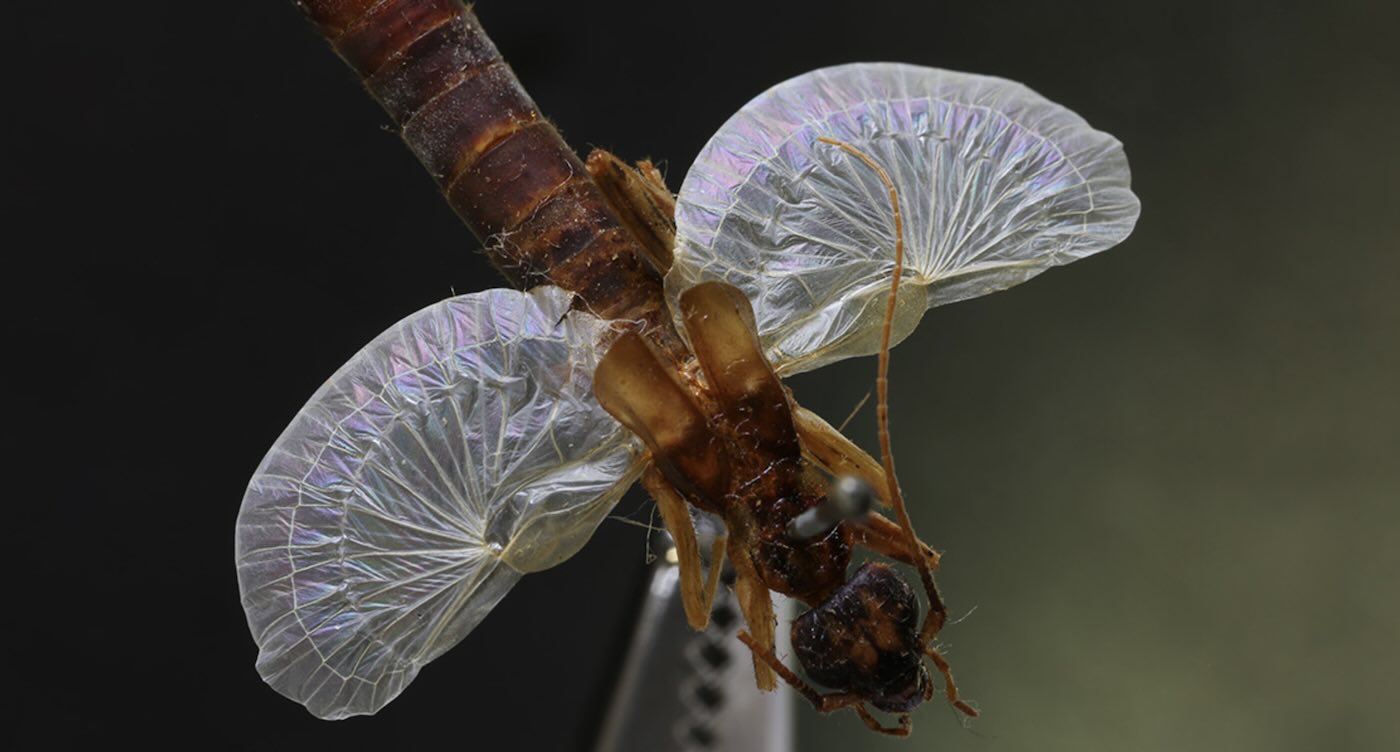
The article explores how nature employs origami-like folding mechanisms, such as in insect wings and microscopic protists, inspiring technological innovations like deployable space structures and robotic wings, highlighting the intricate physics and potential applications of biological folds.
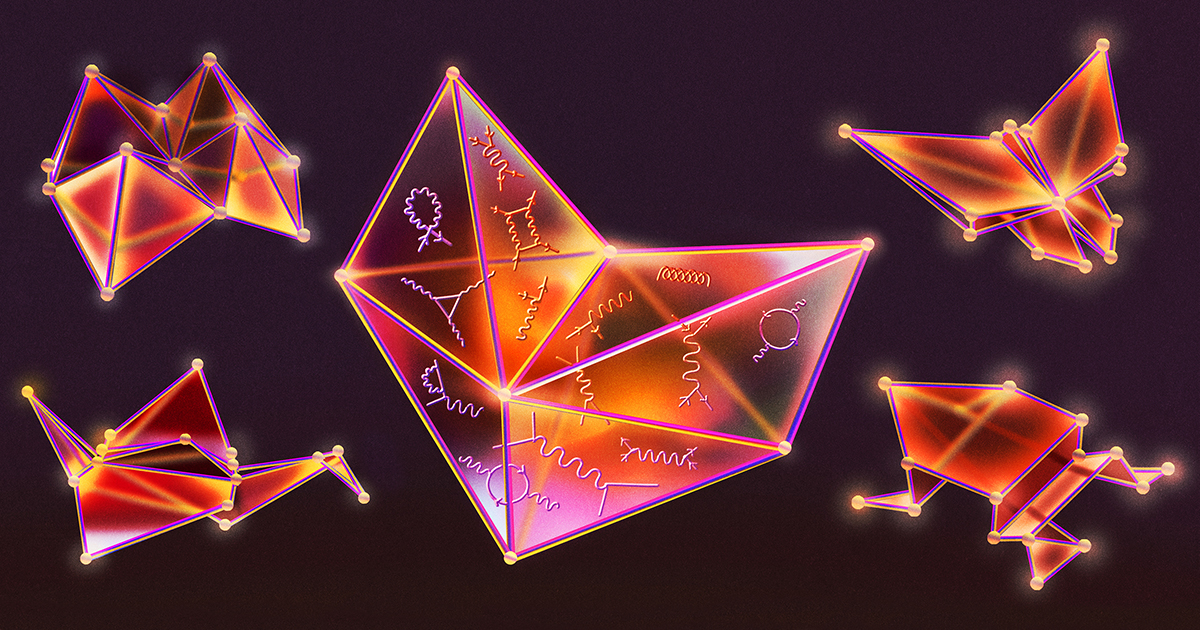
A mathematician at Cornell has discovered a surprising connection between origami patterns and the amplituhedron, a geometric shape that encodes particle interaction probabilities, leading to a proof that the shape can be decomposed into simpler parts, bridging a gap between physics and paper folding mathematics.
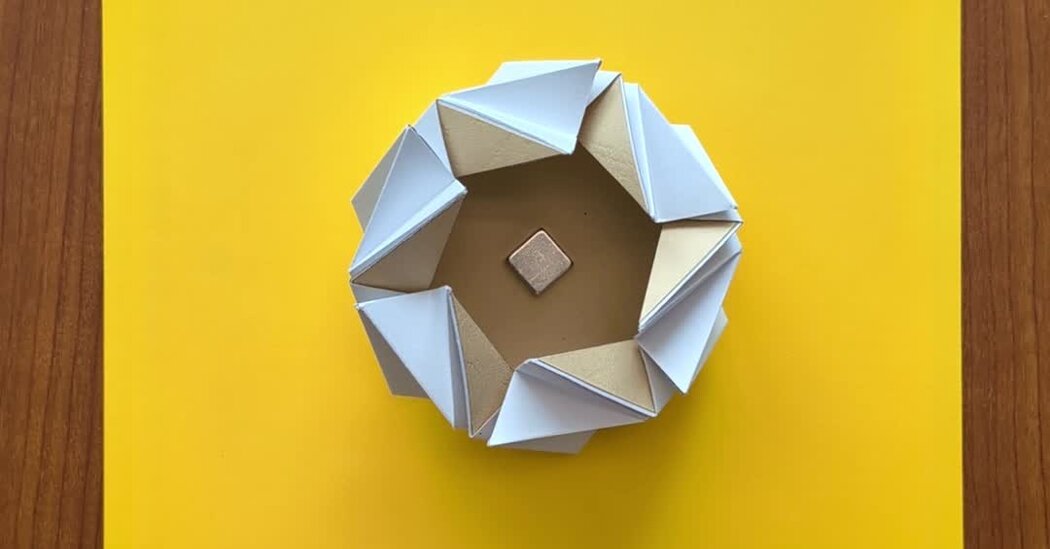
A BYU student discovered a new origami pattern called 'bloom patterns' with potential applications in space, medicine, architecture, and more, opening up infinite variations for practical use in deployable systems and design challenges.
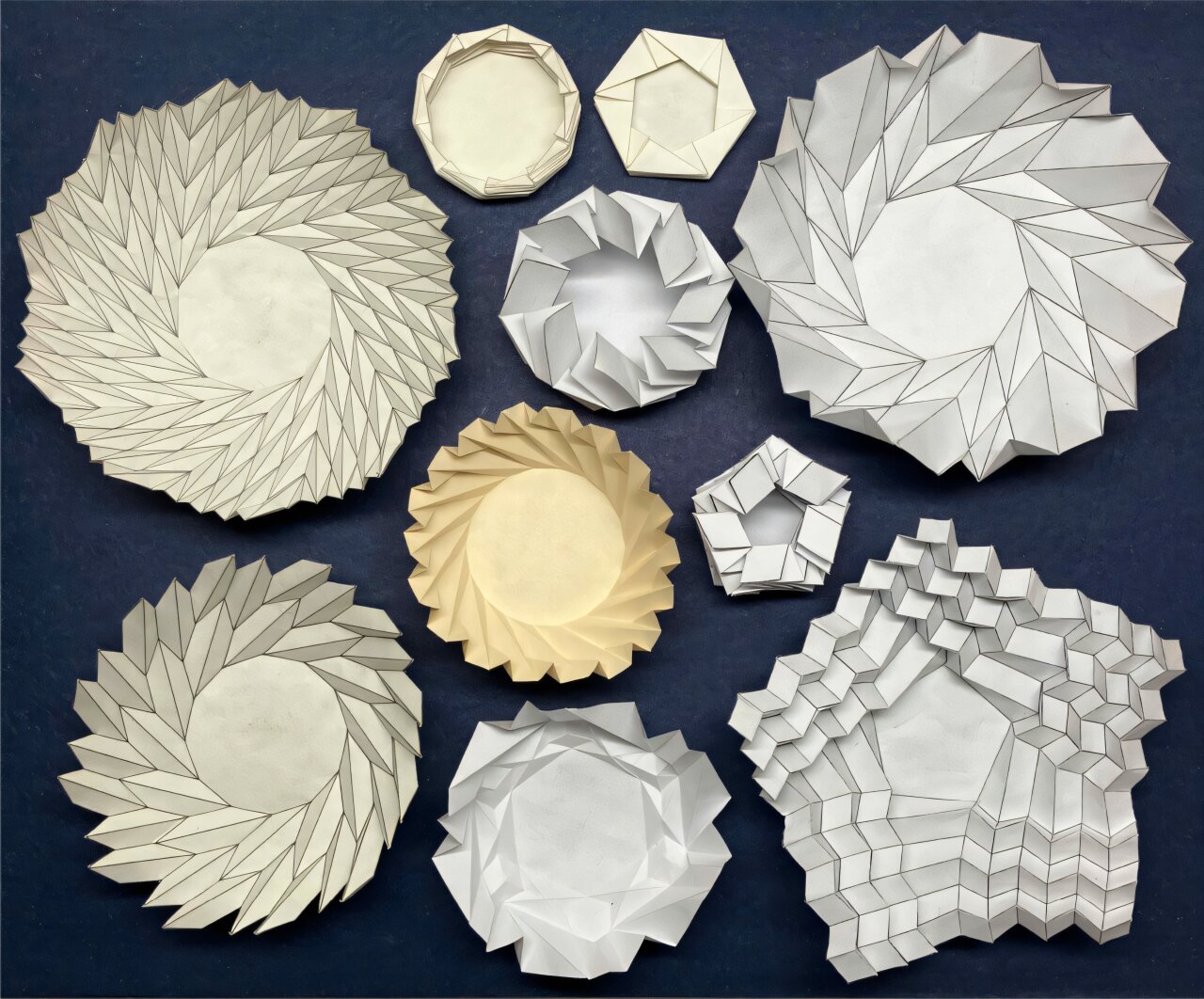
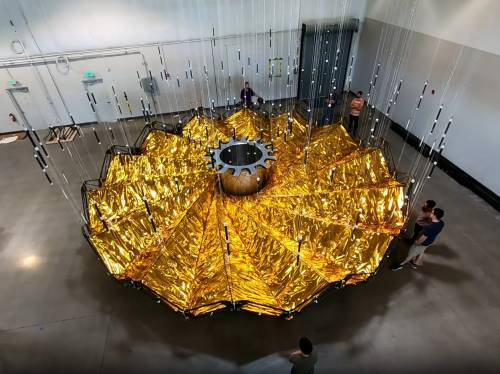
Researchers at Brigham Young University have developed new origami-inspired bloom patterns that can fold flat and unfold like flower petals, offering promising applications for compact, reliable space structures such as antennas, telescopes, and solar arrays, while also having potential uses on Earth for portable and expandable structures.
Researchers have discovered a new class of origami called bloom patterns, which are rotationally symmetric and resemble flowers. These patterns are promising for building foldable structures for space exploration due to their compactness, ability to be made from a single sheet, and scalability.
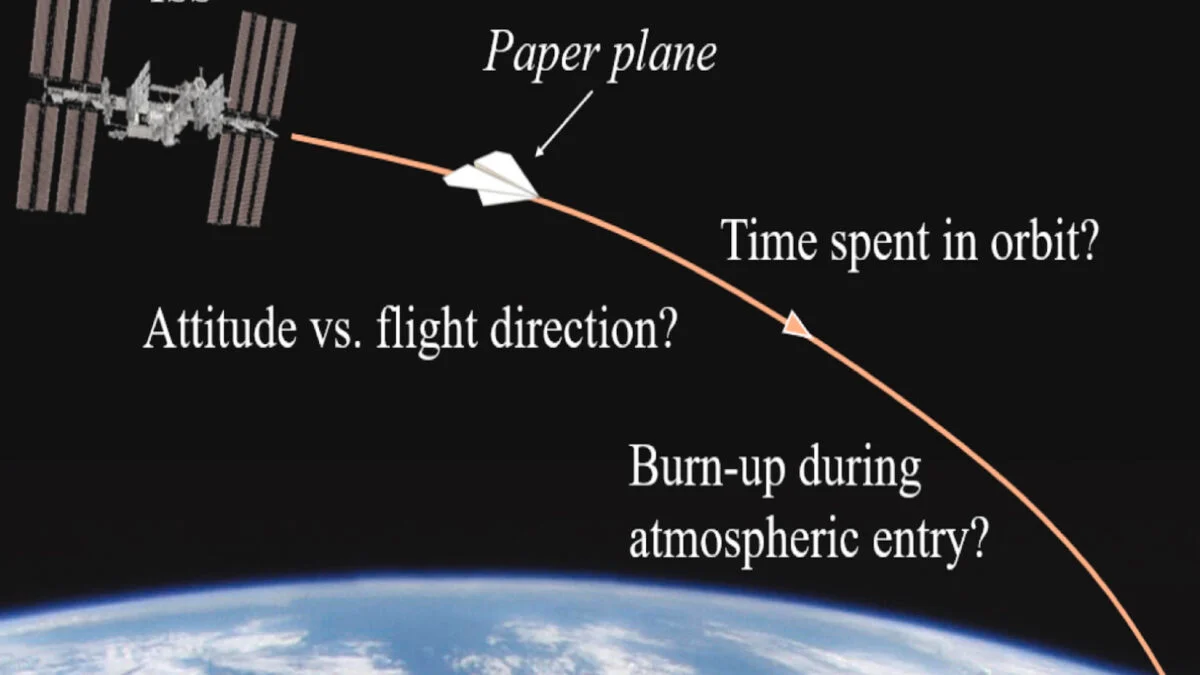
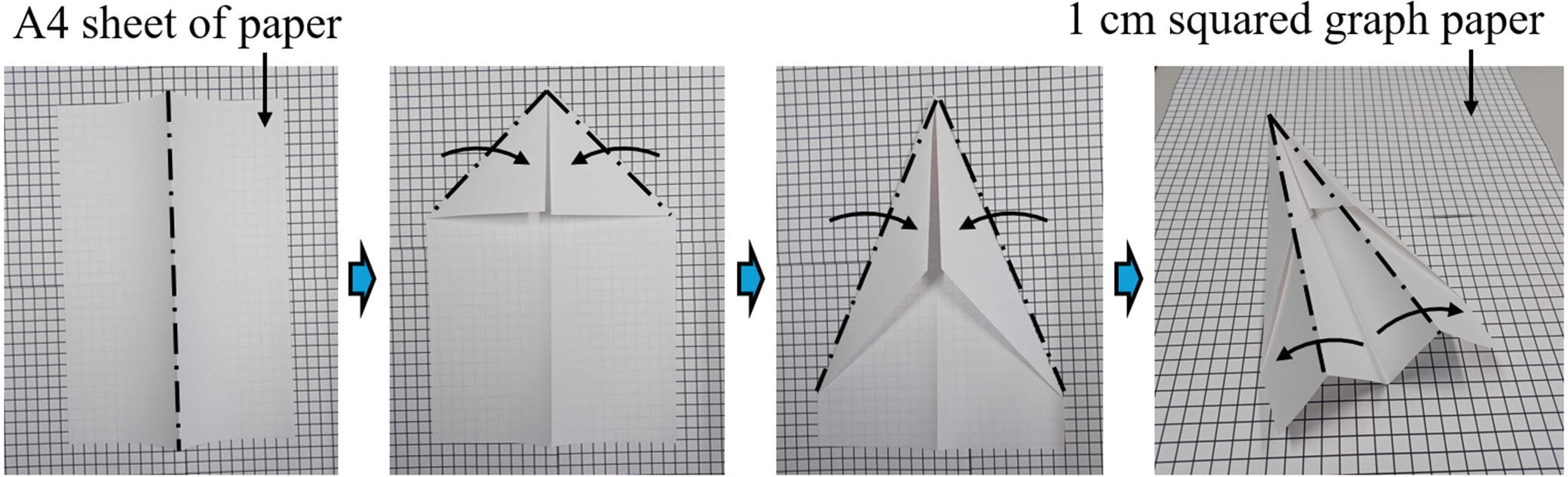
Researchers from the University of Tokyo propose using origami-inspired paper planes as a sustainable, low-cost solution for short-term missions and space debris mitigation in low Earth orbit, demonstrating their potential to burn up upon reentry and reduce environmental impact.
Researchers from the University of Tokyo explored using paper planes as a sustainable, biodegradable solution to space debris, demonstrating that origami-inspired spacecraft could potentially re-enter Earth's atmosphere and burn up without leaving harmful waste, offering an eco-friendly approach to space exploration and debris management.
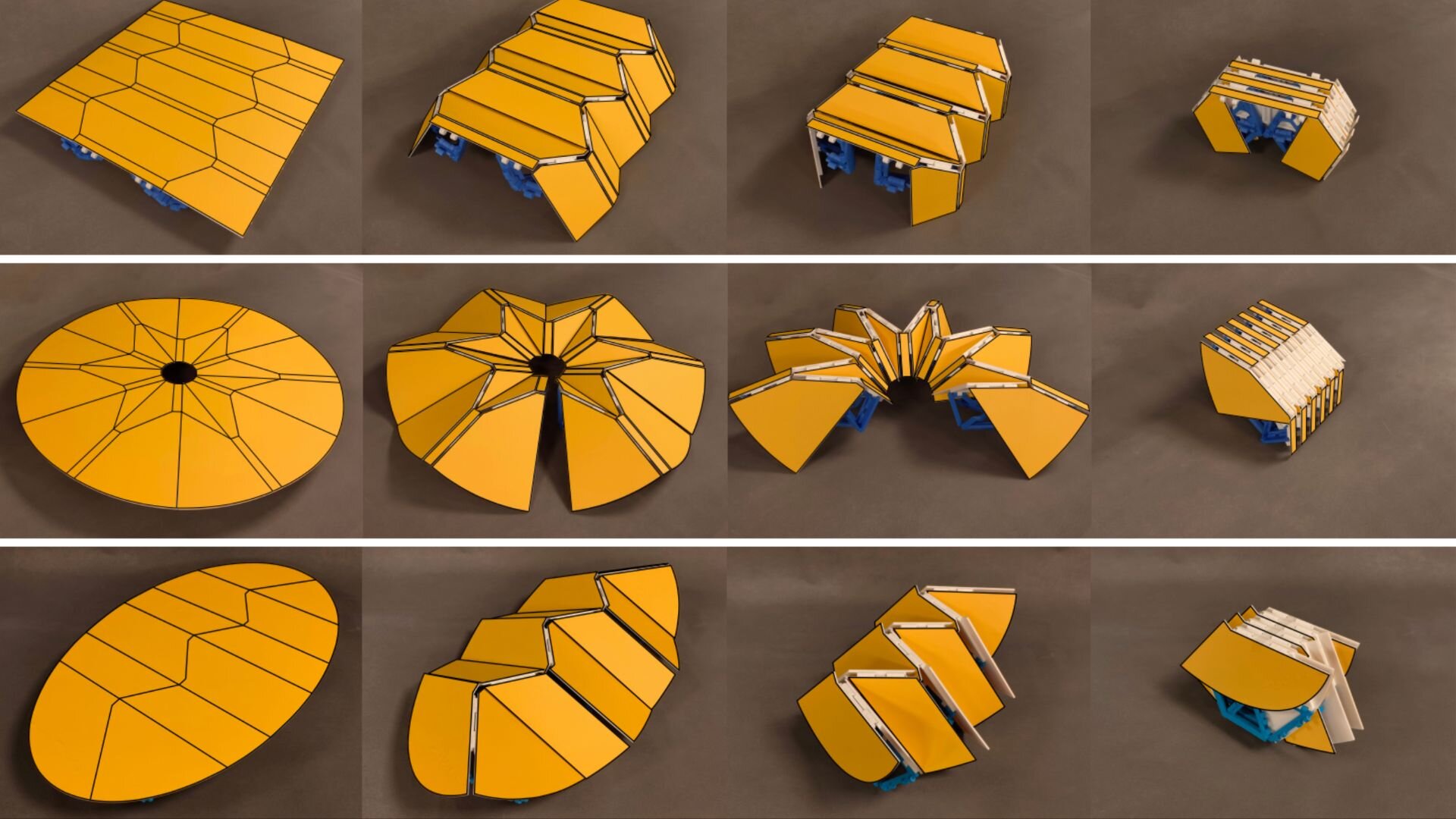
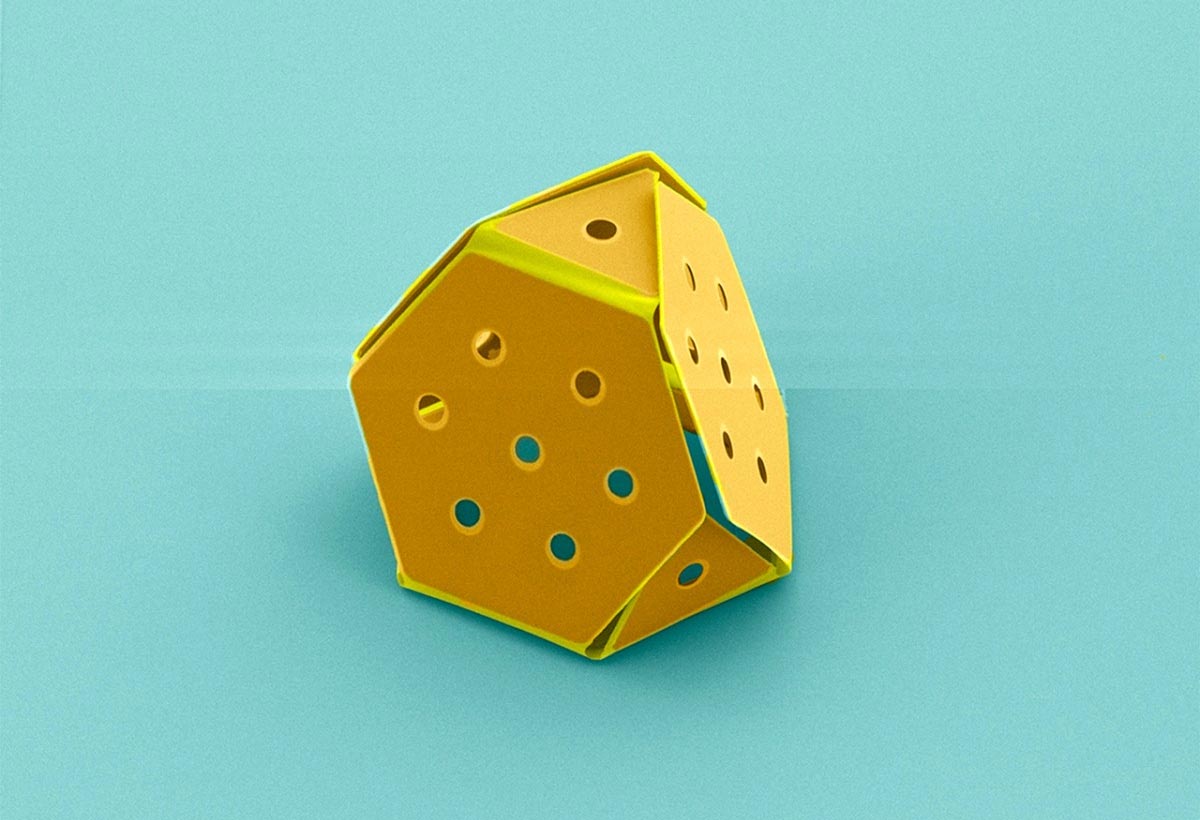
A study in Nature Communications introduces a novel method for creating deployable origami structures from thick materials that transform into smooth, continuous surfaces by removing specific panels, expanding potential applications in architecture, aerospace, and medical fields.
Origami is playing a crucial role in NASA's space exploration efforts. By applying the principles of origami, engineers are developing innovative folding structures that can be deployed in space, allowing for compact storage and efficient deployment of equipment and structures. This approach has the potential to revolutionize space missions by reducing launch costs and enabling the exploration of distant planets and moons.
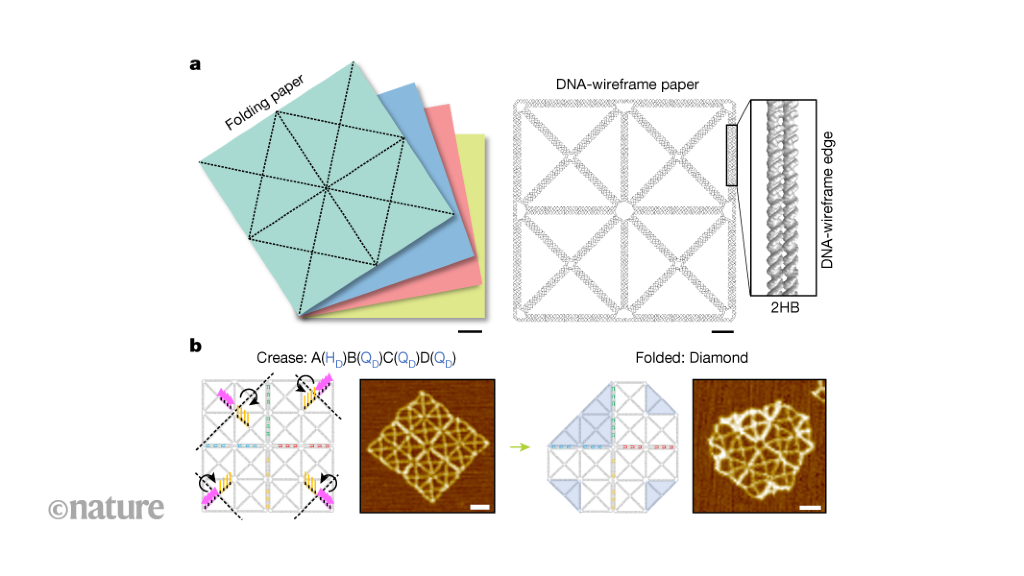
Researchers have developed sheets of "DNA wireframe paper" that can be folded along crease lines to create various shapes at the nanoscale, mimicking the art of origami. These structures can be transformed in response to external stimuli, opening up possibilities for applications in nanotechnology and materials science.
Scientists have developed a liquid metal coating that can be applied to paper and other materials without an adhesive, allowing them to be turned into smart objects. The metal coating conducts heat and electricity and can be used to create origami shapes that can re-fold themselves. The researchers also built 3D structures out of individual pieces of flat, metal-coated paper that could keep their shape without falling apart. The self-adhesive liquid metal coating could be an asset to soft robots in alien environments and could provide a new route for designing space explorers.
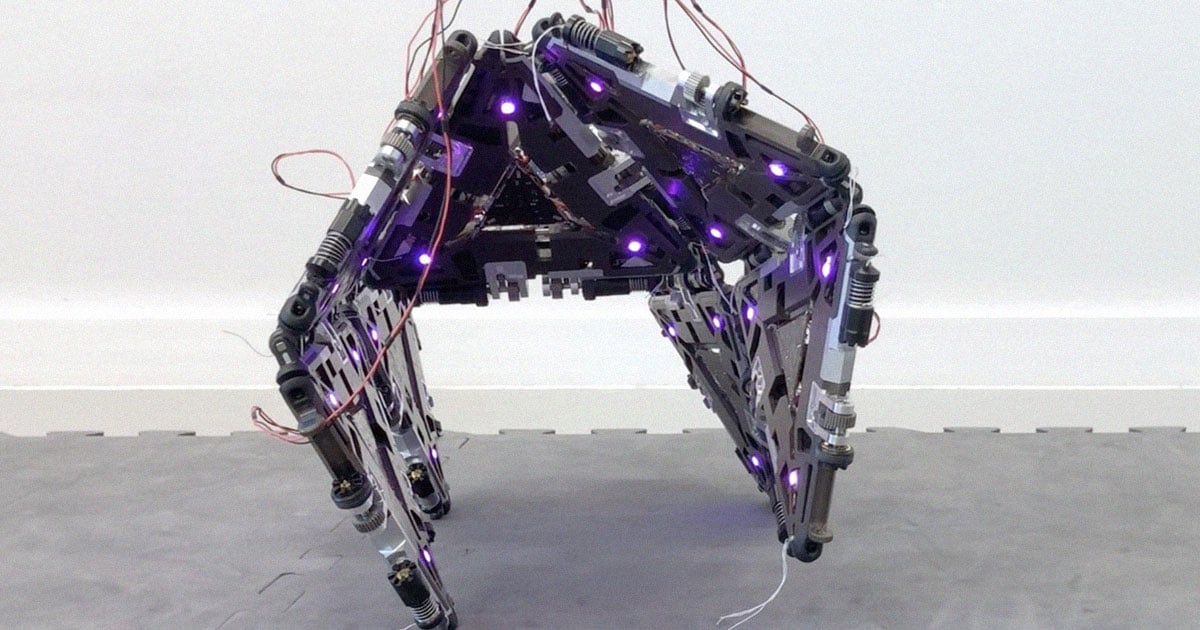
Researchers at Switzerland’s Ecole Polytechnique Fédérale de Lausanne have developed a modular, origami-inspired robot called Mori3 that can fold and unfold itself like a piece of flat-pack Ikea furniture. The robot can turn itself into a huge number of three-dimensional shapes and is an ideal candidate for assisting astronauts inside the cramped environment of a spacecraft. Mori3’s biggest selling point is its versatility, and the researchers are investigating whether multiple robots could attach themselves to each other to be even more useful.
Researchers at Switzerland’s Ecole Polytechnique Fédérale de Lausanne (EPFL) have developed an origami-inspired robot called Mori3 that can morph itself into nearly any 3D object. The design is modular, allowing astronauts to use it for a wide variety of purposes in space travel. The robot can change its size, shape, and function, and can handle objects, interact with its environment, and move around. The Mori3 is intended to be a general-purpose robot, morphing itself for any task that might need to be done on a spacecraft, from external repairs in the vacuum of space to internal transportation.
Researchers at Cornell University have developed a way to use chemical reactions to self-fold microscale origami machines, allowing them to operate in dry environments and at room temperature. The breakthrough could lead to the creation of tiny, autonomous devices that can rapidly respond to their chemical environment. The team exploited a rapid kinetic moment in a catalytic reaction to deform and bend ultrathin platinum sheets, creating a hinge-like movement. The system can actuate at 600 milliseconds per cycle and operate at 20 degrees Celsius. The researchers anticipate applying the technique to other catalytic metals, such as palladium and palladium gold alloys.