Optimism about household finances in the U.S. has reached its highest level since February 2020 following Donald Trump's presidential election victory, according to a New York Federal Reserve survey. The survey showed that 37.6% of households expect their financial situation to improve in the next year, while those expecting a decline dropped to 20.7%. Despite solid economic growth, inflation remains a concern, with expectations slightly rising. The outlook for government debt also improved, with expected growth in debt decreasing to 6.2%.
A New York Fed study reveals that during the pandemic, the net worth of white individuals grew by 30 percentage points more than that of Black individuals, largely due to gains in financial markets. Despite government support and a strong job market, wealth inequality persists, with a larger percentage of white households having investments in stocks and mutual funds. The study highlights the challenge of closing the wealth gap, as Black households have more wealth concentrated in pensions rather than market-linked assets. Black-owned businesses were disproportionately affected by the pandemic, and Treasury Deputy Secretary Walley Adeyemo suggests the need for policy interventions to address the significant wealth disparity between Black and white Americans.
Millennials in their 30s are facing increasing credit card debt, with outstanding balances reaching a record high of $1.13 trillion in the fourth quarter of 2023. The 90-day delinquency rate for credit cardholders has also risen to 6.36%, particularly affecting younger millennials and lower-income households. The end of the federal student loan pause and high interest rates on credit cards are contributing to financial strain. The Federal Reserve's cautious approach to interest rate adjustments may lead some card issuers to consider lowering rates in the near future.
The New York Federal Reserve reported a more than 50% surge in credit card delinquencies in 2023, with total consumer debt reaching $17.5 trillion. Delinquencies also rose in mortgages, auto loans, and other categories, signaling increased financial stress, particularly among younger and lower-income households. Household debt increased by $212 billion in the quarter, with credit card debt jumping 14.5% from the same period in 2022. Higher interest rates, driven by the Federal Reserve's tightening cycle, likely played a role in the delinquency rates. Despite some forgiveness of student loan debt by President Joe Biden, the total student loan debt remained largely unchanged, while mortgage debt increased by 2.8% in 2023.
A report from the New York Fed reveals that low-income borrowers are struggling to make payments on car loans and credit cards, with delinquencies surpassing prepandemic levels. Many missed out on the opportunity to refinance their mortgages during the pandemic, leading to higher monthly payments as current mortgage rates average 6.6%. Low-income areas also have lower levels of homeownership and higher rent burden, with 57% of households spending more than 30% of their income on rent.
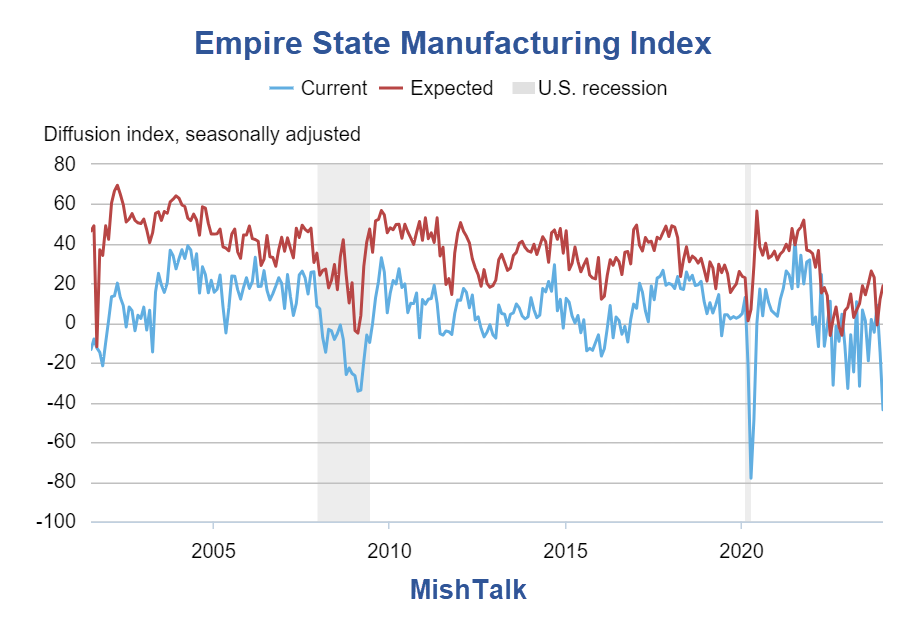
The Empire State Manufacturing Index saw a significant drop to -43.7, with new orders plummeting to -49.4, indicating a sharp decline in business activity in New York State. The report also revealed decreases in shipments, unfilled orders, and employment, while input prices increased. Despite some optimism for future business conditions and capital spending, concerns about excessive optimism and recent negative economic indicators suggest the possibility of an impending recession.
The New York Federal Reserve's Empire State business conditions index, a measure of manufacturing activity, plummeted to its lowest level since May 2020, raising concerns about the U.S. manufacturing sector. The index for new orders and shipments dropped significantly, while employment and hours worked contracted. Despite a slight increase in optimism, the surprise decline has sparked doubts about the sector's performance. Economists caution that the month-to-month swings in regional Fed manufacturing surveys are mostly noise, and the market reacted with stocks opening lower and the 10-year Treasury yield rising to 4% in early morning trading.
The Federal Reserve Bank of New York reported that underlying inflation pressures in the US eased in October compared to September, with its multivariate core trend (MCT) inflation reading at 2.6%. The MCT index peaked at 5.44% in June 2022 and the October reading closely matched the six-month trend of the personal consumption expenditures index, which stood at a 2.5% rise. The report comes ahead of the Fed's final policy meeting of the year, where officials will decide on another interest rate hike or a continued pause.
According to a report from the New York Fed, Americans are facing increasing difficulties in obtaining loans, with credit being the hardest to access in years. The overall rejection rate for credit applicants rose to its highest level since June 2018, with the highest rejection rates observed among those with credit scores below 680. Rejection rates for auto loans, credit cards, credit limit increases, mortgages, and mortgage refinancing have also increased. The survey found a modest decrease in loan seekers, but respondents planning to apply for credit in the next year slightly increased. The tightening of credit access comes as the Federal Reserve has aggressively raised interest rates to combat inflation, with expectations of further rate hikes.
The New York Federal Reserve's monthly Survey of Consumer Expectations for May showed one-year inflation expectations down 0.3 percentage point to a 4.1% rate, the lowest annual outlook since May 2021. The survey also showed that median inflation expectations over the longer run edged higher. The job market strength has come despite a series of 10 Fed interest rate hikes aimed in large part at correcting a labor imbalance. Markets largely expect the Fed to skip hiking rates at its meeting this week as policymakers process the impact that their moves have had on economic conditions.
Deposit withdrawals from US banks after the collapse of Silicon Valley Bank were concentrated in around 30 "super-regional" institutions in the $50 billion to $250 billion range, similar to SVB, according to a study by the New York Fed. Deposits among thousands of "community and smaller regional banks... were relatively stable by comparison" during March, with the largest, systemically important firms receiving the deposits that left the super-regional group. Smaller banks were relatively unaffected, and the high level of uninsured deposits at SVB was a factor in its collapse.
Scott Rechler, a board member of the New York Federal Reserve and CEO of RXR, has warned of potential systemic problems in the commercial real estate finance market, with $1.5tn in debt set to mature in the next three years. Rechler has called on the industry to work with authorities to avoid a crisis, and has joined the Real Estate Roundtable in calling for a program that provides lenders with flexibility to work with borrowers to develop responsible refinancing plans. The real estate sector has been hit hard by Fed rate rises and the shift away from in-office work during the pandemic.
The Federal Reserve Bank of New York has updated its economic forecasts generated by the dynamic stochastic general equilibrium (DSGE) model. The model forecasts use data released through 2022:Q4, augmented for 2023:Q1 with the median forecasts for real GDP growth and core PCE inflation from the February release of the Philadelphia Fed Survey of Professional Forecasters (SPF). The model expects output growth to be higher for 2023 than in December, and inflation is projected to be a bit more elevated at all forecast horizons in comparison to December. Monetary policy is expected to be tighter in absolute terms relative to December, consistent with the January/February Survey of Primary Dealers.