Tag

Kepler Space Telescope

All articles tagged with #kepler space telescope

space-exploration1 year ago

"25 Years of Exoplanet Hunting: Rethinking the Search for Earth 2.0"

Over the past 25 years, exoplanet research has evolved from knowing fewer than 30 exoplanets to over 5,000 today. Despite the significant increase in discoveries, finding an Earth-like planet remains elusive. The field has seen major milestones, such as the launch of the Kepler Space Telescope and the discovery of the Trappist-1 system. Future missions like the Nancy Grace Roman Space Observatory and the Ariel Space Mission aim to further our understanding of exoplanets and their potential to harbor life.

astronomy1 year ago

"Exomoon Controversy: Debating the Existence Beyond Our Solar System"

Scientists are debating the existence of the first exomoons seen beyond our solar system, with one team claiming to have detected exomoons around exoplanets Kepler-1625b and Kepler-1708b, while another team casts doubt on these findings. The disagreement revolves around the interpretation of telescope data and the use of algorithms for analysis. The debate highlights the challenges of detecting exomoons and the need for advancements in telescope technology and detection methods.

science2 years ago

"Kepler Giant Planet Search: Unveiling Life's Potential in the Cosmos"

Astrophysicists led by Lauren Weiss have created the first-ever catalog of small, Earth-like planets with Jupiter-like siblings, providing valuable insights into the diversity of planetary systems and the formation of planets. The catalog, called the Kepler Giant Planet Search, is a crucial tool in the search for life elsewhere in the universe. The team used the radial velocity method to detect gas giants, which are difficult to find using traditional methods. The study recorded almost 3,000 radial velocities of 63 stars hosting 157 known small planets, including rocky ones that may be suitable for life. The research also discovered 13 Jupiter-like planets, eight Neptune-sized planets, and three companion stars. This catalog will serve as a foundation for future studies on planetary systems and the joint occurrence of giant and small transiting planets.

astronomy2 years ago

Scientists Skeptical of Proposed Detection of First Exomoons

Scientists are skeptical about the proposed detection of the first exomoons orbiting planets outside the solar system. The research suggests that exomoons may only be detectable if they are extremely large. While there is no reason to believe that moons don't exist around exoplanets, finding them is challenging. Previous detections of exomoons around Kepler-1625 b and Kepler-1708 b are now in doubt, with alternative explanations for the observed signals. The study also indicates that current technology can only detect particularly large moons in wide orbits around their planets, making exomoon detection even more unlikely.

space2 years ago

Unraveling the Enigma of Shrinking Exoplanets: Insights from Kepler and Retired NASA Telescope

Data from NASA's Kepler Space Telescope suggests that the absence of exoplanets between 1.5 and two times the size of Earth may be due to core-powered mass loss. Scientists have found evidence that the cores of sub-Neptune exoplanets push away their atmospheres from the inside out, causing the exoplanets to shrink. This phenomenon occurs when radiation emitted by the planet's hot core interacts with the atmosphere, causing it to fade away slowly. The study used data from the Kepler Space Telescope's extended mission, K2, and found that core-powered mass loss is the leading explanation for atmospheric loss in sub-Neptunes. Further research is needed to fully understand this process.

space-science2 years ago

Unraveling the Mystery: NASA's Discovery of Shrinking Exoplanets

Researchers using data from the Kepler Space Telescope have discovered that some exoplanets are shrinking due to the loss of their atmospheres, likely caused by radiation from their cores. This finding helps explain the observed size gap in exoplanets and suggests a significant atmospheric loss process different from previously theorized photoevaporation. The study provides evidence supporting the theory of core-powered mass loss, where radiation emitted from a planet's hot core pushes the atmosphere away over time. The research also highlights the ongoing mystery of the missing exoplanets between super-Earths and sub-Neptunes and the need for further investigation.

space2 years ago

Unveiling the Mystery: NASA Data Sheds Light on Exoplanet Shrinkage

A new study using NASA's Kepler Space Telescope suggests that some exoplanets are losing their atmospheres and shrinking due to core-powered mass loss. The study focuses on the "size gap" between super-Earths and sub-Neptunes and provides evidence that the cores of these planets are pushing away their atmospheres from the inside out. The researchers observed star clusters Praesepe and Hyades and found that nearly 100% of stars in these clusters still have sub-Neptune planets or planet candidates, indicating that core-powered mass loss is the most likely explanation for the shrinking of these planets. Further research is needed to fully understand the mechanisms behind this phenomenon.

astronomy2 years ago

"NASA Discovers Fiery 7-Planet System Orbiting Hotter-Than-Sun Star"

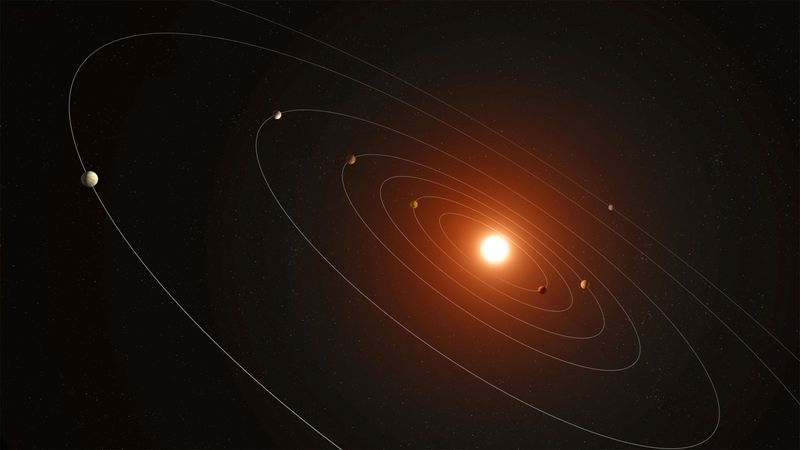
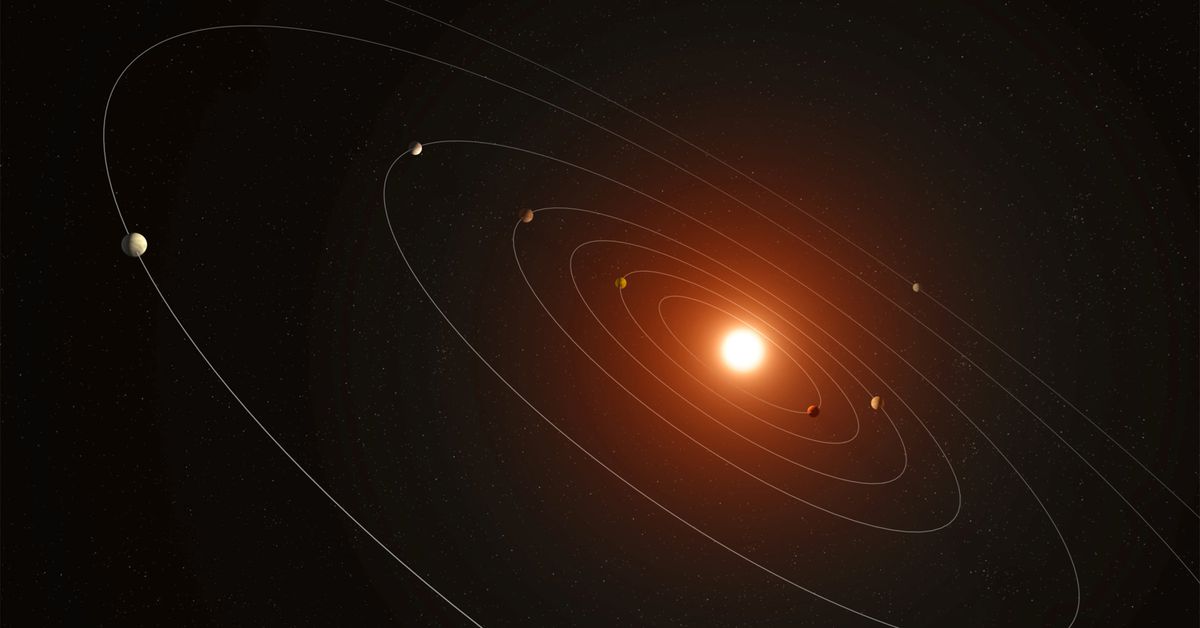
Astronomers have discovered seven exoplanets orbiting a star in our Milky Way galaxy, all of which are larger than Earth but smaller than Neptune. These planets, located closer to their star than Mercury is to the Sun, are being "fried" by intense solar radiation. The study, based on data from NASA's Kepler space telescope, highlights the diversity of planetary systems and suggests that there may be more planets in the system that have not yet been detected. However, the chances of finding life on these planets are considered remote.

astronomy2 years ago

"NASA Discovers Fiery 7-Planet System Orbiting a Sun-Like Star"

Astronomers have discovered seven planets orbiting a star in our Milky Way galaxy, all of which are larger than Earth but smaller than Neptune. These planets, located closer to their star than Mercury is to the Sun, are being "fried" by intense radiant energy. The discovery was made using data from NASA's retired Kepler space telescope, which detected small dips in a star's brightness when a planet passed in front of it. This finding highlights the diversity of planetary systems and suggests that many may not resemble our own solar system. However, these planets are not considered promising candidates for hosting life.

astronomy2 years ago

"NASA's Stunning Discovery: 7 Scorching Exoplanets Orbiting a Distant Star"

NASA's Kepler Space Telescope has discovered a system of seven exoplanets, known as Kepler-385, that are being bombarded by radiation from their parent star. These blisteringly hot planets are larger than Earth but smaller than Neptune and receive more radiation than any planet in our solar system. The discovery is part of a new catalog of exoplanet candidates and multi-planet systems created by the Kepler mission, providing astronomers with valuable information about the characteristics of exoplanets. The Kepler-385 system is located 4,672 light years away and contains one of the few known systems with more than six planets.

astronomy2 years ago

Citizen Scientists Uncover Kepler Space Telescope's Final Planets in Archive Data

Citizen scientists sifting through archive data from NASA's Kepler Space Telescope have identified the last three exoplanets discovered by the telescope. The Kepler Space Telescope, which launched in 2009, spent four years monitoring stars for the dip in brightness caused by a planet passing in front. After a reaction wheel failure in 2013, the telescope conducted the K2 observing campaign until it ran out of fuel in 2018. Despite the lack of fuel, the telescope's last observation run provided enough data for citizen scientists to identify three potential planets, confirming two of them. The discovery highlights the historical importance of these planets, given the circumstances of their identification.

astronomy2 years ago

Kepler Telescope's Final Planetary Discoveries Revealed.

Astronomers, with the help of citizen scientists, have discovered what may be the last three planets that NASA's Kepler Space Telescope saw before it was retired. The two validated planets are K2-416 b and K2-417 b, both "hot mini-Neptunes" located about 400 light years from Earth. The third is a planet candidate, EPIC 246251988 b, which is almost four times the size of Earth and orbits its star in around 10 days, located 1,200 light years from Earth. Kepler discovered over 2,500 exoplanets during its nine and a half year mission, contributing to the confirmation of over 5,000 planets beyond our solar system.

science-and-astronomy2 years ago

Reconsidering the Solitude of Exoplanets: New Discoveries Challenge Previous Assumptions.

Hot Jupiters, exoplanets that orbit their stars in 10 days or less, were thought to be solitary residents in their star systems. However, a new study analyzing data from NASA's Kepler Space Telescope found that 12% of known Hot Jupiters and up to 70% of warm Jupiters might have nearby planetary companions. The study used the transit timing variation method to detect worlds close to hot Jupiters that the transit method couldn’t spot. The presence of neighbor worlds around hot Jupiters is strong evidence that not all hot Jupiters have a violent history as was previously thought.

astronomy2 years ago

Astronomers Discover Rare 'Tatooine-Like' Solar System

Astronomers at the University of Birmingham have discovered a new binary star system called BEBOP-1 where planets orbit two suns, similar to Tatooine in Star Wars. The system features two planets, including TOI-1338b, which was discovered by NASA's TESS space telescope. The team used state-of-the-art instruments to measure the mass of the planets and discovered BEBOP-1c, a gas giant with an orbital period of 215 days and a mass 65 times larger than Earth. The discovery of circumbinary planets is important in understanding planet formation.

science-and-astronomy2 years ago

Kepler Telescope's Last Discovery: Trio of Exoplanets

NASA's Kepler Space Telescope discovered two mini-Neptune exoplanets and one candidate planet in its final dataset just before running out of fuel and shutting down in late 2018. The planets were found by a team of astrophysicists and citizen scientists who combed through the last chunk of data that Kepler sent home. The two confirmed planets, K2-416 b and K2-417 b, are smaller than Neptune and are likely uninhabitable due to their hot, tenuous atmospheres. The third candidate planet has not been confirmed yet.