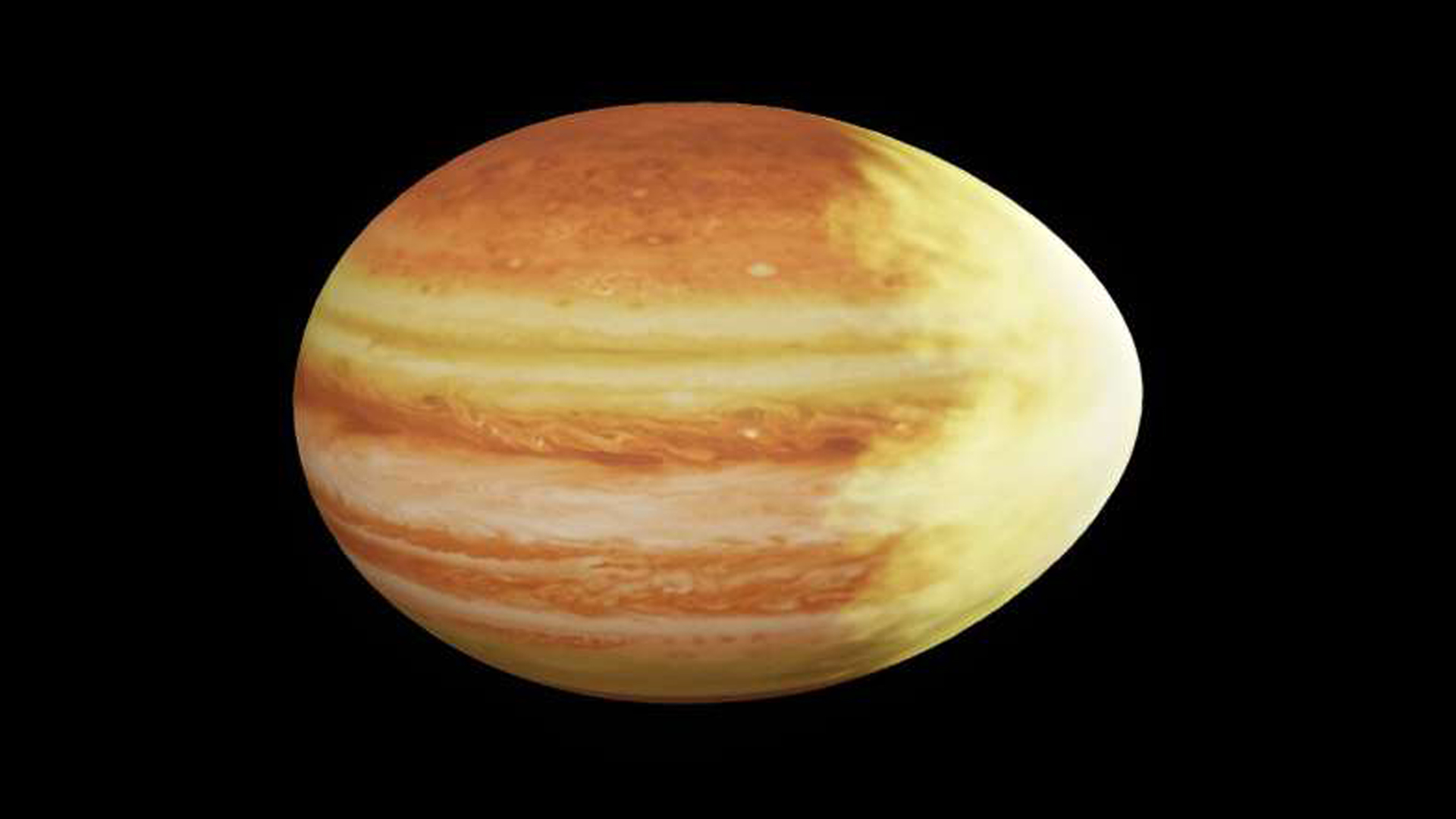
Astronomers have created the first 3D map of an exoplanet's atmosphere, WASP-18b, using a new technique called spectroscopic eclipse mapping with the James Webb Space Telescope, revealing temperature zones and water vapor breakdown in this ultra-hot Jupiter.
A massive exoplanet, TOI-2109b, is spiraling towards its star in a process called orbital decay, with three possible outcomes: it could be consumed by the star, torn apart by tidal forces, or lose its gaseous layers to become a rocky super-Earth. Researchers are monitoring this process to better understand planetary evolution and star-planet interactions.
Scientists have revealed that the Jupiter-like exoplanet WASP-12b, known as a "hot Jupiter," is doomed to be completely devoured by its star in just three million years, much sooner than previously thought. The extreme gravity of the star is already deforming and tearing apart the planet, with its atmosphere being stripped away. This rare and extreme planet, orbiting very close to its giant star, is being slowly cannibalized, and its tragic end has been predicted by researchers.
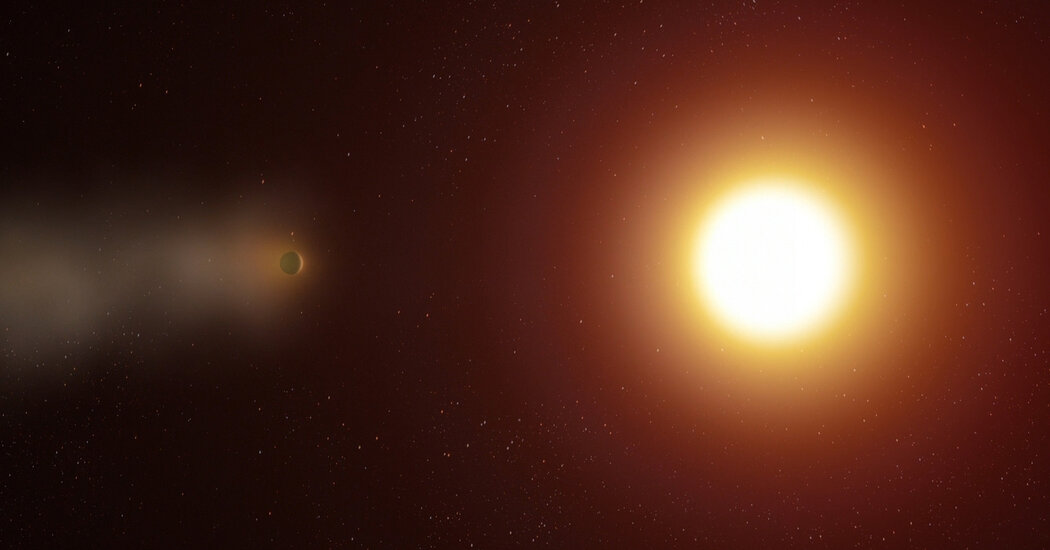
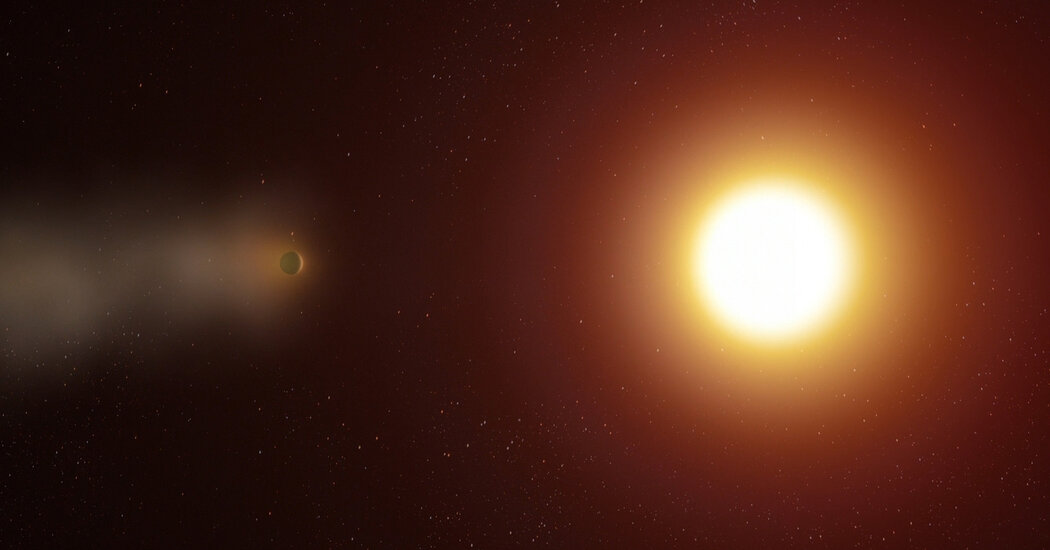
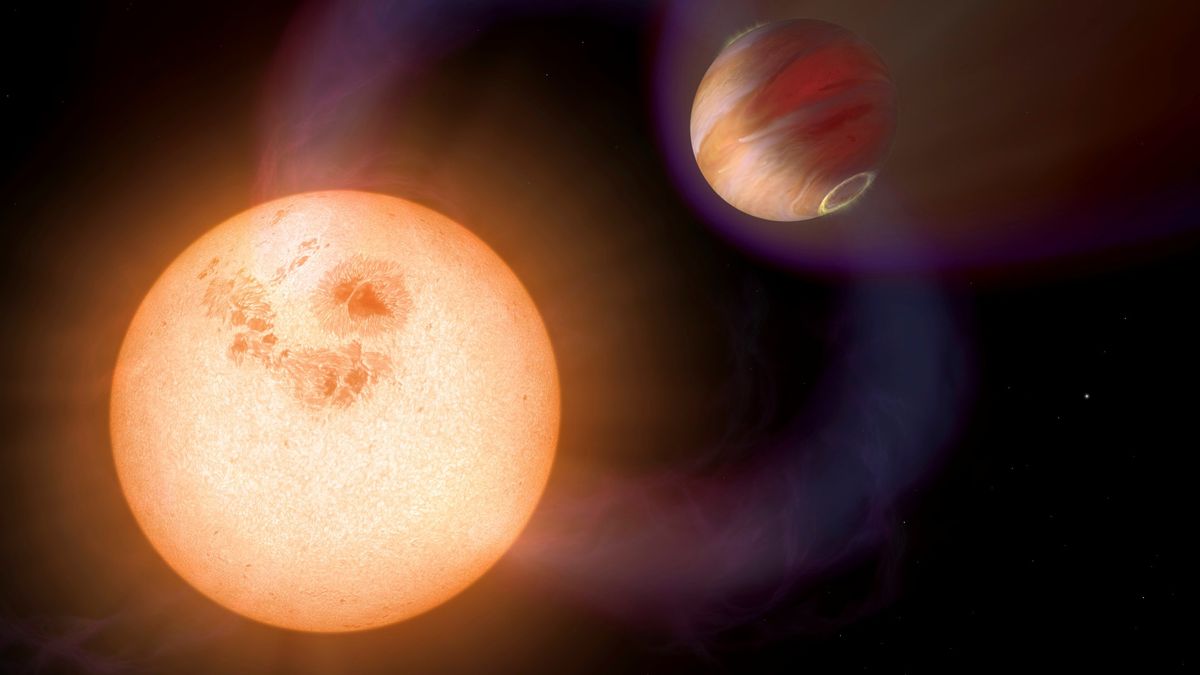
Astronomers have discovered that the exoplanet WASP-69b, located 160 light-years away, has a 350,000-mile-long tail of helium gas trailing behind it, resembling a comet's tail. This "Hot Jupiter" planet, slightly larger than Jupiter and very close to its star, is an eccentric addition to the known exoplanets and offers scientists an opportunity to study how planets lose their atmospheres.
Astronomers have discovered that the exoplanet WASP-69b, located 160 light-years away, has a 350,000-mile-long tail of helium gas trailing behind it, resembling a comet's tail. This "Hot Jupiter" planet, slightly larger than Jupiter and very close to its star, exhibits an extravagant tail due to its atmosphere heating to extreme temperatures and being accelerated into space by the star's intense radiation. The discovery sheds light on how planets lose their atmospheres and provides insight into the behavior of Hot Jupiters.
Astronomers using NASA's TESS have discovered two new "hot Jupiter" exoplanets, TOI-4377 b and TOI-4551 b, orbiting red-giant stars. These giant alien worlds have short orbital periods and high surface temperatures, similar to Jupiter. The findings contribute to the understanding of short-period giant planets around red-giant stars, which are relatively rare.
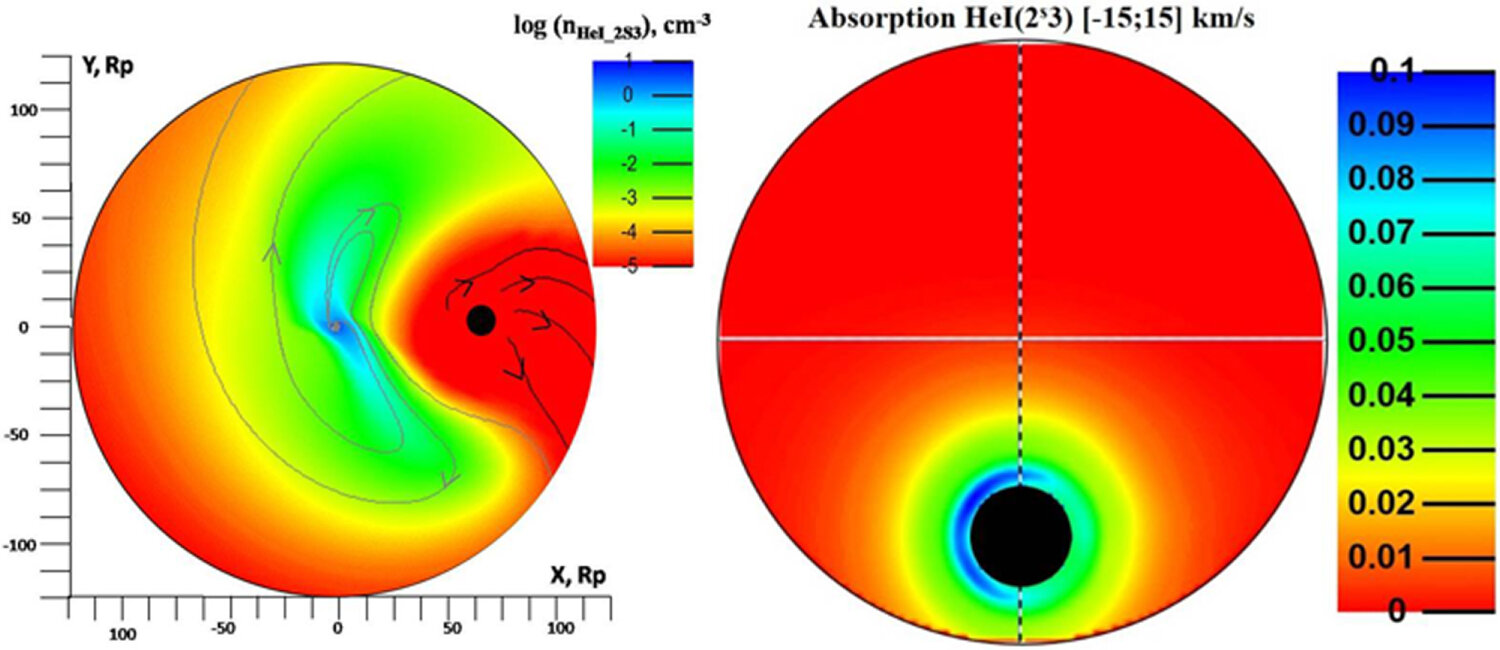
Scientists have modeled the atmosphere of the hot Jupiter exoplanet HD 189733b and discovered that the unstable absorptions in the hydrogen line Lyα are likely caused by the high activity of the host star, resulting in increased radiation flux in the ultraviolet region and a faster loss of stellar material. The researchers used transit spectroscopy to study the movement and composition of the planet's atmosphere, revealing the presence of different elements. This study provides insights into the physico-chemical properties of the HD 189733b planetary system.
Astronomers have discovered a massive gas tail trailing from the exoplanet HAT-P-32 b, located 950 light years away from Earth. The planet, classified as a "hot Jupiter," is losing its atmosphere due to its close proximity to its parent star. The gas tail, about 18 times the size of Jupiter, is one of the largest planetary structures observed outside our solar system. By studying this phenomenon, researchers hope to gain insights into planetary evolution and solve the mystery of the "hot-Neptunian desert" in the exoplanet catalog. Supercomputer simulations have revealed that HAT-P-32 b is being both trailed and led by its outflowing gas, and it is estimated to take 40 billion years for the planet to completely lose its atmosphere. However, the planet is unlikely to survive the lifespan of its host star, which is expected to engulf it in the future.
A study has revealed that the exoplanet HAT-P-32b, located 950 light years away from Earth, is losing its atmospheric helium, resulting in the creation of massive gas trails. This makes it the largest known planetary structure in space. HAT-P-32b is a "hot Jupiter" with a short orbital rotation and a mass of approximately 0.68 Jupiter. Scientists hope to gain insights into the phenomenon of atmospheric escape by studying this planet.
Astronomers have discovered the rare "thermometer molecule" chromium hydride in the atmosphere of the exoplanet WASP-17b, which orbits an F-type star located 1,250 light-years from Earth. Chromium hydride is temperature-sensitive and is abundant in a specific temperature range. This discovery could allow scientists to measure the temperatures of exoplanets in a new way. WASP-17b is an extreme exoplanet located very close to its parent star, causing extreme temperatures and causing its atmosphere to "puff out." The researchers used high-resolution spectroscopy to detect the chromium hydride in the planet's atmosphere and hope to find more metal hydrides in the atmospheres of other exoplanets.
Astronomers have discovered a Jupiter-size planet named Halla that miraculously survived the explosive expansion of its host star, Baekdu. Halla, also known as a "hot Jupiter," should have been engulfed and incinerated by the expanding star, but it managed to survive. The researchers propose two possibilities: either Halla was born after Baekdu transformed into a red giant, or Baekdu was once part of a binary system that later merged, preventing either star from expanding enough to consume Halla.
Astronomers have discovered that the ultra-hot Jupiter exoplanet, WASP-76 b, has a similar composition to its star, with the same abundances of elements heavier than hydrogen and helium. The team identified 11 chemical elements in the atmosphere of the planet, some of which haven't even been measured in the solar system gas giants Saturn and Jupiter yet. The planet's proximity to its parent star causes temperatures to soar to around 4,350 degrees Fahrenheit, hot enough to vaporize iron. The team also found a higher abundance of nickel than expected around WASP-76 b, which could imply that at some point in its history, the gas giant planet swallowed a smaller terrestrial world similar to Mercury that was rich with the element.
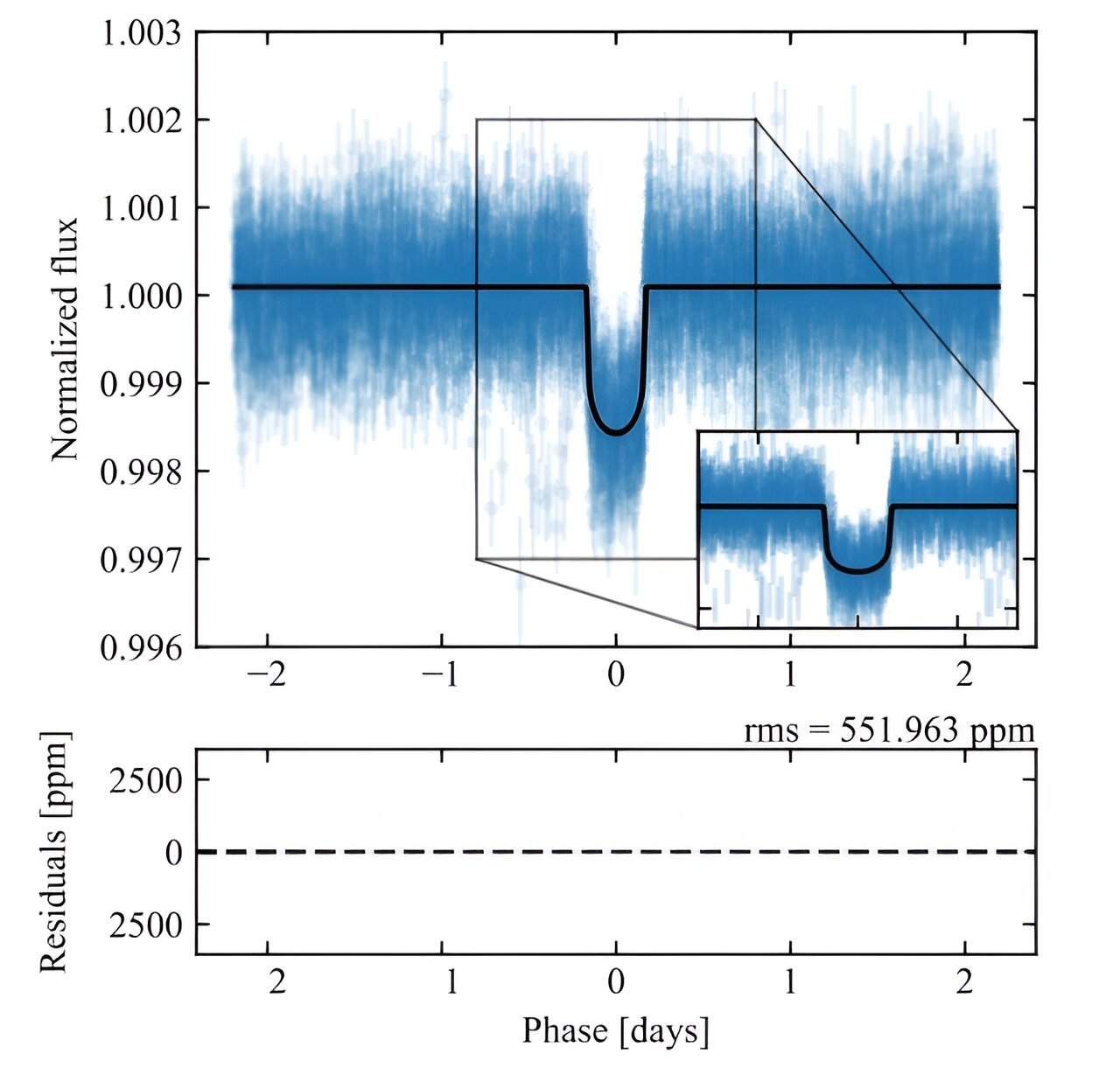
NASA's Transiting Exoplanet Survey Satellite (TESS) has discovered a "warm" exoplanet, TOI-4127 b, with twice the mass of Jupiter orbiting a distant dwarf star. The exoplanet takes 56.4 days to orbit its host star and has a highly eccentric orbit that brings it to within around a third of the distance between the Earth and the sun from the star. The team thinks it has the capability of becoming a hot Jupiter if another celestial object perturbs its orbit. TESS has identified over 6,200 exoplanet candidates since its launch in April 2018.