NASA's Chandra X-ray Observatory has observed a young exoplanet, TOI 1227 b, which is rapidly losing its atmosphere due to intense X-ray radiation from its host star, leading to its shrinking from Jupiter size to a barren world over about a billion years.
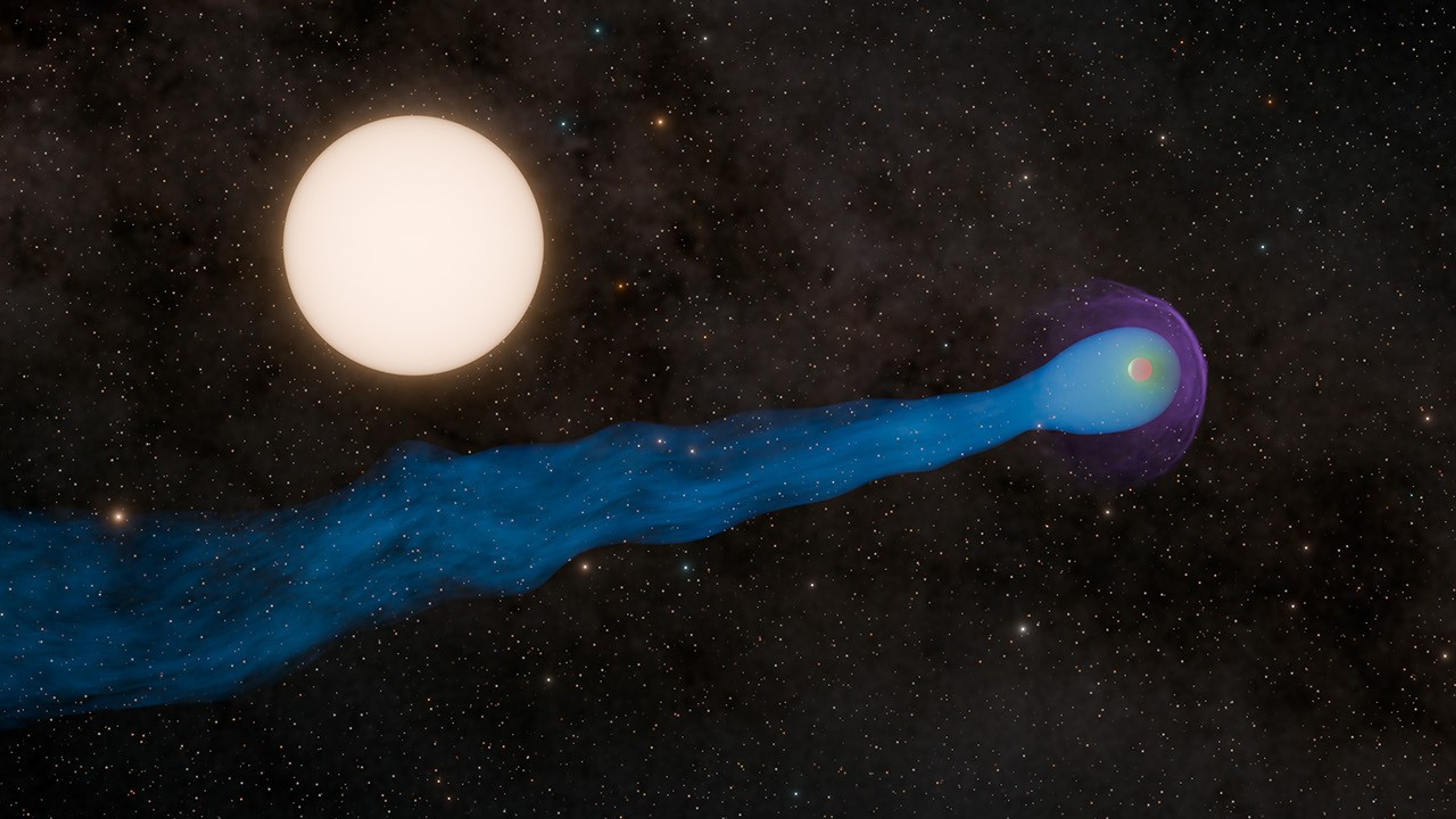
The exoplanet WASP-69 b, a hot Jupiter, is losing its atmosphere, creating a 'tail' of gas shaped by the stellar wind from its host star. This tail, similar to a comet's, is formed as light gases like hydrogen and helium escape due to photoevaporation. The tail's length, observed to be over 350,000 miles, can change with variations in the stellar wind. This phenomenon offers insights into the interactions between stellar and planetary atmospheres and could help understand stellar behavior.
Astronomers have discovered a massive gas tail trailing from the exoplanet HAT-P-32 b, located 950 light years away from Earth. The planet, classified as a "hot Jupiter," is losing its atmosphere due to its close proximity to its parent star. The gas tail, about 18 times the size of Jupiter, is one of the largest planetary structures observed outside our solar system. By studying this phenomenon, researchers hope to gain insights into planetary evolution and solve the mystery of the "hot-Neptunian desert" in the exoplanet catalog. Supercomputer simulations have revealed that HAT-P-32 b is being both trailed and led by its outflowing gas, and it is estimated to take 40 billion years for the planet to completely lose its atmosphere. However, the planet is unlikely to survive the lifespan of its host star, which is expected to engulf it in the future.