Recent research suggests that advanced civilizations could reside near the galactic core, utilizing black holes for time dilation to expand their lifespan and exploration capabilities, which may explain why we haven't detected them and offers new avenues for SETI efforts.
Scientists are exploring the possibility that extraterrestrial civilizations may be only slightly more advanced than humans, leading to a lack of detectable signs of their existence due to boredom or technological plateau, which could explain the silence in the search for alien life.
A new analysis suggests that intelligent life is likely extremely rare in our galaxy, potentially explaining the Fermi Paradox. The study posits that life either emerges almost always or almost never under Earth-like conditions, and the lack of evidence for advanced civilizations supports the idea that we might be alone. However, the possibility of rare but rapidly spreading intelligent life, termed "grabby aliens," remains.
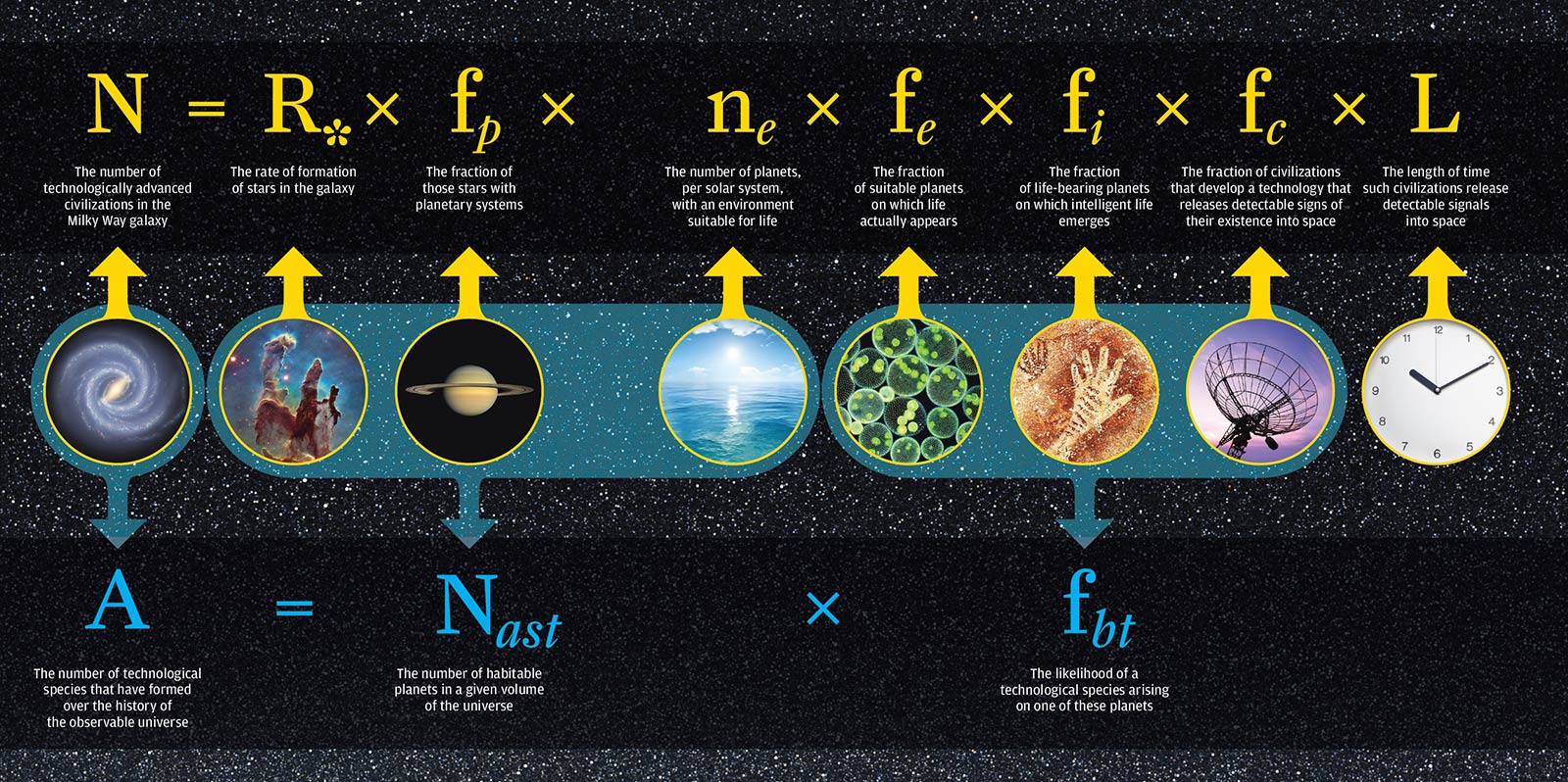
A new study using the Drake Equation suggests that intelligent, communicative alien civilizations (ACCs) may be extremely rare due to the necessity of specific conditions like plate tectonics and sufficient oxygen. The researchers estimate the number of such civilizations in our galaxy to be between less than 0.0004 and less than 20,000, emphasizing the lower end due to potential extinction events and societal collapses. Despite this, the possibility of primitive life remains high, and future discoveries of Earth-like planets could alter these estimates.
The Dark Forest theory, popularized by Cixin Liu's "3 Body Problem" and now a Netflix adaptation, suggests that alien civilizations hide to avoid detection by potentially hostile neighbors. While it offers a chilling solution to the Fermi Paradox, experts argue it's unlikely all extraterrestrial intelligences would uniformly choose to hide. The vastness of space and the diversity of potential alien behaviors make the theory less compelling, though it remains a thought-provoking possibility.
The discovery of life on Mars could have significant implications for humanity, according to Oxford University philosophy professor Nick Bostrom. He believes that finding evidence of advanced civilizations would be good news, but discovering the wrong stages of life in our own solar system would be the worst possible news, indicating that the bulk of the "Great Filter" is still in humanity's future and raising the probability of human extinction before technological maturity.
Scientists have proposed the Silurian hypothesis, a thought experiment exploring the possibility of a pre-human civilization on Earth. While no fossilized evidence has been found, geological processes such as tectonic plate subduction and glaciation could have erased any remnants of ancient urbanization. Instead, researchers suggest looking for global signatures, such as carbon isotopes and microplastics, that could indicate the presence of an intelligent civilization. Additionally, artifacts on the moon left by humans may endure for millions of years, providing potential evidence for future xenoarcheologists. The search for signs of pre-human civilizations raises questions about the Fermi Paradox and the possibility of overlooking deep-space alien signatures.
These five science fiction works explore the idea that intelligent tool-using beings are their own worst enemies, causing their own extinction with misapplied ingenuity. From a mad alien AI's plan to assist humanity to avoid inevitable doom to a lone explorer's invention that causes an apocalypse, these works offer unique perspectives on the Fermi Paradox and the possibility of self-extinction.
A new study suggests that advanced life might have peaked billions of years ago due to the effect of black holes on star formation. The research explores the connection between black holes, feedback, and star formation, and how it affects the emergence of extraterrestrial intelligence. The study concludes that advanced life peaked billions of years ago due to the direct connection between mergers, black holes, star formation, and the planets that form around those stars. The research could help advance the search for extraterrestrial intelligence by showing us where to look and where not to.
X-rays produced by core-collapse supernovas can damage planets up to 160 light-years away, according to new evidence collected by NASA’s Chandra Observatory. Before Type II supernovas explode, the progenitor star throws off a lot of gas and dust. When the blast wave hits this material X-rays bathe everything around. These X-rays probably wouldn’t reach the lower stratosphere, let alone the surface, of a planet with an oxygen-rich atmosphere, but would produce chemicals that greatly damage the ozone layer. This in turn would let in ultraviolet light from the planet’s star. Earth-like life would be unlikely to survive, other than in the deep ocean or underground.