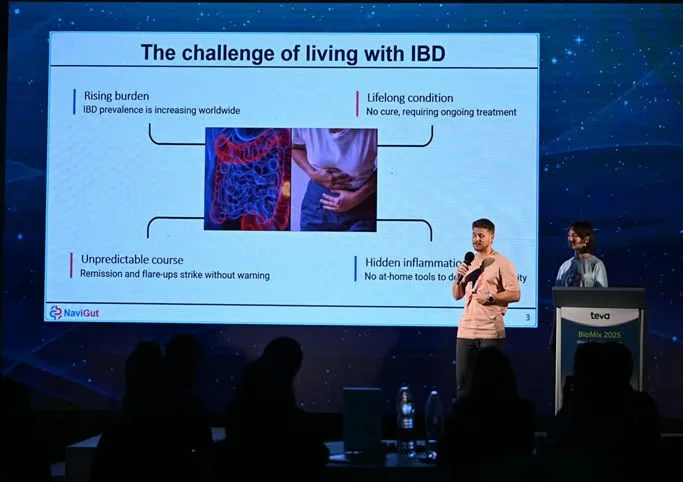
Israeli researchers have developed innovative technologies, including genetically engineered bacteria and a wearable stress monitor, to detect inflammatory bowel disease flare-ups before symptoms appear, potentially enabling earlier intervention and improved management of the condition.
Innovative Israeli technologies using engineered bacteria and wearable stress monitors aim to detect Crohn's disease flare-ups before symptoms appear, potentially transforming disease management by enabling earlier intervention and reducing complications.
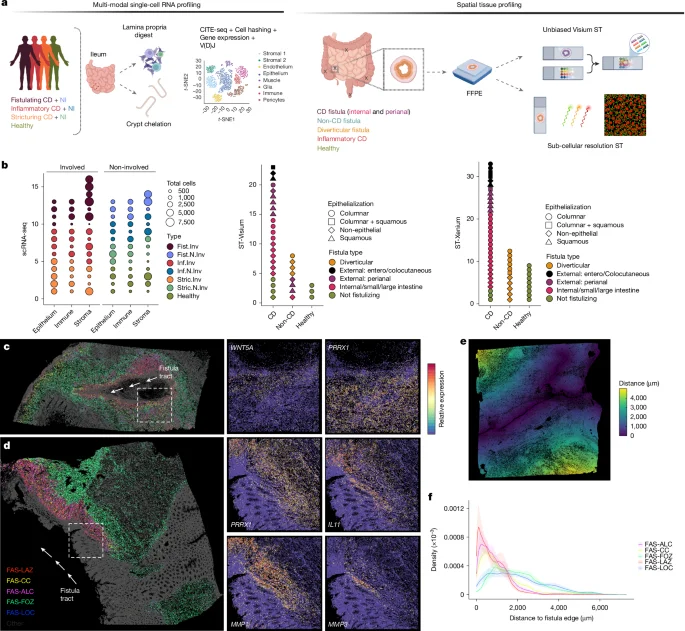
This study uses spatial transcriptomics and single-cell analysis to uncover how specialized fibroblast niches, particularly FAS cells, contribute to the formation, progression, and persistence of Crohn's fistulae, highlighting their roles in tissue remodeling, immune regulation, and epithelial regeneration, with implications for targeted therapies.
Researchers at UC San Diego used AI and molecular biology to uncover how a gene called NOD2 influences macrophage behavior in Crohn's disease, revealing that a mutation disrupting the NOD2-girdin interaction leads to chronic inflammation, and paving the way for new treatments.
UC San Diego researchers used AI and molecular biology to uncover how the NOD2 gene influences macrophage behavior in Crohn's disease, revealing that mutations disrupt the balance between inflammatory and healing macrophages, which contributes to the disease's development.
UC San Diego researchers used AI and molecular biology to uncover how a mutation in the NOD2 gene disrupts the balance of inflammatory and healing macrophages in Crohn's disease, resolving a 25-year mystery and highlighting potential treatment avenues.
Researchers at MIT and McMaster University used AI, specifically DiffDock, to develop and understand a targeted antibiotic, enterololin, that treats gut bacteria linked to Crohn's disease with minimal impact on the microbiome, potentially revolutionizing treatment and reducing antimicrobial resistance.
A study shows that pro-inflammatory diets can worsen IBD symptoms, with those consuming such diets being up to three times more likely to experience moderate to severe disease, emphasizing the importance of an anti-inflammatory diet for managing IBD.
Inflammatory bowel disease (IBD), affecting up to 3.1 million adults in the U.S., is a chronic condition where the immune system attacks the intestines, causing inflammation and damage. Diagnosis involves medical history, physical exams, lab tests, and imaging like endoscopy or MRI. IBD differs from irritable bowel syndrome (IBS), which has similar symptoms but no underlying disease. Managing IBD requires a team approach to find effective medication and lifestyle strategies to prevent flare-ups and address related health issues.
Researchers at the Francis Crick Institute in London have discovered a key driver of inflammatory bowel disease (IBD) and other immune disorders, potentially leading to new treatments using existing drugs. This breakthrough could significantly impact the lives of millions suffering from conditions like Crohn's disease and ulcerative colitis.
Scientists at the Francis Crick Institute and University College London have discovered a "gene desert" in DNA linked to Inflammatory Bowel Disease (IBD), including Crohn's Disease. This genetic weak spot in white blood cells, which release inflammation-causing cytokines, appears in 95% of IBD patients. The discovery could lead to new treatments, including the use of existing MEK inhibitor drugs to reduce inflammation, potentially improving the lives of millions affected by IBD.
Scientists from University College London and the Francis Crick Institute have identified a genetic pathway that significantly contributes to inflammatory bowel disease (IBD), including Crohn's disease. By exploring a "gene desert," they discovered an enhancer that activates inflammation-related genes in macrophages. This breakthrough could lead to more effective treatments using existing drugs that target this pathway, offering new hope for IBD patients. The findings were published in Nature.
UK scientists have identified a genetic weak spot present in 95% of people with inflammatory bowel disease (IBD), which causes immune cells to drive excessive inflammation in the bowels. Existing drugs have shown promise in reversing the disease in lab experiments, and researchers aim to start human trials within five years. This discovery could lead to new treatments for conditions like Crohn's disease and ulcerative colitis, which affect around half a million people in the UK.
The article explores the experience of a man living with Crohn's disease, which led to complications that required him to rely on total parenteral nutrition (TPN) for sustenance. The psychological and social impacts of not being able to eat are discussed, shedding light on the challenges faced by patients on artificial nutrition. The article also delves into the history of TPN and the physiological and neurological aspects of hunger and satiety, highlighting the profound impact of food beyond mere sustenance.
A large-scale clinical trial has shown that early treatment with the drug infliximab for Crohn’s disease can drastically improve outcomes, reducing the need for urgent abdominal surgery by tenfold. The research involved 386 patients and found that immediate use of infliximab after diagnosis led to 80% of patients having symptoms and inflammatory markers controlled throughout the year, compared to only 15% with the usual UK treatment plan. Patients receiving infliximab also had higher quality of life scores, less use of steroid medication, and lower hospitalizations, with a significantly lower risk of urgent surgery. The drug, previously overlooked due to cost and side effects, has become more affordable and well tolerated, offering a new treatment path for Crohn’s patients.