Madeleine Finlay interviews Sophie Scott, a cognitive neuroscience professor, about the science of laughter, exploring its definition, purposes for humans and animals, and the potential mental health benefits of prioritizing laughter.
Researchers at Dartmouth College have developed "OpenNeuro Average" (onavg), a new cortical surface template based on 1,031 brains that improves the accuracy and efficiency of neuroimaging data analysis. This template provides a more uniform and less biased map, requiring less data for accurate analysis, which is beneficial for studies with limited datasets. The onavg template is expected to have broad applications in cognitive and clinical neuroscience, including research on vision, language, and neurodegenerative diseases.
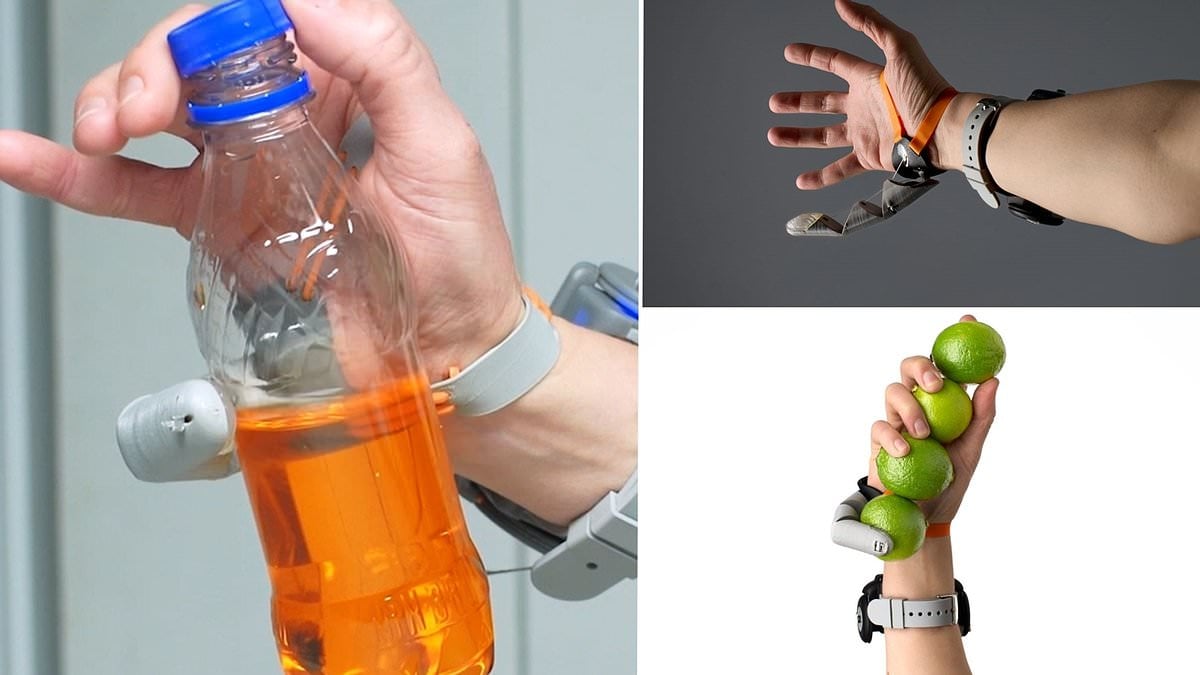
Scientists at the University of Cambridge have developed a controllable prosthetic 'Third Thumb' that attaches to the right hand, allowing users to perform tasks like picking up objects and peeling bananas with one hand. The device, controlled by pressure sensors under the big toes, was successfully used by 99.3% of study participants, demonstrating its potential to enhance human motor capabilities and assist amputees.
Recent findings in cognitive neuroscience presented at the annual meeting of the Cognitive Neuroscience Society (CNS) in Toronto shed light on the impact of dreams on our waking lives. Researchers are exploring innovative ways to study dreams and their influence on cognition, including the potential to engineer dreams to aid those with sleep disorders. Studies suggest that perceptions of dreams and sleep quality often differ from traditional objective measures, with implications for understanding the architecture of sleep and addressing insomnia. Additionally, researchers are leveraging lucid dreaming as a tool to gather real-time data on dreams and better understand their function, opening new avenues for manipulating dreams and reducing nightmares.
A comprehensive cross-cultural study led by researchers from MIT and the Max Planck Institute for Empirical Aesthetics reveals a universal bias towards rhythms formed by simple integer ratios in music, regardless of cultural background. The study, spanning 15 countries and encompassing diverse participant groups, found a common inclination towards rhythms composed of simple integer ratios, while also highlighting significant variations in rhythmic preferences across different cultures. The findings challenge the notion that only trained musicians develop sophisticated rhythmic perceptions and underscore the profound impact of cultural and environmental factors on cognitive processes related to music.
A new study published in PNAS used advanced AI to analyze brain activity patterns and found significant and consistent differences between male and female brains, suggesting implications for personalized medical approaches. The study utilized spatiotemporal deep neural networks to distinguish sex differences within the Human Connectome Project cohort and achieved high accuracy rates. These findings were validated across multiple datasets and independent cohorts, revealing specific brain regions consistently distinguishing between sexes and linking these differences to cognitive functions. The research challenges prior understandings and emphasizes the importance of sex in the study of brain health and disorders.
A recent study in cognitive neuroscience reveals that our ability to learn and make connections between information is significantly influenced by our feelings towards the person presenting the information. Participants were found to be more adept at remembering and connecting information when it was presented by personas they liked, potentially leading to the reinforcement of polarized beliefs within social groups. The study sheds light on how our social biases might extend into our cognitive processes, particularly memory integration, and suggests that favored groups can provide information that aligns with our pre-existing beliefs, potentially reinforcing polarized viewpoints.
Researchers from Cleveland Clinic and Oregon Health and Science University have developed a new method, using the CaMPARI system, for mapping real-time brain activity by highlighting active neurons in red and inactive ones in green. This breakthrough has the potential to improve our understanding of behavior changes in patients with neurological diseases like Alzheimer's and could lead to better treatment options. The researchers hope to use this technique to study how Alzheimer's-related genes affect neuron signaling in learning and memory, with the goal of developing interventions to improve cognitive performance in affected individuals.
A new study by researchers at the Paris Brain Institute explores how individual preferences influence the speed and creativity of idea generation. Using a behavioral study and computational modeling, the researchers found that the subjective evaluation of ideas plays a crucial role in creativity. The study also revealed that individuals inclined towards original ideas tend to suggest more inventive concepts. The findings challenge the notion that creative thinking is a mysterious process and suggest the possibility of precisely describing the mechanisms of creativity at a neurocomputational level. The researchers aim to further investigate different creativity profiles and explore how environments can foster or inhibit creativity.
Cognitive neuroscientist Caroline Leaf shares four daily tips for a younger and more resilient brain. First, take note of your morning emotions and manage any negative thoughts or complaints. Second, prepare your brain for waves of emotion by practicing calming techniques like deep breathing or grounding exercises. Third, designate a safe space in your home for emotional reflection and train yourself to associate it with mind work. Finally, instead of suppressing worry, analyze it, identify the underlying causes, and develop actionable plans to address them, empowering yourself and shifting your physiology. By managing your thoughts, you can change the physical state of your brain and body.
Cognitive neuroscientists are studying how people forget information and the mechanisms involved in removing information from working memory. Researchers have identified distinct mechanisms by which people remove information from their working memory and have also found that forgetting requires much effort. The hope is that the body of work can lead not only toward better understanding attention and focus but also toward clinical targets for helping patients suffering from disorders ranging from depression and schizophrenia to PTSD and ADHD.