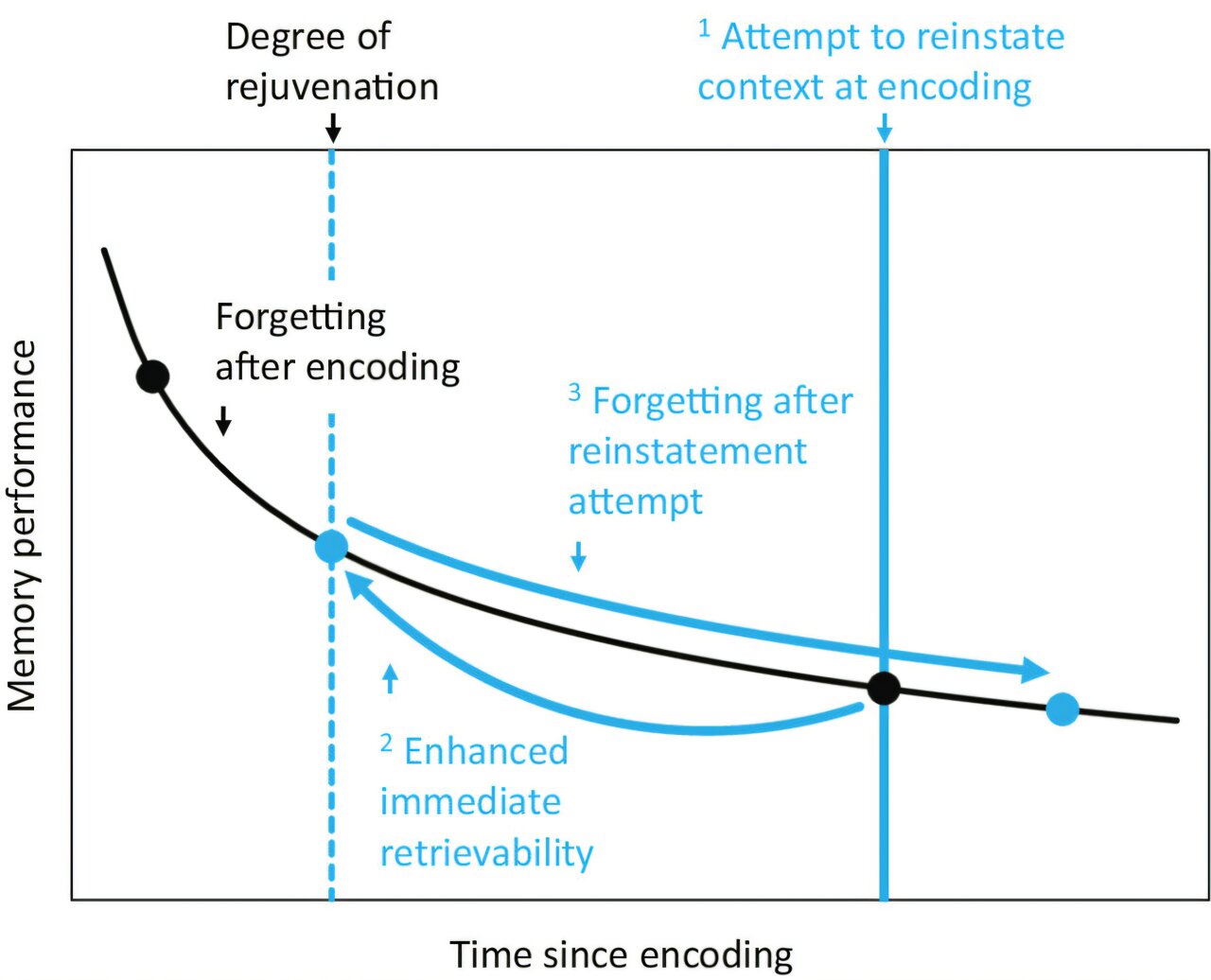
A new study suggests that mentally revisiting the context of past memories can temporarily restore their retrievability and reverse the typical forgetting curve, especially when done within a few days of encoding, offering hope for memory recovery but requiring further research for real-life applications.
Scientists have identified a neural mechanism, involving a traveling wave in the brain, that actively clears irrelevant memories, which could have implications for treating mental health disorders and improving cognitive control.
Neurologist Charan Ranganath discusses the science of memory, explaining when forgetting is normal and when it may indicate a problem, highlighting the importance of understanding memory changes as we age.
Neuroscientists propose that "forgetting" is a form of learning that benefits flexible behavior in dynamic environments. Their experimental tests demonstrate that memories are not truly lost but stored in engrams that can be reactivated. The study suggests that forgetting can be an intentional characteristic of the brain, allowing it to adaptively engage with ever-changing surroundings. The findings have implications for conditions like Alzheimer's disease, as they show that memories can be retrieved through natural and artificial cues.
Recent studies suggest that forgetting might not just be a mere oversight of our brains, but a dynamic response to our changing environments. Neuroscientists propose that as environments shift, forgetting irrelevant memories can foster adaptability and better decision-making. Experiments revealed that even after certain memories in mice seemed forgotten, they could be retrieved with the right cues. This breakthrough understanding about the nature of memory could have major implications, especially for conditions like Alzheimer’s disease.
Neuroscientists have conducted experimental tests that support the theory that forgetting is a form of learning. They found that forgetting, specifically retroactive interference, can be beneficial in a changing environment as it allows for more flexible behavior and better decision-making. By genetically labeling memory engram cells in mice, the researchers discovered that forgotten memories can be retrieved and rejuvenated through stimulation and exposure to relevant cues. This research has implications for understanding memory processes and potential applications in diseases like Alzheimer's.
Cognitive neuroscientists are studying how people forget information and the mechanisms involved in removing information from working memory. Researchers have identified distinct mechanisms by which people remove information from their working memory and have also found that forgetting requires much effort. The hope is that the body of work can lead not only toward better understanding attention and focus but also toward clinical targets for helping patients suffering from disorders ranging from depression and schizophrenia to PTSD and ADHD.