Research shows that as people age, their perception of color can diminish due to changes in the eyes and brain, with older adults often perceiving colors as duller, especially in terms of saturation, which is primarily linked to brain processing rather than eye health. Routine eye exams and surrounding oneself with vibrant colors may help mitigate some effects, but lifestyle changes currently have limited impact on this natural aging process.

Research reveals that negating adjectives with "not" slows down brain processing and weakens rather than inverts their meaning, providing insights into how the brain handles complex linguistic operations.
A rare brain condition called aphantasia prevents individuals from visualizing memories, while hyperphantasia allows for vivid recall. Aphantasia can be associated with memory impairment, autism, and face blindness, and is more common in science, mathematics, and IT fields. Hyperphantasia, on the other hand, may lead to heightened emotional responses and synesthesia. Both conditions can have pros and cons, and individuals with these unique brains hope to raise awareness to help others, especially children, who may feel alienated due to their differences in processing sensory information.
People with post-traumatic stress disorder (PTSD) process sad, non-traumatic memories differently from traumatic memories. A study published in Nature Neuroscience found that sad memories are processed in the hippocampus, while traumatic memories associated with PTSD activate the posterior cingulate cortex (PCC). The PCC is more focused on internally directed thought, while the hippocampus is responsible for organizing and contextualizing memories. The findings could potentially lead to the development of new therapies that aim to transform traumatic memories into ones that resemble non-traumatic memories.
A new study published in Psychological Medicine suggests that the neurological roots of hallucinations, particularly hearing voices, may lie in how the brain processes contradictory signals from the environment. Researchers conducted experiments where volunteers experienced a ghostly presence by pressing a button that caused a rod to touch their backs. They found that volunteers were more likely to report hearing a voice when there was a delay between the button press and the rod's touch. The study also revealed that hearing a nonexistent voice was more likely if the volunteers had previously heard bursts of noise with someone else's voice. These findings support the idea that hallucinations may arise from difficulty in recognizing one's own actions and being primed to expect a particular outcome. Further research may involve studying healthy individuals who regularly hear voices, such as mediums, to gain a better understanding of how these beliefs arise and how they can be controlled.
Researchers in Switzerland conducted a study using a setup that induced the feeling of a ghostly presence to investigate the phenomenon of hearing voices. They found that volunteers were more likely to report hearing a voice when there was a delay between a button press and a rod's touch. The study suggests that hallucinations may arise from the brain's difficulty in recognizing one's own actions and being primed to expect a particular outcome. Further research into how the brain builds the impression of a voice when none is present may provide insights into understanding and managing distressing hallucinations.
New research conducted at USC Dornsife reveals that lonely individuals have distinct and varied brain processing patterns compared to those who aren't lonely, contributing to their feelings of isolation. The study found that lonelier individuals exhibited more dissimilar and idiosyncratic brain processing patterns, suggesting a lack of shared understanding with others. This uniqueness may further impact their feelings of isolation and difficulty in establishing social connections. The research highlights that loneliness is not solely determined by the quantity of social connections but also by the quality and shared understanding. The findings shed light on the complex relationship between loneliness and brain processing, emphasizing the need for further investigation into the causes and effects of loneliness.
A study conducted on college students using functional magnetic resonance imaging (fMRI) has found that lonely individuals exhibit more unique and idiosyncratic brain processing patterns compared to non-lonely individuals. This suggests that loneliness alters the way people process the world, potentially impacting their social connections. The findings highlight the importance of understanding the nuances of loneliness and its impact on mental health.
Scientists have made progress in understanding the mind-bending secrets of optical illusions that deceive the brain into perceiving incorrect colors. These "simultaneous contrast illusions" manipulate our perception by altering the brightness or color of the background, tricking us into seeing different colors in the foreground. A new computer model called the "spatiochromatic bandwidth limited model" was used to mimic human vision and analyze over 50 illusions. The model consistently identified the wrong colors, suggesting that these illusions rely on basic-level neural processing rather than higher-order visual processing or past experiences. This supports the bottom-up hypothesis and confirms that illusions can be explained by a single layer of neurons.
A study published in Psychological Science reveals that lonely individuals process the world in unique and idiosyncratic ways compared to non-lonely individuals. Using functional magnetic resonance imaging (fMRI), researchers found that lonelier individuals exhibited more dissimilar brain processing patterns. This lack of neural similarity makes it difficult for lonely individuals to establish social connections and contributes to their feelings of isolation. The study suggests that idiosyncratic processing may be a risk factor for loneliness, regardless of the number of friends or social connections one has. Further research will explore how lonely individuals process specific situations and contexts differently.
A recent study published in Psychological Science found that lonely individuals process the world in idiosyncratic ways, with each lonely person exhibiting unique brain processing patterns. The study used functional magnetic resonance imaging (fMRI) to examine the brains of college students while they watched videos. Lonelier individuals showed more dissimilar brain processing patterns compared to non-lonely individuals. This finding suggests that neural similarity, which is important for establishing social connections, is lacking in lonely individuals. The study also found that high levels of loneliness, regardless of the number of friends or social connections, were associated with idiosyncratic brain responses. The research highlights the complexity of loneliness and its impact on social connections and mental health.
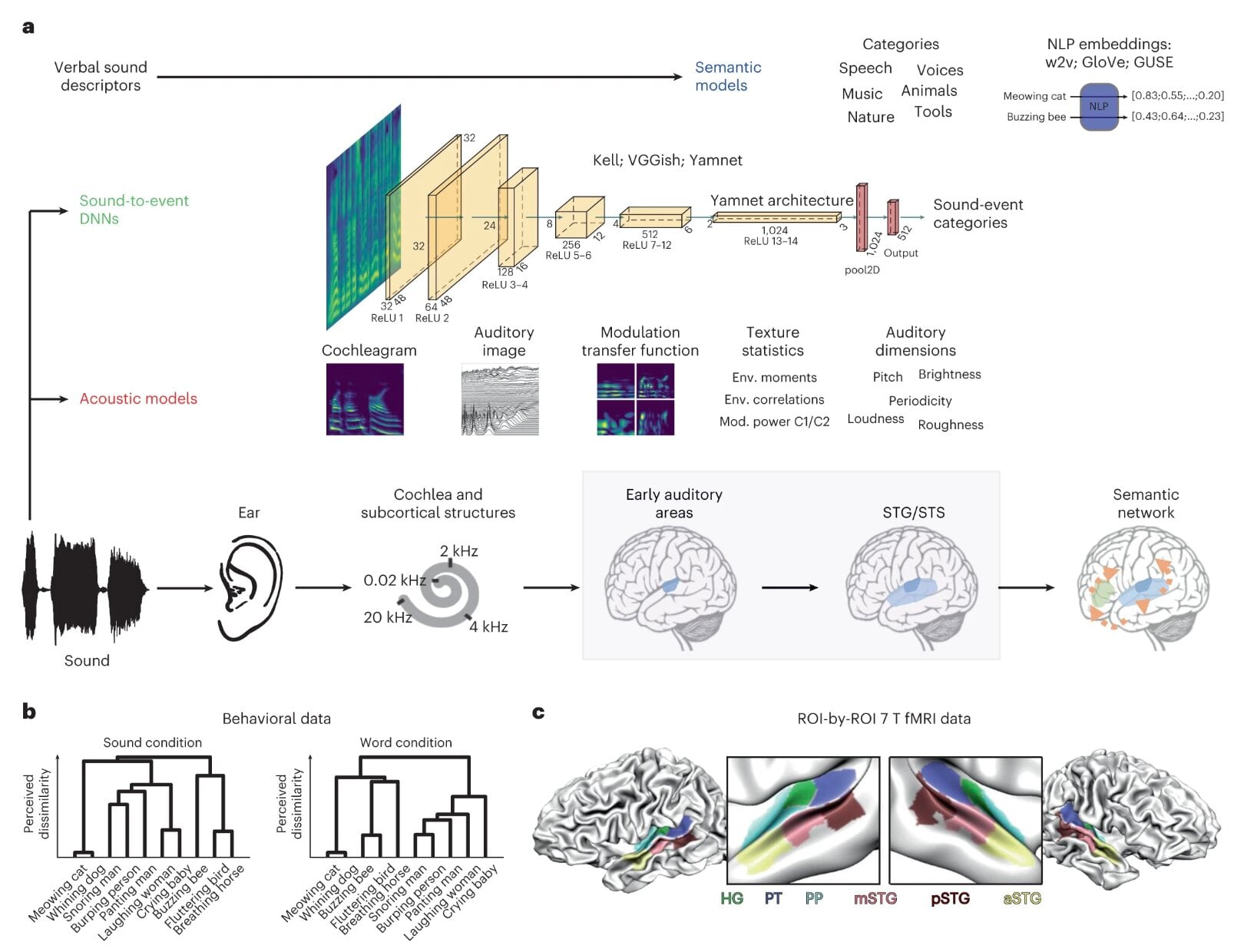
Researchers at CNRS and Université Aix-Marseille and Maastricht University have used computational models to predict how the human brain transforms sounds into semantic representations of what is happening in the surrounding environment. The team assessed three classes of computational models, namely acoustic, semantic and sound-to-event DNNs, and found that DNN-based models greatly surpassed both computational approaches based on acoustics and techniques that characterize cerebral responses to sounds by placing them in different categories. The researchers also hypothesized that the human brain makes sense of natural sounds similarly to how it processes words.