The article explores how different cultures perceive and treat hearing voices, with some viewing it as a spiritual or positive experience, contrasting with Western psychiatry's view of it as a symptom of psychosis, highlighting cultural influences on mental health perceptions and outcomes.
A new study published in Psychological Medicine suggests that the neurological roots of hallucinations, particularly hearing voices, may lie in how the brain processes contradictory signals from the environment. Researchers conducted experiments where volunteers experienced a ghostly presence by pressing a button that caused a rod to touch their backs. They found that volunteers were more likely to report hearing a voice when there was a delay between the button press and the rod's touch. The study also revealed that hearing a nonexistent voice was more likely if the volunteers had previously heard bursts of noise with someone else's voice. These findings support the idea that hallucinations may arise from difficulty in recognizing one's own actions and being primed to expect a particular outcome. Further research may involve studying healthy individuals who regularly hear voices, such as mediums, to gain a better understanding of how these beliefs arise and how they can be controlled.
Researchers in Switzerland conducted a study using a setup that induced the feeling of a ghostly presence to investigate the phenomenon of hearing voices. They found that volunteers were more likely to report hearing a voice when there was a delay between a button press and a rod's touch. The study suggests that hallucinations may arise from the brain's difficulty in recognizing one's own actions and being primed to expect a particular outcome. Further research into how the brain builds the impression of a voice when none is present may provide insights into understanding and managing distressing hallucinations.
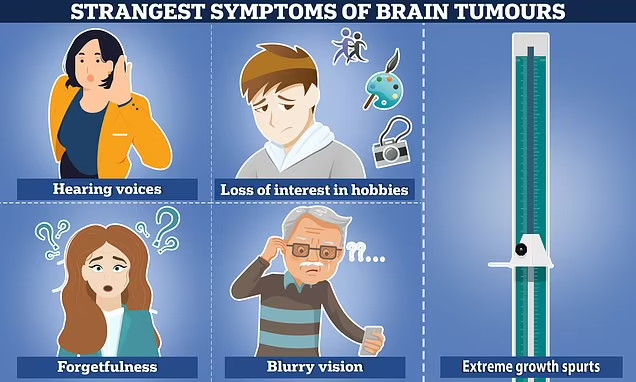
Brain tumours can have lesser-known symptoms such as hearing voices, excessive growth spurts, loss of interest in hobbies, forgetfulness, and blurry vision. Tumours affecting the pituitary gland can cause extreme growth spurts in adults and children. Forgetfulness and blurry vision can also be signs of a brain tumour. Hearing voices and random sounds can indicate a brain tumour located in the temporal lobe. Early detection and treatment are crucial as brain tumours are often misdiagnosed, and only 20% of patients survive five years after diagnosis.